


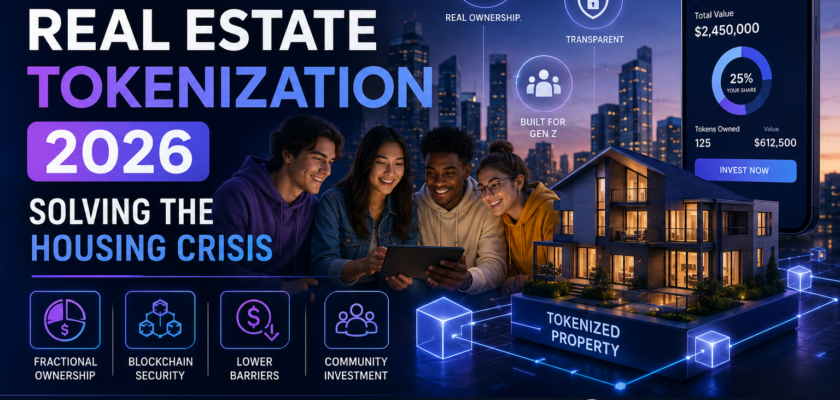
Tokenized Property Ownership: How Blockchain is Solving the Gen Z Housing Crisis in 2026.
The traditional path to buying a home has completely fractured. For previous generations, the blueprint for entering the property market was clear and predictable: secure a stable corporate position, accumulate a down payment over a few years of structured saving, obtain a standard bank mortgage, and buy a starter home. Success was a simple matter of matching personal savings to predictable market baselines.
But as we advance through May 2026, that legacy lifecycle is entirely out of reach for young professionals. Driven by skyrocketing interest rates, hyper-inflated home valuations, and strict bank lending criteria, the conventional real estate market has created a deep barrier to entry.
For Generation Z, dropping half a million dollars on an investment property or coming up with a massive upfront cash down payment is a mathematical impossibility. The housing market has fundamentally locked them out.
However, younger, tech-savvy buyers are refusing to accept permanent renter status. Instead of trying to force their finances into an outdated, broken mortgage system, they are leveraging decentralized networks to bypass institutional gatekeepers entirely.
We have entered the era of Gen Z Real Estate Tokenization 2026. By wrapping physical real-world assets (RWAs) in compliant digital structures, blockchain technology is turning the old property model on its head—transforming real estate from an illiquid, exclusive club into an open, fractional digital ecosystem.
1. The RWA Wrapper: Breaking Properties Into Micro-Shares
The core mechanism behind this modern real estate shift is tangible asset tokenization. Rather than requiring a single buyer to shoulder the entire cost of a residential building or commercial space, properties are legally structured inside a Special Purpose Vehicle (SPV) and split into thousands of identical, fungible digital tokens on public blockchains like Ethereum or Solana.
                  [ The Traditional Real Estate Barrier ]
         (Massive Down Payments ──► High Interest ──► Asset Lockout)
                                     │
                                     ▼
               [ The On-Chain Real Estate Solution ]
         (Fractional Shares ──► Automated Logic ──► Liquid Portfolios)
                                     │
         ┌───────────────────────────┴────────────────___________┐
         ▼                                                       ▼
┌─────────────────────────────────┐                     ┌─────────────────────────────────┐
│     Fractionalized Entry        │                     │   Automated Yield Processing    │
│ • Invest as little as $1,000    │                     │ • Rents collected by managers   │
│ • Purchase micro-equity rights  │                     │ • Distributed via code logic    │
│ • Build diversified portfolios  │                     │ • Instant on-chain payouts     │
└─────────────────────────────────┘                     └─────────────────────────────────┘
- Micro-Equity Accessibility: A premium multi-family apartment complex or commercial space worth $10 million is fractionalized into individual digital units. Instead of needing a massive loan, an individual can enter the market with small budgets—purchasing tokens for as little as $1,000 to gain authentic equity rights.
- The “Step-Up” Accumulation Path: Gen Z is utilizing fractional property ownership as a high-yield savings engine. By accumulating real estate tokens over time, younger investors can outpace inflation, build actual growth capital, and benefit from real property appreciation.
- True Secondary Liquidity: Real estate has historically been a highly illiquid asset class, taking months to buy or sell. On-chain tokens dissolve this friction by enabling secondary market trading. Investors can trade or transfer their property shares through verified digital marketplaces in seconds, giving them total control over when they enter or exit an investment.
2. Programmable Revenue: How On-Chain Rent Works Natively
The major breakthrough making Gen Z Real Estate Tokenization 2026 trends highly practical is the total automation of passive income pipelines. On-chain real estate isn’t a vague speculative bet; it delivers real, verifiable cash flows backed by tangible physical rent.
When an individual holds a property token, their wallet address is securely logged on an immutable blockchain ledger. Professional property management partners handle the physical asset—collecting rent, maintaining the building, and managing tenants.
Once the physical rent is paid, smart contracts natively process the numbers and distribute the payouts proportionally to all token holders’ wallets.
There are no manual checks, no bank delays, and no heavy processing fees. The entire distribution process runs entirely via code logic, turning real estate into a frictionless, accessible digital portfolio asset.
3. Strategic Matrix: Traditional Homebuying vs. Tokenized Co-Ownership
| Market Matrix | Traditional Real Estate Purchasing | Tokenized Real Estate Platforms (2026) |
| Minimum Capital Input | High Premium ($50k to $100k+ down payments) | Ultra-Low (Fractional units from $1,000) |
| Transaction Velocity | Exceptionally slow; 30 to 90 days of paper paths | Near-Instant; settled on-chain within seconds |
| Management Overhead | High; manual tenant sourcing & repair tracking | Zero; fully managed by platform partners |
| Geographic Flexibility | Highly localized due to manual constraints | Global; frictionless cross-border investing |
| Risk Characterization | High asset concentration & heavy debt exposure | Minimized Risk; easy, un-bottlenecked diversification |
4. Overcoming the Legal and Trust Bottlenecks of RWA Tech
While the technical advantages of fractional property ownership are clear, industry leaders and financial analysts recognize that moving real estate onto the blockchain introduces tough regulatory hurdles.
The primary obstacle facing the sector is Regulatory Compliance Verification. Because real estate tokens represent fractional ownership and financial rights, international regulators—including the U.S. SEC—treat them strictly as digital securities.
If a platform attempts to launch an unvetted token without proper guardrails, it faces immediate shut-downs and heavy legal penalties.
  [ Strict Upfront Due Diligence ] ───► [ Automated Smart Contract Controls ]
   • Certified third-party appraisals    • Mandatory built-in KYC/AML identity screening
   • Immutable property title audits     • Dynamic cross-border rule compliance
   • Verifiable legal escrow pools       • Multi-signature governance frameworks
To completely solve this systemic operational liability, modern tokenization ecosystems are adopting an “institutional-first” architecture. Top platforms build automated compliance rules directly into the smart contracts.
Before an investor can buy a single micro-share, they must complete automated identity checks (KYC/AML) and verify their jurisdiction. The underlying token code natively blocks any illegal transfers.
By backing every token action with a real, enforceable legal contract, the industry is building an unshakeable foundation of trust—ensuring digital property investment remains safe, compliant, and structurally secure.
Conclusion
The widespread rise of the Gen Z Real Estate Tokenization 2026 movement marks a permanent evolution in how humanity defines property ownership. It proves that the long-standing dream of building long-term generational wealth shouldn’t be restricted to institutional funds or buyers with massive savings accounts.
By clearing away the slow, high-friction paper trails of the traditional market and replacing them with transparent blockchain ledgers, fractional platforms are giving younger generations a real chance to compete. They are transforming real estate into an inclusive, liquid, and accessible digital asset class.
The old abacus maze of taking on decades of restrictive mortgage debt is no longer the only way forward. The future of property ownership is decentralized, tokenized, and resting right inside our digital wallets—proving that we can build a stronger, more accessible financial foundation for everyone, one fractional share at a time.


