


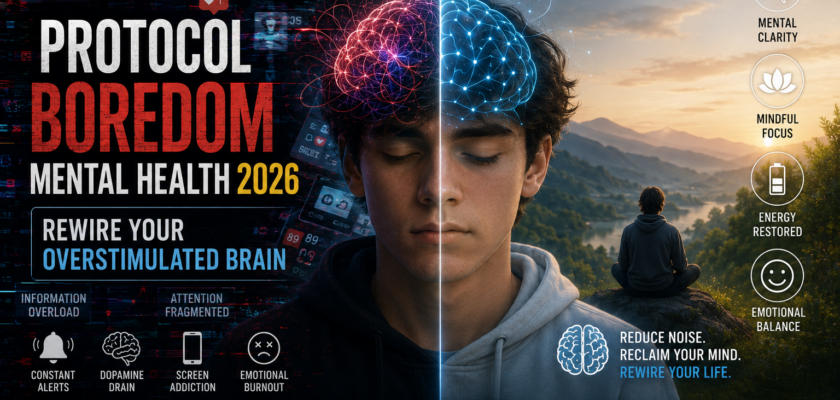
The Silent Protocol: How 30 Minutes of Disconnected Boredom Re-wires Your Mental Health.
We have systematically weaponized our attention lines against ourselves. In the modern workspace and throughout our daily routines, we treat any empty pocket of time as a void that must be instantly conquered. The moment we encounter a minor pause—waiting in a vehicle queue, standing in an elevator, or lingering at a food counter—our default psychological reflex is to reach for a smartphone. We pull up high-frequency short-form videos, scan financial tickers, or check messaging threads. We are a society suffering from an intense fear of switching off (FOSO).
But as we advance through May 2026, clinical data and neurobiological research suggest that this constant escape from quiet is creating an unprecedented mental health crisis. By continuously feeding our minds fast-paced, fragmented pieces of digital content, we are aggressively driving up our brain’s dopamine baseline.
This excessive stimulation leaves our attention spans fractured, increases baseline anxiety, and makes everyday real-world activities feel incredibly flat and unmotivating.
To counter this digital noise, leading performance psychologists and neuroscientists are popularizing a surprising counter-cultural exercise: Protocol Boredom Mental Health 2026.
Known as “The Silent Protocol,” this simple framework requires you to spend 30 minutes a day in absolute, disconnected boredom—completely stripping away screens, headphones, reading material, and social interaction. Far from a simple waste of time, this deliberate embrace of stillness acts as a powerful operational reset for your nervous system. Here is the science behind how practicing conscious boredom can completely clear your mental windshield.
1. The Dopamine Thermostat: Resetting the Hedonic Scale
To understand why the Protocol Boredom Mental Health 2026 framework is so effective, we must analyze the cellular mechanics of our internal reward systems. Dopamine is not the “pleasure chemical” the media often makes it out to be; it is the molecule of anticipation, drive, and novelty seeking.
                    [ The Digital Overload Balance ]
     (Constant App Scrolling ──► Spiked Dopamine Baseline ──► Real World Feels Flat)
                                   │
                                   ▼
                [ The 30-Minute Silent Protocol Reset ]
     (Zero Screen Input ──► Deep Understimulation ──► Restored Focus & Motivation)
                                   │
         ┌─────────────────────────┴─────────────────────────┐
         ▼                                                   ▼
┌─────────────────────────────────┐                 ┌─────────────────────────────────┐
│  Default Mode Network (DMN)     │                 │     Systemic Emotional Shield   │
│ • Inner reflection comes alive  │                 │ • Practices tolerating quiet    │
│ • Processes background memories │                 │ • Calms your amygdala\'s alarms │
│ • Sparks creative breakthroughs │                 │ • Reduces daily chronic stress  │
└─────────────────────────────────┘                 └─────────────────────────────────┘
When you hit your brain with a continuous stream of notifications, your neural pathways build a high tolerance to the stimulation—similar to how your body handles caffeine. This process, called hedonic adaptation, means everyday tasks like writing a technical report, balancing a spreadsheet, or having a focused conversation begin to feel incredibly slow and painful because they cannot compete with the high-intensity chemical spikes delivered by your phone.
The Silent Protocol solves this imbalance by cutting off artificial stimulation at the source. When you sit in a room for 30 minutes with absolutely nothing to occupy your attention, you intentionally lower your brain’s baseline stimulation. This break gives your dopamine receptors a chance to recover and regain their natural sensitivity. As a result, your internal motivation returns, allowing you to dive into deep work blocks without constantly fighting the urge to check your devices.
2. Activating the Default Mode Network: The Brain’s Creative Engine
When you practice the Protocol Boredom Mental Health 2026 routine, your brain does not simply turn off or go dormant. Instead, it shifts its entire operational architecture.
As your attention network slows down from a lack of external tasks, the brain naturally lights up a massive, interconnected neural circuit known as the Default Mode Network (DMN).
What Happens Inside the DMN:
- Introspection & Memory Processing: The DMN is the primary engine behind deep imagination, autobiographical memory integration, and self-reflection.
- Spontaneous Synthesis: Unchained from external screens, the brain begins to generate its own ideas natively, building fresh connections between scattered memories and experiences. This internal processing explains why your most profound creative breakthroughs or solutions to complex professional problems often flash into your mind when you are doing something mundane, like staring out a window or taking a long walk without headphones.
- Reclaiming Strategic Vision: Continuous consumption turns you into a passive recipient of other people’s thoughts. Stepping into a quiet space clears out that mental debris, allowing your true inner voice to emerge so you can focus on what actually matters to your life and career.
3. Strategic Matrix: Constant Connectivity vs. Conscious Boredom
| Cognitive Axis | Constant Digital Consumption & Busyness | Protocol Boredom Mental Health (2026) |
| Dopamine Baseline | Hyper-stimulated; everyday tasks feel flat | Calibrated; restores natural motivation & drive |
| Neural Circuitry | Active task-attention networks; suppressed DMN | Highly active Default Mode Network (DMN) |
| Attention Stability | Fractured; high urge to constantly multitask | Sustained; trains deep, linear concentration |
| Stress Response | Elevated cortisol levels from notification loops | Nervous system regulation; lower anxiety |
| Risk Characterization | High vulnerability to chronic fatigue & burnout | Minimized Risk; enhanced mental resilience |
4. Building the Muscle of Emotional Regulation
The most difficult part of executing a Protocol Boredom Mental Health 2026 reset is surviving the first ten minutes. When you step away from external stimulation, your brain’s internal alarm system—the amygdala—frequently triggers a wave of restlessness, irritation, and cognitive anxiety.
This initial discomfort isn’t a sign that the protocol is failing; it is a clear indicator of how dependent your mind has become on constant digital inputs.
  [ Initial 10 Minutes: Restlessness ] ───► [ Amygdala Registers Understimulation ]
                                                     │
                                                     ▼
                                      [ The Emotional Turning Point ]
                                    "Tolerating the Internal Friction"
                                                     │
                                                     ▼
                                      [ Final 20 Minutes: Mental Clarity ]
                                    "Nervous System Drops into Deep Calm"
Learning to sit through that initial restlessness is an extraordinary exercise in emotional regulation. Instead of immediately soothing your discomfort by reaching for a screen, you force your prefrontal cortex to manage and de-escalate the anxiety natively.
As you practice this response over several weeks, you build a powerful sense of mental resilience. The daily micro-stressors of your professional life lose their ability to throw you off balance, allowing you to maintain an unshakeable sense of focus and calm under pressure.
Conclusion
In our modern economy, true luxury is no longer defined by how much information you can consume—it is measured by the clarity of your focus and the quietness of your mind. The global movement toward the Protocol Boredom Mental Health 2026 layout highlights a healthy, collective rejection of constant digital noise.
By stepping away from the endless scrolling of the abacus maze for just 30 minutes every day, you reclaim ownership of your attention span. You move past the exhausting cycle of reactive consumption to give your mind the breathing space it needs to reset, heal, and innovate. Turn off your devices, welcome the silence, and discover the deep mental clarity that emerges when you give yourself permission to simply exist.


