


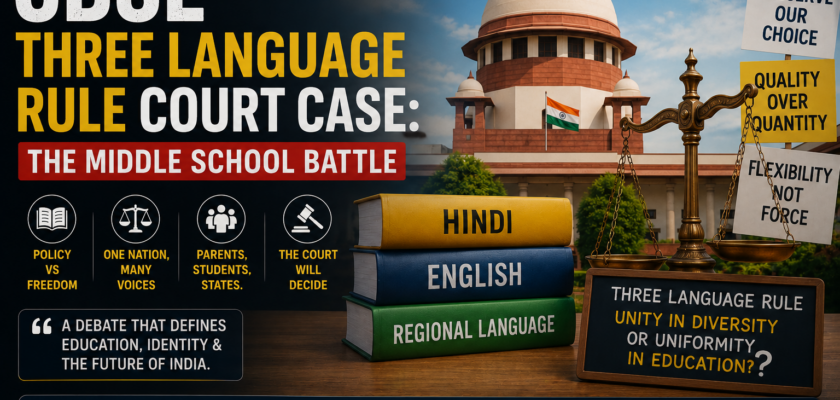
The Three-Language Conflict: Why Parents are Legally Challenging the New Middle School Curriculum.
A massive institutional legal battle has erupted at the absolute highest level of the Indian educational system. For several years, school boards across the country have gradually calibrated their academic syllabi to slowly mirror the structural multi-lingual visions of the National Education Policy (NEP) 2020. Parents, schools, and students generally operated under the assumption that any major, system-wide curricular burdens would be deployed through transparent, multi-year, phased implementation strategies. This allowed families to map out academic preparation lines years in advance.
However, that predictable timeline was suddenly shattered in May 2026.
Driven by an unexpected administrative acceleration, the Central Board of Secondary Education (CBSE) issued an abrupt directive that fundamentally rewrites secondary school curriculum requirements overnight.
The response from the community has been swift and severe. Moving past standard school-ground complaints, a unified collective of parents and educators has filed a high-profile Public Interest Litigation (PIL) in the apex court, establishing the CBSE Three Language Rule Court Case.
With the Supreme Court officially agreeing to list the urgent matter for a bench hearing next week under Chief Justice of India Surya Kant, the nation’s premier board finds itself defending its rollout against accusations of creating total academic chaos.
1. The Eleventh-Hour Circular: What Sparked the Legal Uproar?
The immediate fuse that triggered this national legal flashpoint was the sudden release of CBSE Circular No. Acad-33/2026 on May 15, 2026. The directive mandates that with effect from July 1, 2026, the study of three distinct languages ($R1, R2, R3$) will become completely compulsory for all Class 9 students, with a strict rule dictating that at least two of these languages must be native Indian languages.
                    [ The Legally Disputed CBSE Roadmap ]
                                      │
         ┌────────────────────────────┴────────────────────────────┐
         ▼                                                         ▼
┌─────────────────────────────────┐               ┌─────────────────────────────────┐
│     The April 9 Assurance       │               │      The May 15 Reversal        │
│ • R3 mandatory ONLY from Class 6│               │ • R3 made mandatory for Class 9 │
│ • Class 9 deferred until 2029   │               │ • Absolute July 1, 2026 Deadline│
│ • Allowed schools to pre-plan   │               │ • Forced mid-session adaptation │
└─────────────────────────────────┘               └─────────────────────────────────┘
         │                                                         │
         └────────────────────────────┬────────────────────────────┘
                                      ▼
                      [ Systemic Academic Friction ]
             (PIL Filed Under Article 32 of the Constitution)
The core argument driving the PIL—jointly filed by 19 petitioners across Delhi, Gurugram, Noida, and Chennai through Senior Advocate Mukul Rohatgi—is that the board executed an unpredicted, harmful policy reversal.
Just weeks earlier, on April 9, 2026, CBSE had explicitly notified schools that the compulsory third-language requirement would not apply to Class 9 levels until the 2029–30 academic session.
By completely tearing up that timeline after the 2026–27 academic year had already commenced, language allocations had been completed, and timetables had been locked, the board left families trapped in an absolute structural mess.
2. The Ad-Hoc Liability: Sixth-Grade Books for Ninth-Grade Minds
Beyond the sudden timeline shift, the legal challenge targets severe structural flaws in infrastructure availability. The petition claims that the policy violates Article 14 (prohibiting manifest arbitrariness) and Article 21A (the right to meaningful, quality education) by forcing a curriculum change when the board openly lacks the physical resources to support it.
A. The Textbook Deficit
Because dedicated secondary-stage textbooks for the newly mandated third languages do not exist, the May 15 circular instructs Class 9 students to use standard Class 6 textbooks for their chosen regional language as a temporary fix.
Parents argue that forcing 14-year-old minds preparing for critical board cycles to study from elementary materials supplemented by scattered local photocopies represents a total breakdown in academic standards.
B. The “Functional Proficiency” Trap
Compounding the book shortage is a severe deficit of trained language teachers. To address this gap, the board’s circular suggests that schools facing staffing constraints can assign teachers of entirely different subjects who happen to possess basic “functional proficiency” in a regional language to lead the classrooms.
Educators warn that expecting a science or math teacher to effectively guide students through a new language stream without formal training compromises the academic integrity of the classroom.
3. Strategic Matrix: Legacy Language Layout vs. Accelerated 2026 Mandate
| Curricular Axis | Legacy CBSE Language Model | Accelerated May 2026 Directives |
| Language Quota Requirement | Dual-language core ($R1 + R2$); optional foreign paths | Compulsory three-language system ($R1 + R2 + R3$) |
| Native Indian Language Cap | Minimum of one native Indian language stream | Absolute mandate: Minimum of two native Indian tracks |
| Foreign Language Status | Can serve as a primary second language choice | Throttled; restricted to $R3$ or an additional 4th subject |
| Class 10 Assessment Format | Centralized board-level written examinations | 100% School-based, internal assessments for $R3$ |
| Risk Characterization | High reliance on localized, single-language streams | Minimized Risk via exemption; internal grading baseline |
4. The Foreign Language Squeeze and Teacher Layoffs
The final structural front of the CBSE Three Language Rule Court Case highlights severe disruptions to teacher employment and school programming. Over the past decade, urban schools aggressively integrated popular international languages like French, German, Spanish, and Arabic into their core curricula to prepare students for global opportunities.
Under the accelerated May 2026 directive, a foreign language can no longer be used to satisfy the primary dual-language requirement.
  [ Compulsory Native Indian Quota ] ───► [ Displaces Popular Foreign Streams ]
                                                      │
                                                      ▼
                                       [ Severe Timetable Consolidation ]
                                     "Foreign Languages Pushed to 4th Slot"
                                                      │
                                                      ▼
                                       [ Structural Teacher Attrition ]
                                  "Livelihoods of Specialized Staff At Risk"
Because students must take two native Indian languages first, foreign options are being pushed out of the main timetable into a crowded fourth optional slot.
This shift has triggered immediate employment concerns for schools. The PIL explicitly invokes Article 19(1)(g), pointing out that thousands of highly trained, specialized foreign language teachers face sudden job losses as schools are forced to cut international language tracks to clear space for regional language staff.
While the board has tried to ease student anxiety by confirming that the third language will be graded through internal school assessments rather than strict centralized board exams, parents counter that adding another compulsory class to an already dense curriculum creates immense, unnecessary pressure during critical secondary school years.
Conclusion
The intense conflict surrounding the accelerated implementation of the three-language formula serves as a vital case study for educational administrators: even the most well-intentioned policy reforms will fail if their execution cuts corners on basic preparation. The push to cultivate a rich, multi-lingual generation of students is a noble objective, but trying to achieve it by rushing policy changes mid-session is a recipe for system-wide failure.
By trading a transparent, phased multi-year transition for an abrupt, ad-hoc rollout dependent on elementary textbooks and un-certified staff, the board has compromised its own policy goals.
As the Supreme Court takes up the case next week, the focus will extend far beyond simple language preferences. The court will evaluate the structural obligations of state governance, ensuring that educational policies respect the real-world limitations of teachers, schools, and families. True progress cannot be built on administrative chaos—it requires patience, proper resources, and an unyielding commitment to classroom quality.


