


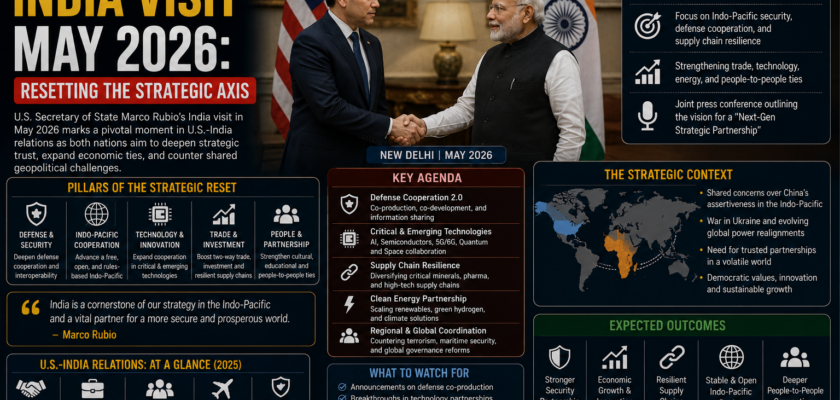
US Secretary of State Arrives in India: Inside the Strategic Agenda Ahead of the Vital Quad Talks.
The geopolitical architecture connecting Washington and New Delhi has entered a phase of intensive diplomatic recalibration. For the past year, the bilateral relationship between the world’s two largest democracies experienced a series of complex headwinds. Punitive tariff adjustments enacted by the Trump administration on Indian exports, combined with rising H-1B visa processing fees and friction over regional border stabilization narratives, introduced a layer of cold uncertainty into what had been a smoothly progressing alliance.
However, as we move through May 2026, that diplomatic frost is being aggressively cleared away by a high-profile, multi-city diplomatic tour.
On Saturday, May 23, 2026, U.S. Secretary of State Marco Rubio officially commenced his historic, maiden four-day official visit to India. Landing early in the eastern metropolitan city of Kolkata before transitioning smoothly to New Delhi, Rubio’s arrival marks the end of a long gap in high-level State Department engagement across India’s key regional hubs.
With the landmark Marco Rubio India Visit May 2026 wave serving as the critical precursor to the upcoming Quad Foreign Ministers’ Meeting on May 26, both nations are moving past previous trade policy disagreements.
Instead, they are executing an uncompromised strategic reset designed to secure energy supply lines, expand technological integration, and solidify their shared vision for a free and open Indo-Pacific. Here is an inside look at the active agenda, the closed-door meetings with Prime Minister Narendra Modi, and the economic variables driving this diplomatic pivot.
1. The Opening Salvo: From Kolkata’s History to New Delhi’s Power Corridors
The structural pacing of Secretary Rubio’s itinerary was intentionally engineered to blend deep cultural respect with hard-nosed realpolitik.
                     [ The 4-Day Diplomatic Itinerary ]
                                     │
         ┌───────────────────────────┴────────────────___________┐
         ▼                                                       ▼
┌─────────────────────────────────┐                     ┌─────────────────────────────────┐
│     Day 1: Cultural & State     │                     │     Day 2: Bilateral Front      │
│ • Arrival in Kolkata at 7:00 AM │                     │ • Strategic talks with Jaishankar│
│ • Visits Mother House & Memorial│                     │ • US Embassy Independence Gala  │
│ • Direct flight to New Delhi    │                     │ • "Mission 500" Trade Alignment │
└─────────────────────────────────┘                     └─────────────────────────────────┘
         │                                                       │
         └───────────────────────────┬────────────────___________┘
                                     ▼
                      [ Day 3 & 4: Regional & Quad ]
            • Travel to historical sites in Agra & Jaipur
            • Convergence on May 26 for Quad Ministers' Meet
Stepping off the plane at Netaji Subhash Chandra Bose International Airport at 7:00 AM, Rubio immediately began his tour by visiting the Mother House, the world headquarters of Saint Teresa’s Missionaries of Charity, followed by a historical tour of the iconic Victoria Memorial.
By mid-afternoon, the Secretary arrived in New Delhi to head straight into an extended, one-hour closed-door briefing with Prime Minister Narendra Modi.
The meeting yielded immediate, high-profile diplomatic fruit: U.S. Ambassador Sergio Gor confirmed that Rubio, acting on behalf of President Donald Trump, formally extended an official White House invitation to PM Modi to visit Washington in the near future, signaling a major normalization of high-level ties.
2. The Energy Defense Shield: Breaking the Iranian Hostage Loop
The absolute most urgent operational front dominating the closed-door discussions between Secretary Rubio and Prime Minister Modi is the escalating security crisis in West Asia, specifically the ongoing naval blockade forcing the closure of the Strait of Hormuz.
  [ Strait of Hormuz Closure ] ───► [ Threat of $200/Bbl Crude Inflation ]
                                                │
                                                ▼
                                 [ US Strategic Counter-Offer ]
                           "Divert Fuel Buys to US Shale & Venezuela"
                                                │
                                                ▼
                                 [ "Mission 500" Economic Pivot ]
                            • Target: $500 Billion Bilateral Trade by 2030
With India’s industrial economy highly exposed to spikes in international crude oil prices, Washington is actively stepping forward with an alternative supply narrative. State Department spokesman Tommy Pigott released an explicit post-meeting brief confirming that the United States is ready to deploy its massive domestic production capabilities to shield its South Asian ally. Pigott noted:
“The Secretary emphasized that the United States will not let Iran hold the global energy market hostage and affirmed that U.S. energy products have the potential to diversify India’s energy supply.”
By offering a robust energy partnership backed by guaranteed U.S. liquefied natural gas (LNG) and crude exports, Washington aims to persuade New Delhi to safely diversify away from volatile Middle Eastern corridors and sanctioned alternatives. This shift supports the broader “Mission 500” strategic roadmap, which legally binds both administrations to aggressively double their bilateral trade volume to an unprecedented $500 billion by the year 2030.
3. Strategic Matrix: Strained 2025 Friction vs. The May 2026 Diplomatic Alignment
| Strategic Pivot Point | Legacy Friction Era (2025 Architecture) | Post-Reset Framework (May 2026 Realities) |
| Bilateral Trade Policy | Punitive unilateral tariffs on Indian goods | Resolution to firm up a mutually beneficial trade deal |
| Energy Procurement | Disapproval of independent cross-border oil tracking | Direct expansion of U.S. shale & LNG export streams |
| Immigration & Mobility | Sudden hikes in H-1B visa fees | Stabilization paths via technology & defense talent loops |
| Indo-Pacific Framework | Transactional, localized defense tracking arrays | Comprehensive Quad integration to balance regional power |
| Risk Characterization | High vulnerability to supply chain and tariff updates | Minimized Risk via institutional partnerships & shared goals |
4. The Quad Convergence: Countering Regional Expansionism
While the opening days of the Marco Rubio India Visit May 2026 tour focus heavily on bilateral trade repairs and energy security, the final leg of the trip is designed to address broader regional stability across the Indo-Pacific. On Tuesday, May 26, Rubio will join Australian Foreign Minister Penny Wong, Japanese Foreign Minister Motegi Toshimitsu, and Indian External Affairs Minister S. Jaishankar for the centralized Quad Ministerial Meeting.
  [ Quad Ministerial Convergence: May 26 ] ───► [ US / India / Japan / Australia ]
                                                             │
                                                             ▼
                                              [ Unified Tactical Objectives ]
                                  • Critical maritime security & open shipping lanes
                                  • Joint semiconductor fabrication corridors
                                  • Countering military muscle-flexing in South Asian waters
The unified front presented by the Quad ministers serves as a critical counterweight to growing maritime assertiveness in the region.
The ministers are prepared to advance joint initiatives across critical sectors—including securing semiconductor fabrication corridors, building resilient telecommunications infrastructure, and coordinating maritime patrol networks.
While Beijing routinely criticizes the security alliance as an artificial mechanism designed to contain its economic influence, the Quad partners maintain that their cooperation is entirely defensive. By ensuring key global shipping lanes remain open and un-bottlenecked, the alliance provides an essential shield for international trade, proving that the future of global security rests on stable, transparent, and rules-based cooperation.
Conclusion
The sweeping progress of Secretary Rubio’s maiden trip to India marks a historic shift away from reactive, transactional diplomacy toward a resilient, long-term global partnership. The old abacus maze of allowing isolated tariff disputes or local visa adjustments to disrupt the alliance is officially over.
By anchoring the relationship in direct energy cooperation, committing to the massive “Mission 500” trade goals, and projecting a unified security stance through the Quad framework, the U.S. and India are building a highly stable strategic alliance.
True diplomatic success isn’t about avoiding every point of economic friction; it is about establishing a mature, institutional foundation strong enough to withstand international shocks. As the Quad ministers gather in New Delhi to finalize their security roadmaps, the deep alignment between Washington and New Delhi proves that when it comes to safeguarding global trade, technology, and democratic values, our shared strategic future is completely secure.


