


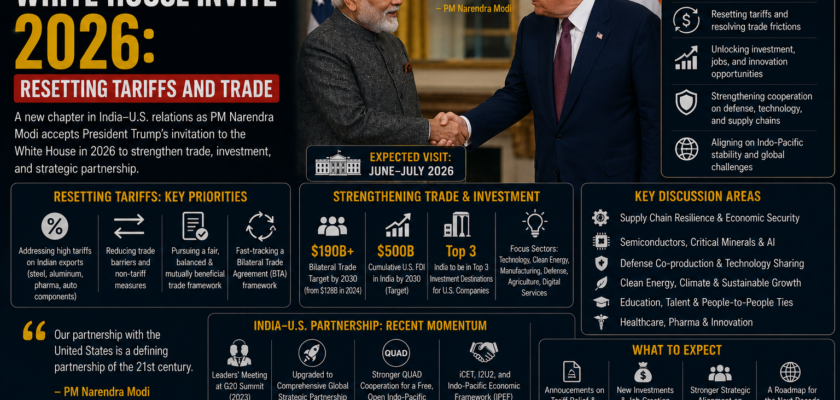
The White House Invitation: How the Latest US-India Diplomatic Talks are Resetting Tariffs.
The geopolitical and economic friction that briefly strained relations between Washington and New Delhi has shifted into a major, high-velocity corporate and diplomatic de-escalation. Over the past year, under the Trump administration’s aggressive “reciprocal trade” doctrine, bilateral relations neared a breaking point when a staggering 50% peak tariff regime was slapped on primary Indian exports. This massive tariff wall combined a baseline 25% reciprocal duty with a restrictive 25% punitive tariff explicitly tied to India’s continued purchase of Russian crude oil during global conflicts. Thin-margin sectors like textiles, leather, and engineering goods felt an immediate operational squeeze.
However, as we cross through May 2026, that heavy protectionist architecture is being fundamentally re-engineered.
The definitive turning point arrived during US Secretary of State Marco Rubio’s monumental four-day diplomatic tour across India. Following an intense, productive meeting in New Delhi, US Ambassador Sergio Gor officially unsealed a historic development: the formal PM Modi White House Invite 2026.
Extended on behalf of President Donald Trump, this high-level invitation to visit Washington in the “near future” serves as a powerful signal that both economic powers are moving past reactive trade skirmishes to finalize an unprecedented transactional alignment.
1. De-Escalating the Tariff Wall: The 18% Strategic Window
The foundational framework backing the PM Modi White House Invite 2026 wave is an extraordinary, newly deployed bilateral trade deal. Rather than allowing a prolonged trade war to permanently break Indo-Pacific supply chains, President Trump and Prime Minister Modi hammered out an aggressive tariff rollback.
                 [ The 2025 Tariff Crisis Blueprint ]
       (August 2025: 25% Reciprocal + 25% Punitive = 50% Peak Tariff)
                                    │
                                    ▼
                [ The February 2026 De-Escalation Deal ]
       (Halt Russian Oil ──► Remove 25% Punitive ──► Lower Core to 18%)
                                    │
         ┌──────────────────────────┴──────────────────────────┐
         ▼                                                     ▼
┌─────────────────────────────────┐               ┌─────────────────────────────────┐
│     The Indian Export Gain      │               │     The US Market Access Core   │
│ • Restores thin-margin edge     │               │ • "Zero-tariff" path on ag-goods│
│ • Beats Vietnam/Bangladesh (20%)│               │ • Drastic cuts on industrial manufacturing│
│ • Massively undercuts China     │               │ • Unlocked $30 Trillion US Sphere│
└─────────────────────────────────┘               └─────────────────────────────────┘
- The Punitive Strip Away: In direct recognition of India’s monumental diplomatic concession to systematically halt and phase out its purchases of Russian Federation oil, President Trump signed an Executive Order completely removing the 25% punitive duty.
- The 18% Reciprocal Baseline: To further fuel economic integration, the United States lowered its core reciprocal tariff on standard Indian imports from 25% down to a lean 18% overall effective rate.
- The Regional Competitive Edge: At 18%, Indian manufacturing now commands a dominant positioning matrix across global retail sectors, successfully undercutting regional competitors like Vietnam (20%), Bangladesh (20%), and China (30% to 35%).
2. Energy for Microchips: Inside the Transactional Payback
The Trump administration’s trade policies operate through a deeply transactional lens—every single tariff reduction from Washington requires a massive, matching economic or strategic payback from its allies. To secure the 18% tariff window and protect domestic MSMEs, India committed to a sweeping series of structural market access overhauls.
A. The $500 Billion Energy Pivot
To fill the massive resource gap left by breaking away from Russian crude, India is moving its energy procurement directly to the Western Hemisphere. Under the newly established trade deal, India is on track to purchase an absolute minimum of $500 billion worth of American energy, liquefied natural gas (LNG), coal, and technology products over the coming years. Rubio heavily pushed this energy shield during his talks with Modi, highlighting that deep integration with U.S. shale resources represents the ultimate way to insulate India from the ongoing West Asia conflict and the effective closure of the Strait of Hormuz.
B. Protecting Farmers while Opening Markets
In a parallel move, India agreed to systematically eliminate non-tariff barriers and slash import duties on a vast range of high-value American industrial items, tree nuts, cotton, and soybean oil.
Crucially, Commerce Minister Piyush Goyal successfully protected domestic agricultural livelihoods by negotiating complete exemptions for sensitive core staples—ensuring wheat, rice, maize, dairy, and poultry remain completely insulated from foreign import surges.
In return, Indian technology firms captured an extraordinary win: gaining streamlined, high-trust access to state-of-the-art NVIDIA artificial intelligence processors and advanced semiconductor chips, completely de-risking the country’s software and digital innovation corridors.
3. Strategic Matrix: High-Tariff Isolation vs. The 2026 Interconnected Alliance
| Strategic Parameter | The August 2025 Tariff Conflict Phase | Post-Bilateral Trade Reality (May 2026) |
| Effective US Tariff Rate | Brutal 50% flat rate across manufacturing lines | Highly competitive 18% unified rate |
| Russian Oil Alignment | Heavy Indian purchases despite Western sanctions | Complete halt; energy pivot to U.S. shale |
| US Technology Access | Restrictive export control blocks on top-tier silicon | Direct, un-bottlenecked access to NVIDIA AI chips |
| Agricultural Tariffs | Rigid reciprocal blocks on both trade sides | Zero-tariffs on select US goods; staples protected |
| Risk Characterization | High vulnerability to a prolonged, destructive trade war | Minimized Risk; institutionalized transactional stability |
4. Re-Anatomizing the Indo-Pacific Strategic Shield
Beyond the immediate balancing of economic ledgers, the upcoming White House meeting between Trump and Modi is designed to cement a long-term defense perimeter across the Indo-Pacific. Washington view a robust, hyper-capitalized India as the ultimate counterbalance to regional expansionism.
  [ Strategic White House Synchronization ] ───► [ Hard-Anchored Indo-Pacific Strategy ]
                                                              │
                                                              ▼
                                               [ Joint Defense Operations ]
                                   • Absolute freedom of navigation in global waters
                                   • Harmonized regulatory standards for advanced military tech
                                   • Shifting tech assembly to deep domestic manufacturing
By leveraging the transactional trade framework to move from simple tech assembly to deep, specialized domestic manufacturing, India is rapidly embedding its corporate base directly into the high-security defense supply chain of the United States.
During his address at the U.S. Embassy Annex Building dedication ceremony in New Delhi, Secretary Rubio remarked on this deep institutional alignment, noting that the relationship forms the absolute cornerstone of America’s posture in the region.
As the two leaders prepare to align their strategic visions in Washington, the alliance is moving past old diplomatic pleasantries to build a resilient, highly practical partnership—proving that true security is achieved when economic incentives and national defense goals are perfectly matched.
Conclusion
The rapid progression toward the PM Modi White House Invite 2026 summit marks the definitive start of a highly structured, mature era in international relations. It shatters the outdated theory that intense trade disagreements must inevitably lead to destructive, permanent economic isolation.
By clearing away the volatile, high-overhead 50% tariff walls and replacing them with a disciplined 18% reciprocal framework backed by hard energy and technology benchmarks, the United States and India are building an unshakeable trade corridor.
The old abacus maze of allowing isolated policy disputes to paralyze bilateral cooperation is dead. As both administrations prepare to finalize these historic frameworks in Washington, this deep strategic alignment offers a clear blueprint for modern diplomacy: when global leaders embrace pragmatic, transactional statecraft, they can successfully safeguard domestic industries, de-risk critical supply chains, and build a safer, more prosperous future for the entire world.


