
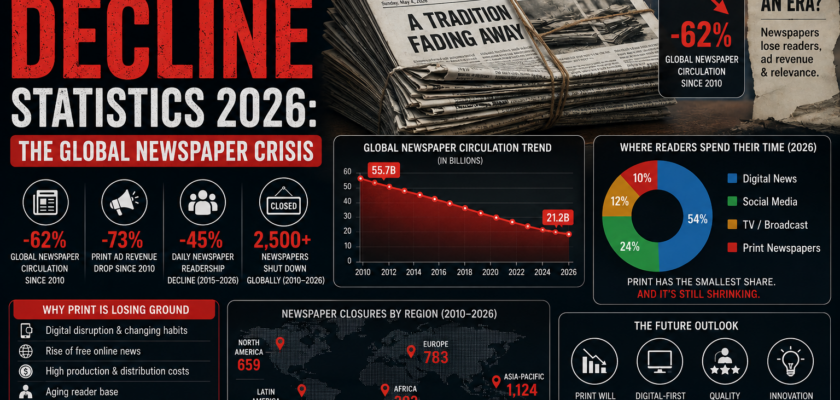
The Death of Print Media? Why Traditional Daily Circulation Has Dropped by 50% Internationally.
The morning ritual of unfolding a freshly printed ink-and-paper newspaper is rapidly turning into an ancient historical artifact. For over two centuries, the physical daily press stood as the undisputed gatekeeper of the global information ecosystem. Newsrooms established massive capital infrastructures—comprising giant industrial printing presses, vast localized distribution networks, and fleets of morning delivery vans—simply to bring yesterday’s occurrences to your front door. Success for a publishing house was structurally anchored in its audited physical circulation volume.
But as we advance through May 2026, the physical printing presses are grinding to a permanent halt.
The latest data from global media monitoring bureaus highlights an unprecedented structural collapse. According to verified Print Media Decline Statistics 2026 trackers, international daily newspaper circulation has plummeted by a staggering 50% over a five-year rolling window.
As major legacy mastheads across London, New York, Tokyo, and New Delhi scale back their physical print runs or abandon daily editions entirely, the media landscape is facing a profound truth: the old paper distribution abacus has run out of time. Here is a deep dive into the economics behind the 50% drop, the changing behavioral patterns of modern audiences, and how the news industry is frantically rebuilding its revenue lines.
1. The Industrial Suffocation: Squeezed by Newsprint and Energy Costs
While public attention frequently focuses on the convenience of smartphones, the initial catalyst forcing publishers to kill off their physical papers is a punishing, supply-side financial squeeze.
                    [ The Print Supply Chain Strangled ]
     (Hyper-Inflation on Paper Stock ──► Skyrocketing Distribution Fuel ──► 50% Run Cuts)
                                     │
                                     ▼
                [ The 2026 Digital-First Pivot Reality ]
     (Instant Server Pushes ──► 0% Material Overhead ──► Dynamic Revenue Layers)
                                     │
         ┌───────────────────────────┴────────────────___________┐
         ▼                                                       ▼
┌─────────────────────────────────┐                     ┌─────────────────────────────────┐
│     The Legacy Printing Debt    │                     │     The Real-Time Matrix        │
│ • Sunk costs in iron machinery  │                     │ • Zero physical shipping friction│
│ • Massive, rigid physical plants │                     │ • Immediate global deployment   │
│ • Fixed delivery window delay   │                     │ • Personalized algorithmic feeds│
└─────────────────────────────────┘                     └─────────────────────────────────┘
The operational costs of running a physical press network have mounted rapidly over the past few years:
- The Paper Stock Spike: Global supply shocks have driven the baseline market price of standard raw newsprint upward by more than 45%.
- Logistical Friction: Compounding the paper shortage is the high cost of distribution. Scurrying localized delivery trucks across metropolitan grids in the face of ongoing fuel inflation has turned early-morning drops into a high-loss corporate exercise.
- The Production Cutback: Faced with these compounding costs, prominent regional publishers are choosing to optimize their budgets. Many have permanently canceled their high-overhead Monday-through-Friday physical print runs, choosing instead to preserve paper stock exclusively for premium, high-ad-yield Sunday editions.
2. Chasing the Feed: The Great Generational Reading Migration
The underlying engine pulling the floor out from beneath Print Media Decline Statistics 2026 metrics is a fundamental evolution in human psychological habits. Modern information consumers no longer value static, retrospective news summaries that were written last night and printed at midnight.
The Instantaneous Multi-Modal Shift
Today’s audience demands a continuous, real-time news current. Users expect breaking global events to drop directly into their personalized social streams, complete with live text updates, high-definition video clips, and crowd-sourced community discussions the exact second a story breaks.
The Interactive Disconnect
Physical paper is completely static—it cannot host an interactive chart, run a live audio translation, or update its text as new details emerge from authorities.
As Generation Z and Millennial demographics achieve absolute purchasing dominance within the consumer marketplace, their complete aversion to offline media formats has isolated print papers. They view physical newspapers as a slow, wasteful format that causes environmental guilt and offers zero personalized utility.
3. Strategic Matrix: Traditional Daily Newspapers vs. Native Digital Feeds
| Operational Axis | Traditional Physical Newsprint Formats | Native Digital News Platforms (2026) |
| Information Latency | High (8 to 24-hour manufacturing lag) | Zero; updated continuously second-by-second |
| Material Overhead | Heavy (Raw paper stock, factory ink, physical trucks) | Minimal (Cloud server hosting and CDN footprints) |
| Monetization Architecture | Fading classifieds & flat display page ads | Dynamic paywalls, premium newsletters, micro-tips |
| Media Format Diversity | Monochromatic text layouts and static images | Multimodal video, live audio spaces, dynamic data |
| Risk Characterization | High vulnerability to physical distribution blocks | Minimized Risk; un-bottlenecked global deployment |
4. Re-Engineering the Ledger: The Rise of Sovereign Digital Subscriptions
The dramatic collapse of physical circulation doesn’t mean the death of journalism itself—it marks the total migration of journalistic assets into high-margin digital safe havens.
Publishing groups that recognized this shift early are successfully removing physical manufacturing costs from their balances sheets entirely. They are replacing old newsstands with specialized, high-yield digital walls.
  [ Old Newsstand Distribution ] ───► [ High Material Friction & 50% Returns Loss ]
                                                   │
                                                   ▼
                                    [ On-Chain Digital Paywalls ]
                              "Direct Credit-Card Relationship to Reader"
                                                   │
                                                   ▼
                                    [ Sustainable Media Revenue ]
                                "Uncapped Scale, Recurring Cash Flow"
Elite global brands have successfully moved past old-school ad-supported clickbait loops. Instead, they are locking down their deep investigations behind metered digital paywalls and specialized subscription structures.
Furthermore, the industry is seeing a massive surge in independent creator ecosystems. Top-tier political analysts and veteran investigative reporters are leaving traditional newsrooms entirely to set up their own premium newsletters on platforms like Substack.
By building a direct, personal link to their audience, these writers can capture close to 90% of their subscription revenues directly. This shift bypasses corporate media overhead entirely, proving that while the physical ink-and-paper newspaper format is rapidly fading away, the economic value of high-quality, trusted human writing remains uncompromised.
Conclusion
The undeniable reality reflecting across the latest Print Media Decline Statistics 2026 records marks a necessary, albeit painful, technological transition. The physical daily newspaper is no longer a viable tool for modern information distribution; it has become an expensive, slow format that cannot survive in a lightning-fast digital world.
By trading the high-friction, low-margin abacus maze of physical printing plants for the un-bottlenecked scale of real-time digital publishing, the news industry is discovering a more resilient path forward.
This evolution doesn’t destroy the core value of journalism; it strips away the heavy, industrial waste of the printing process. As physical papers fade into specialty collector pieces for nostalgic readers, the digital news current will continue to run faster and cleaner than ever—proving that while the paper medium may be dying, our collective desire for truth, speed, and perspective is completely immortal.


