


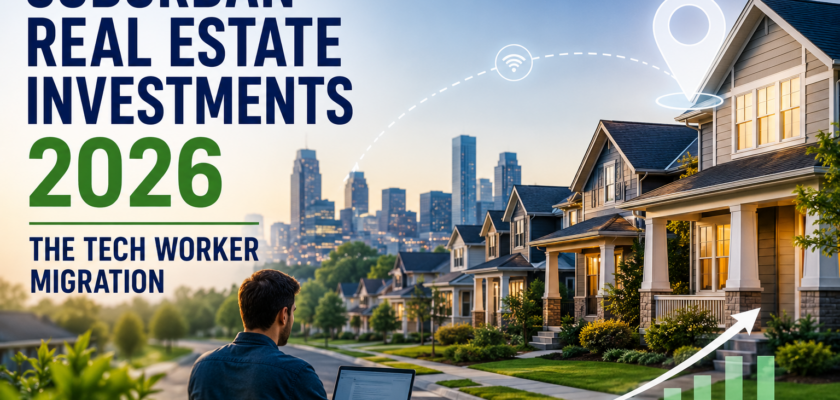
The Smart-Suburban Premium: Why Tech Workers Are Trading Luxury High-Rises for Connected Suburbs.
The premium corporate housing model has officially reached a saturation point. For the past decade, the ultimate status symbol for top-tier software engineers, AI researchers, and tech executives was anchored directly to the dense urban core. Elite professionals willingly paid immense premiums to rent or buy fractional studio footprints inside luxury high-rise towers in Downtown San Francisco, Manhattan, Austin, and Bengaluru. The playbook was simple: trade square footage and quiet green spaces for the sake of being walking distance from regional corporate headquarters and high-density nightlife.
But as we advance through 2026, that centralized urban premium is undergoing a massive structural correction.
Driven by the absolute stabilization of asynchronous remote work, the rise of autonomous AI co-pilots that minimize synchronized office dependencies, and a profound desire for sensory decompression, tech workers are executing a major migration.
Investors are aggressively tracking this shift, causing a surge in suburban real estate investments 2026 trends.
Tech-driven capital is exiting crowded metropolitan high-rises to establish a new real estate category: The Connected Smart Suburb. By bridging the physical footprint of rural living with the hyper-fast fiber infrastructure, mesh automation networks, and green micro-living frameworks of tomorrow, these master-planned communities are capturing the highest real estate premiums in the country.
1. The Volumetric Arbitrage: Trading Glass Boxes for Smart Plots
The initial catalyst forcing this demographic realignment is basic spatial mathematics. High-rise living traps professionals within rigid structural parameters—where a multi-million-dollar valuation often buys a layout with zero private exterior land, restrictive community HOA rules, and continuous exposure to urban ambient noise pollution.
                    [ The Real Estate Capital Pivot ]
     (Urban High-Rise Condos ──► Over-Valued Saturated Margins ──► Capitulation)
                                     │
                                     ▼
                [ The 2026 Connected Smart Suburb Model ]
     (Suburban Acreage + Integrated Fiber + Off-Grid Solar = High Yield Asset)
                                     │
         ┌───────────────────────────┴────────────────___________┐
         ▼                                                       ▼
┌─────────────────────────────────┐                     ┌─────────────────────────────────┐
│      Spatial Freedom Core       │                     │    Hyper-Connected Infrastructure│
│ • 4x to 6x greater square footage│                     │ • Low-latency native fiber runs │
│ • Private organic growing plots │                     │ • Fully integrated mesh micro-grids│
│ • Specialized dedicated home labs │                     │ • Seamless EV charging gateways │
└─────────────────────────────────┘                     └─────────────────────────────────┘
Connected suburbs unlock an extraordinary volume arbitrage. For the exact same capital requirements of a mid-tier city studio, tech workers are securing expansive properties that offer:
- The Dedicated Engineering Lab: Moving past makeshift desk setups, professionals are building large, acoustically insulated home offices optimized for high-power server racks and specialized deep-learning setups.
- Intrinsic Energy Self-Reliance: Unlike older suburban homes, 2026 smart developments feature integrated solar roof tiles, modular battery storage walls, and rainwater filtration systems that allow homes to function off-grid during climate emergencies.
- The Return to Nature: Properties balance advanced digital interiors with organic exterior spaces—including private permaculture gardens, native tree canopies, and quiet outdoor workspaces that offer natural creative inspiration.
2. The Smart City Fabric: What Makes a Suburb “Connected”?
A common misconception about the modern suburban shift is that tech workers are simply returning to the generic, car-dependent suburban designs of the late 1990s. The 2026 connected suburb is completely different; it is built from the ground up as a decentralized smart city hub.
  [ Master-Planned Community ] ───► [ Hyper-Fast Local Connectivity ] ───► [ Integrated Micro-Living Utilities ]
     • Dedicated 10-Gbps Lines          • Walkable Micro-Retail Loops         • Autonomous Drone Delivery Pads
     • Seamless Community Mesh          • Shared Solar Power Banks            • Net-Zero Localized Ecosystems
Developers are actively installing dedicated, low-latency 10-Gbps fiber networks directly into the soil before a single brick is laid. The entire community operates on a unified mesh communication layer, providing seamless outdoor wireless connectivity across community parks, shared workspaces, and walking trails.
Furthermore, these modern master-planned spaces discard old zoning laws in favor of walkable micro-living alternatives.
Neighborhood layouts are designed around localized pedestrian town squares featuring curated co-working spaces, automated organic grocery markets, and localized drone-delivery landing bays. This layout allows residents to enjoy the peaceful quiet of a country lifestyle while keeping their data infrastructure and daily conveniences within a single-click loop.
3. Strategic Matrix: Urban Luxury High-Rises vs. Connected Smart Suburbs
| Real Estate Vector | High-Density Urban Luxury Towers | Master-Planned Connected Suburbs (2026) |
| Average Asset Cost Basis | Extreme cost per square foot; minimal space | Highly optimized; 4x to 6x value-to-space yield |
| Infrastructure Integration | Dependent on aging municipal utility grids | Native off-grid solar, mesh nets, and fiber |
| Workplace Capability | Restricted; high ambient structural noise | Premium; built-in insulated home engineering labs |
| Community Mobility | High-congestion transit; elevator dependencies | Walkable pedestrian loops; micro-mobility trails |
| Risk Characterization | High risk of asset stagnation in crowded cities | Minimized Risk; sustained long-term capital growth |
4. Capturing the Yield: The 2026 Investment Playbook
For wealth managers and property portfolios looking to capitalize on suburban real estate investments 2026 movements, the investment framework requires adjusting standard asset models away from old location priorities. Prestige is no longer measured by a property’s proximity to a metropolitan financial center; it is defined by its infrastructure resilience.
Capital is rapidly consolidating around mid-sized suburban boundaries situated roughly 45 to 90 minutes outside of traditional primary tech nodes.
These secondary asset rings allow professionals to travel easily to central offices for occasional corporate syncs, while preserving their day-to-day lifestyle focus.
As multi-family high-rise developments in crowded cities face rising vacancy rates and falling rental yields, smart-suburban developments are seeing record-breaking absorption trends and premium rent generation. By building residential products tailored exactly to the lifestyle and technology requirements of the modern knowledge worker, real estate portfolios are securing a highly stable, non-cyclical asset class—proving that the ultimate luxury in a digital world is the combination of physical space, environmental harmony, and absolute digital power.
Conclusion
The undeniable momentum reshaping the global property landscape marks a permanent evolution in human geography: true quality of life isn’t defined by how high you live above a crowded city floor, but by your freedom to build a balanced lifestyle on your own terms. The old abacus maze of forcing families to tolerate small spaces and urban stress just to stay close to a physical office building is rapidly dissolving.
By clearing away high city overheads and replacing them with resilient, hyper-connected smart suburban layouts, developers are demonstrating how to build sustainable residential models for the future.
These communities don’t require workers to choose between a thriving career and a peaceful lifestyle—they blend both seamlessly. As these smart-suburban master plans continue to expand their footprints worldwide, they deliver a clear message to the broader real estate market: the future of property development isn’t about building higher into the clouds, but about planting smart, connected, and sustainable roots across our landscapes.


