


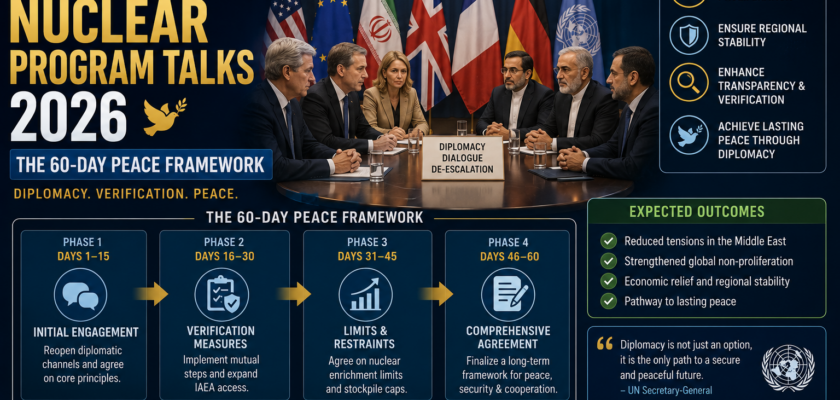
The 60-Day Nuclear Clause: Inside the Strategic Postponements of the Draft Peace Framework.
The international community is currently witness to the most complex, high-stakes game of diplomatic chicken since the onset of the atomic age. Following the outbreak of intense, multi-front military hostilities involving the United States, Israel, and Iran on February 28, 2026, global markets and defense networks have operated in a state of continuous emergency footing. The subsequent counter-blockades and mining of the strategic Strait of Hormuz effectively froze the world’s most critical energy artery, triggering acute inflationary panic across major importing nations.
But as the calendar turns to late May 2026, a highly structured, back-channel diplomatic lifeline has finally emerged.
Over the weekend, U.S. President Donald Trump announced via Truth Social that a landmark Memorandum of Understanding (MOU) to end the regional war has been “largely negotiated”.
At the absolute epicenter of this historic de-escalation is a highly sophisticated, deeply debated diplomatic mechanism: the 60-day nuclear clause.
While the preliminary framework establishes a temporary path toward peace, a rigorous look at the draft text reveals that the ultimate fate of the region hinges on a series of deliberate, strategic postponements.
By splitting immediate maritime security and economic relief from the infinitely more volatile atomic file, the Iran nuclear program talks 2026 structure gives both superpowers critical breathing room—while setting a strict, 60-day doomsday clock to resolve the core issue of uranium enrichment.
1. The Two-Tiered Architecture: Separating the War from the Core
The primary diplomatic innovation behind the newly revealed MOU is its strict, two-tiered operational structure. Historically, international peace initiatives fail because negotiators attempt to resolve complex, decades-old structural disputes simultaneously with an active battlefield crisis. The 2026 framework intentionally discards that old playbook.
                    [ The 2026 Phased Peace Pipeline ]
                                     │
         ┌───────────────────────────┴────────────────___________┐
         ▼                                                       ▼
┌─────────────────────────────────┐                     ┌─────────────────────────────────┐
│   Phase 1: Immediate Stabilization  │                     │   Phase 2: The 60-Day Countdown  │
│ • Complete halt to combat on fronts│                     │ • Enter deep bilateral talks    │
│ • Lift the bilateral naval blockade│                     │ • Debate zero-enrichment rules  │
│ • Cleanly reopen Strait of Hormuz│                     │ • Finalize HEU stockpile fates  │
└─────────────────────────────────┘                     └─────────────────────────────────┘
         │                                                       │
         └───────────────────────────┬────────────────___________┘
                                     ▼
                     [ The Final Treaty Threshold ]
      (Durable Macro Settlement ──❌ OR❌── Instant Return to Active War)
The preliminary agreement functions as an immediate stabilization valve to cool down the global energy sector. It establishes a comprehensive 60-day pause of combat on all active fronts—explicitly requiring an end to fighting in Lebanon—while forcing the mutual lifting of the American naval blockade and the immediate reopening of the Strait of Hormuz to civilian shipping without local transit tolls.
However, as Iranian Foreign Ministry Spokesman Esmaeil Baqaei explicitly stated on state television, “the nuclear issue was not part of an initial framework”.
By pushing the intensely controversial atomic debate into separate, subsequent discussions over a locked 60-day negotiation window, both administrations can secure immediate commercial relief while delaying the high-friction showdown over enrichment rights.
2. The Trump Doctrine: Demanding the “Zero-Enrichment” Blueprint
While Tehran frames the 60-day clause as an open-ended diplomatic runway to discuss broad regional security, Washington’s view of the upcoming Iran nuclear program talks 2026 timeline is remarkably rigid. The Trump administration’s core foreign policy goal has been made absolutely clear: utilizing maximum economic and military pressure to force a complete, irreversible dismantling of Iran’s nuclear capacities.
The Uncompromising American Demands:
- The Absolute Enrichment Ban: In a complete contrast to the historical parameters of the 2015 JCPOA framework, Vice President JD Vance and Secretary of State Marco Rubio are operating under a strict “zero enrichment” mandate. The U.S. draft framework demands that Iran permanently cease all domestic nuclear enrichment activity, regardless of purity levels.
- Stockpile Relinquishment: Backed by early leaks published by The New York Times, Washington is requiring that Tehran completely surrender and remove its entire existing stockpile of highly enriched uranium (HEU) from its territory.
- The Military Shadow: To ensure compliance, the Pentagon has confirmed that massive U.S. naval task forces will remain actively stationed within the Gulf region for the entirety of the 60-day period. This preserves an immediate, high-readiness military option if Iranian scientists fail to meet verification standards.
3. Strategic Matrix: Initial War Stablization vs. The 60-Day Postponement Risks
| Diplomatic Vector | Phase 1: Initial Stabilization Framework | Phase 2: The 60-Day Negotiation Window |
| Primary Objective | End active hot war; safely reopen maritime trade lanes | Dismantle atomic facilities; secure HEU assets |
| Sanctions Posture | U.S. issues temporary waivers for targeted oil sales | Comprehensive lifting dependent on verified compliance |
| Strait of Hormuz Status | Reopened immediately; maritime mines cleared safely | Long-term international transit frameworks locked in |
| Frozen Assets Access | Rapid, partial release of specified frozen cash pools | Full unlocking of remaining $25 Billion asset core |
| Risk Characterization | High vulnerability to sudden local ceasefire violations | Sustained Risk; collapse triggers full military return |
4. Sovereign Resistance: The Iranian Red Lines
The ultimate point of friction that could completely break the 60-day peace framework during secondary negotiations centers squarely on the concept of national sovereignty. Even as the diplomatic text moves toward formal signatures, media outlets affiliated with the Islamic Revolutionary Guard Corps (IRGC) and state-aligned news agencies like Fars and Tasnim have issued fierce, coordinated pushbacks.
  [ US Maximum Framework Demand ] ───► [ Zero Enrichment + Surrender of HEU Stockpiles ]
                                                   │
                                                   ▼
                                    [ The Iranian Sovereignty Red Line ]
                              "No Facility Closures, No External Fuel Transfers"
                                                   │
                                                   ▼
                                    [ The 60-Day Doomsday Deadline ]
                               "Unresolved Atomic Deadlock Triggers Total War"
Iranian state media has repeatedly broadcasted that the preliminary MOU contains absolutely no prior commitments to hand over nuclear materials, disable centrifuges, or shut down deep underground facilities.
Tehran’s domestic hardliners view their peaceful nuclear enrichment technology as a non-negotiable sovereign achievement.
While pragmatic elements within the Iranian presidency are willing to grant extensive access to International Atomic Energy Agency (IAEA) inspectors to prove they are not actively weaponizing their research, any forced external transfer of their domestic fuel stockpile is being branded as a domestic political non-starter.
Because the preliminary agreement conditions the final, permanent lifting of economic sanctions and the complete unfreezing of $25 billion in overseas assets on a total resolution of the nuclear file, this sovereignty debate forms an explosive core. If negotiators cannot find a creative way to bridge this gap before the 60-day clock expires, the temporary peace will instantly collapse—shoving both nations right back into a high-intensity hot war.
Conclusion
The delicate deployment of the 60-day nuclear clause across the current Iran nuclear program talks 2026 landscape offers a textbook lesson in high-stakes modern statecraft. It proves that in the face of an existential international crisis, delaying a complex ideological conflict can often be the only logical way to secure immediate real-world relief.
By trading a temporary halt to combat and partial sanctions relief for an immediate restoration of global shipping corridors, both superpowers have successfully avoided an imminent economic collapse.
However, we must look past early celebration headlines to recognize that this MOU is not a final peace treaty; it is a temporary ceasefire with a built-in doomsday timer. The structural abacus maze of resolving the zero-enrichment debate remains entirely intact. As the 60-day negotiation clock begins its countdown over the coming weeks, the world will watch closely—knowing that the ultimate choice between long-term Middle Eastern stability and a catastrophic return to total war rests on the shoulders of those who must turn this fragile draft into a permanent reality.


