


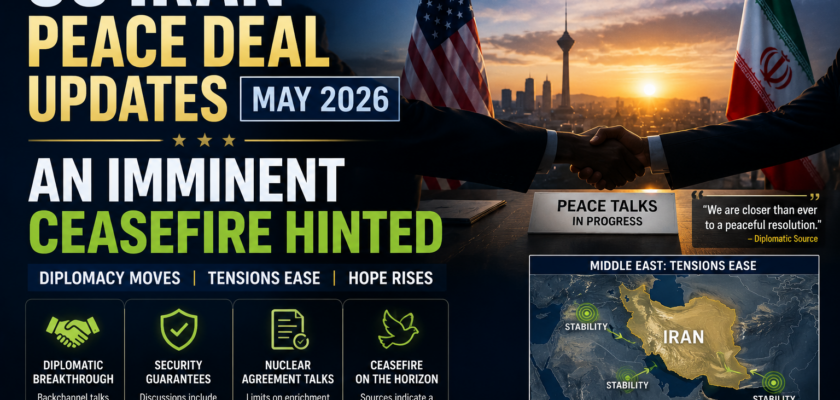
US-Iran War Ending? Secretary Marco Rubio Hints at an Imminent West Asia Peace Accord.
The global security architecture has just experienced its most profound diplomatic tectonic shift of the decade. Ever since the direct military escalation ignited a full-scale war involving the United States, Israel, and Iran on February 28, 2026, the international community has hovered in a state of high-alert panic. The subsequent deployment of severe naval blockades across the Persian Gulf strangled close to 20% of the world’s vital energy transit, choking supply chains and pushing major oil-importing economies to the absolute brink of systemic stagflation. To many defense analysts, the geopolitical landscape mirrored the dark, unyielding containment crises of the mid-20th century.
But today, Sunday, May 24, 2026, the prospects for a near-term regional resolution have suddenly scaled to an unprecedented high.
Speaking live from the historic halls of Hyderabad House in New Delhi, India, U.S. Secretary of State Marco Rubio dropped a monumental, high-stakes disclosure that has instantly transformed the global news cycle.
The latest US Iran peace deal updates May 2026 feeds confirm that Washington and Tehran are on the absolute precipice of executing a sweeping, comprehensive ceasefire framework.
Addressing a packed international press delegation alongside Indian External Affairs Minister S. Jaishankar, Secretary Rubio boldly asserted that the world could receive decisive, historic “good news” within the next few hours—signaling a dramatic pause to the intense West Asia conflict.
1. The New Delhi Briefing: What Rubio Declared at the Microphones
The exact phrasing utilized by Secretary Rubio during his joint press conference underscores the intensive, late-night diplomatic maneuvering that took place behind closed doors over the weekend.
                [ The New Delhi Diplomatic Disclosure ]
                                   │
         ┌─────────────────────────┴─────────────────────────┐
         ▼                                                   ▼
┌─────────────────────────────────┐                 ┌─────────────────────────────────┐
│     The Escalation Timeline     │                 │     The 48-Hour Breakthrough    │
│ • Feb 28: Outbreak of active war│                 │ • Intense back-channel sync     │
│ • Mar-May: Harsh Hormuz blockade│                 │ • Drafted via Pakistani mediators│
│ • Record-high crude oil panics  │                 │ • Breakthrough leaked in Delhi  │
└─────────────────────────────────┘                 └─────────────────────────────────┘
         │                                                   │
         └─────────────────────────┬─────────────────────────┘
                                   ▼
                   [ The Imminent Ceasefire Verdict ]
        "Possibility that in the next few hours, the world gets good news"
Flanked by Minister Jaishankar following extensive, high-level bilateral and regional delegation talks, Rubio cleared away speculative fog to deliver a direct message to global markets:
“We have made some progress over the last 48 hours working with our partners in the Gulf region on an outline that could ultimately – if it succeeds – leave us not just with a completely open strait… [but also address] some of the key things that underpin what have been Iran’s nuclear weapons ambitions in the past.”
Rubio confidently told reporters that a comprehensive agreement was finalized to a state where President Donald Trump recently confirmed on social media that the parameters of the historic accord are now “largely negotiated”.
While the package still awaits final institutional approval from Iran’s Supreme Leader Ayatollah Ali Khamenei and their Supreme National Security Council in Tehran, the momentum toward a cessation of hostilities is officially unstoppable.
2. Inside the Structural Clauses: Reopening Hormuz and Sanctions Relief
The emerging peace accord operates through a highly structured, phased quid-pro-quo mechanism designed to address both immediate economic bottlenecks and long-term security threats. According to leaked drafts obtained by regional diplomatic desks, the treaty is anchored by three specific core pillars:
A. The Immediate Unblocking of Global Commerce
The immediate phase-one breakthrough mandates a total end to the active U.S. naval blockade on Iranian ports, matched instantly by Iran completely restoring open, unrestricted passage through the Strait of Hormuz. Maritime transit through the waterway will return to pre-war operational safety layouts under standard Iranian management, completely clearing out a massive backlog of stranded global cargo ships.
B. The 60-Day Diagnostic Windows
To facilitate a durable cooling-off period, the accord institutes a strict 60-day regional truce.
  [ 60-Day Peace Window Triggered ] ───► [ Reopen Hormuz Under Iranian Management ]
                                                     │
                                                     ▼
                                      [ Parallel US Economic Relief ]
                                  "Deploy Sanctions Waivers for Oil & Gas"
                                                     │
                                                     ▼
                                      [ Phased Asset Release ]
                                  "Partial Unfreezing of Tehran's Overseas Cash"
During this two-month window, the Trump administration will officially deploy targeted sanctions waivers, legally allowing Iran to resume commercial sales of crude oil, natural gas, and petrochemicals to global buyers. Concurrently, Washington will permit the partial release of Tehran’s multi-billion-dollar asset pools currently frozen in international banking hubs.
3. Strategic Matrix: High-Conflict War Footing vs. The May 2026 Peace Outline
| Conflict Axis | Active Warfare Architecture (Feb–May 2026) | Emerging Peace Treaty Parameters |
| Hormuz Transit Status | Heavily restricted; choked by active naval blockades | 100% Reopened; returned to safe pre-war volume levels |
| Iranian Oil Commercialization | Complete global ban; tracking and capturing cargo | Temporary sanctions waivers to allow open oil trading |
| Nuclear Enriched Stockpile | Accelerated 60% purity enrichment tracks | Commitment to address stockpiles via 60-day talks |
| Regional Ceasefire Scope | Multi-front active artillery exchanges | Includes complete end to Israel-Hezbollah fighting |
| Risk Characterization | High vulnerability to global energy system collapse | Minimized Risk; tech-backed diplomatic safety corridor |
4. The Nuclear Sore Point: The Battle Over Uranium Stockpiles
While European leaders and global markets have enthusiastically welcomed the rapid de-escalation of the US Iran peace deal updates May 2026 wave, high-trust diplomatic tracking reveals that a profound, long-term point of friction remains unresolved. The ultimate strategic objective driving the Trump administration’s foreign policy is ensuring that Iran can never weaponize its atomic research.
  [ US Strategic Demand ] ───► [ Total Relinquishment of 60% Enriched Uranium Stockpile ]
                                                 │
                                                 ▼
                                  [ Proposed Russian Compromise ]
                             "Ship Highly Enriched Fuel to Moscow Hubs"
                                                 │
                                                 ▼
                                  [ Iranian Sovereign Resistance ]
                              "Nuclear Sovereign Rights are Non-Negotiable"
According to regional officials close to the back-channel negotiations mediated by Pakistani Army Chief Asim Munir, a major sticking point involves Iran’s current 440.9-kilogram stockpile of 60% enriched uranium.
Washington is demanding that Tehran completely ship this highly enriched fuel out of the country to be diluted or stored securely in a third nation, with Russia already stepping forward to serve as the storage hub.
While Iranian President Masoud Pezeshkian explicitly announced on state television that his country is “ready to reassure the world that we are not after a nuclear weapon,” domestic hardliners and diplomatic representatives have fiercely rejected any forced relinquishment of their existing materials.
Tehran maintains that any structural discussion regarding its peaceful nuclear technology must be deferred to secondary negotiations for a final agreement, rather than being shoved into the current short-term truce. Balancing this intense sovereignty debate will determine whether the temporary 60-day peace line can successfully mature into a permanent foundation for regional stability.
Conclusion
The spectacular diplomatic turnaround playing out across Secretary Rubio’s historic New Delhi press briefing offers an undeniable, permanent lesson to students of international relations: direct, pragmatic, and transactional statecraft remains the most powerful tool to resolve even the most volatile global crises. The old abacus maze of assuming that a multi-nation hot war must inevitably drag on for years, destroying the global economy along the way, has been shattered by a highly focused diplomatic intervention.
By trading temporary, high-yield economic sanctions relief for immediate maritime security guarantees and clear avenues for nuclear verification, global leadership is saving our integrated supply chains from systemic collapse.
Of course, ironing out the final, highly sensitive details regarding uranium transport will require absolute patience and rigorous monitoring over the upcoming 60-day window. However, the immediate lowering of weapons across West Asia delivers an extraordinary sigh of relief to manufacturing grids, shipping lines, and families all over the earth—proving that even in our loudest, most fractured moments, the pathway to peace is always built through open, uncompromised, and courageous dialogue.


