
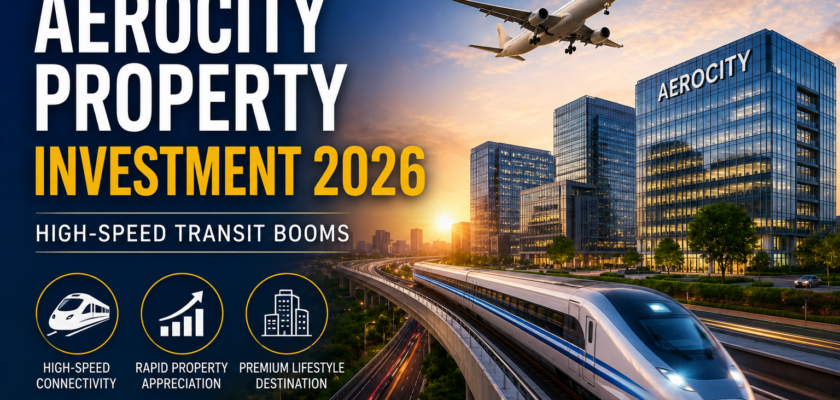
Commercial Hub Aerocities: Why Property Values Surrounding New High-Speed Rail Hubs are Booming.
The structural map of premium commercial real estate has broken out of traditional downtown financial districts. For decades, institutional property developers and corporate enterprises associated high asset valuations with centralized urban cores. Companies paid immense rental premiums to secure office space in landlocked metropolitan centers. However, dense city cores have run into extreme physical saturation, skyrocketing gridlock, and aging municipal utilities.
Consequently, modern commercial capital is rapidly pivoting toward a highly connected alternative rooted in Transit-Oriented Development (TOD).
The primary engine driving this nationwide geographic transformation is the rapid rise of the integrated Aerocity.
Data surrounding Aerocity property investment 2026 trends show an unprecedented surge in capital inflows targeting land zones near major airports. By linking international aviation gates directly with new high-speed rail lines, metro extensions, and regional expressways, these edge-city business districts are capturing the highest commercial yields in the country. They are successfully transforming peripheral airport land into high-density economic powerhouses.
1. The Transit-Oriented Multiplier: Why Aerocities Command the Top Yields
The core innovation behind the modern aerotropolis model is its unique capacity to merge multiple distinct transport networks into a single commercial footprint. A traditional business park merely sits near a highway, forcing commuters to brave congested local roads.
In contrast, the 2026 Aerocity structure functions as a comprehensive, multi-modal transport gateway.
                    [ The Saturated Urban Office Loop ]
     (City Center Grids ──► Heavy Road Congestion ──► Stagnant Rental Asset Yields)
                                     │
                                     ▼
                  [ The 2026 Aerocity Transit Matrix ]
     (Aviation Gates + High-Speed RRTS + Metro Phase IV = Global Business Node)
                                     │
         ┌───────────────────────────┴────────────────___________┐
         ▼                                                       ▼
┌─────────────────────────────────┐                     ┌─────────────────────────────────┐
│     The Intercity Rail Link     │                     │      Hyper-Scale Footfall       │
│ • Sub-45 minute regional transit│                     │ • Millions of annual passengers │
│ • Connects far-away worker bases│                     │ • Seamless retail hub access    │
│ • Cuts down long road commutes  │                     │ • Massive entertainment spaces  │
└─────────────────────────────────┘                     └─────────────────────────────────┘
These highly optimized hubs systematically reduce long-distance travel times for large corporate workforces.
- The High-Speed Connection: The integration of the Regional Rapid Transit System (RRTS) allows professionals traveling from distant suburban towns to reach Aerocity business terminals in under 45 minutes.
- The Metro Phase IV Synergy: Concurrently, expanding urban subways connect the airport zone directly to local neighborhoods, providing quick transit across the city.
- The Value Capture: As a result, commercial assets within these corridors enjoy exceptionally low vacancy rates and stable rental growth. This position makes them a top choice for global investment funds and corporate headquarters.
2. Inside the Blueprint: The Infrastructure Expansion Profile
The massive valuation increases seen across leading Aerocity zones are backed by highly aggressive commercial and lifestyle space developments.
A. Hyper-Scale Commercial Inventory Integration
Leading developments are rapidly expanding their physical commercial scale to meet corporate demands.
For instance, prime aerotropolis hubs are projected to grow their leasable office and retail space more than sixfold over the coming years.
This massive supply expansion features premium Grade-A+ corporate facilities engineered with large, flexible floor plates that offer top-tier structural flexibility for multinational tenants.
B. The Emergence of Destination Retail
Furthermore, modern Aerocity infrastructure completely discards old, mono-functional zoning in favor of diverse, mixed-use ecosystems:
  [ Integrated Aerotropolis ] ───► [ High-Volume Leasable Grade-A Offices ]
                                                    │
                                                    ▼
                                     [ Destination Retail Hubs ]
                                "India's Largest Mega Malls Under Construction"
                                                    │
                                                    ▼
                                     [ 24/7 High-Street Ecosystems ]
                                "Late-Night Dining & Global Corporate Hubs"
Developers are seamlessly blending massive office assets with hyper-scale lifestyle spaces, including mega-malls spanning over 2.8 million square feet.
These properties integrate premium work arenas with 24/7 high-street retail zones, curated dining terraces, and major indoor entertainment centers.
Consequently, the district stays highly active and accessible well beyond traditional working hours. This continuous activity drives immense footfall and secures durable revenue streams for real estate portfolios.
3. Strategic Matrix: Traditional CBD Commercial Assets vs. 2026 Aerocity Hubs
| Commercial Real Estate Vector | Traditional Central Business Districts | Connected Aerocity Smart Hubs (2026) |
| Transit-Oriented Integration | Poor; dependent on congested municipal roads | Native; direct high-speed RRTS & metro links |
| Inventory Growth Space | Low; landlocked plots with high ceiling restrictions | High; multi-million sq. ft. planned expansions |
| Ecosystem Versatility | Rigid; closed office blocks quiet after 6 PM | Dynamic; 24/7 live-work-play destination layouts |
| Tenant Influx Profile | Standard localized businesses and local agencies | Elite international firms & global headquarters |
| Risk Characterization | High risk of stagnation due to urban decay factors | Withdrawn Risk; tech-backed transit connectivity |
4. Capturing the Premium: The Institutional Investment Playbook
The macroeconomic momentum backing the commercial real estate high yield sector has completely altered how global wealth funds allocate property capital. Value is no longer calculated purely by a property’s location inside a heritage city center.
Instead, maximum asset premiums are awarded to real estate layouts that offer structural connectivity, top-tier environmental certifications, and highly efficient commute paths.
  [ High-Speed Transits Open ] ───► [ Corporate Commute Times Drop 60%+ ]
                                                    │
                                                    ▼
                                     [ Multi-National Tenant Influx ]
                                "Firms Influx to Secure Premium visibility"
                                                    │
                                                    ▼
                                     [ Institutional Capital Consolidation ]
                                "REITs Lock In High-Yield Annuity Income"
Real Estate Investment Trusts (REITs) and alternative asset managers are rapidly consolidating their holdings around these transit nodes.
By investing heavily in projects situated near high-speed rail stations, these platforms secure predictable, inflation-protected annuity income.
Thus, the transit-oriented aerotropolis model is reshaping urban development. This evolution proves that the most resilient commercial assets in the modern economy are those designed around fast, frictionless human mobility.
Conclusion
The undeniable value growth defining the Aerocity property investment 2026 landscape outlines a permanent shift in urban geography. True property value is no longer determined by central locations, but by how effectively a space connects to transit networks. The old abacus maze of forcing corporate teams to lose hours daily in city traffic jams is being replaced by hyper-accessible edge cities.
By combining international airports with high-speed regional rail lines and expansive mixed-use developments, planners are outlining the future of urban centers.
These integrated districts provide businesses with the global visibility and transit logistics they need to thrive. As these smart transit master plans continue to mature across major transportation nodes, they deliver a clear message to the global real estate market: the future of commercial real estate isn’t just about building spaces to work, but about creating connected ecosystems that move the world smoothly.


