


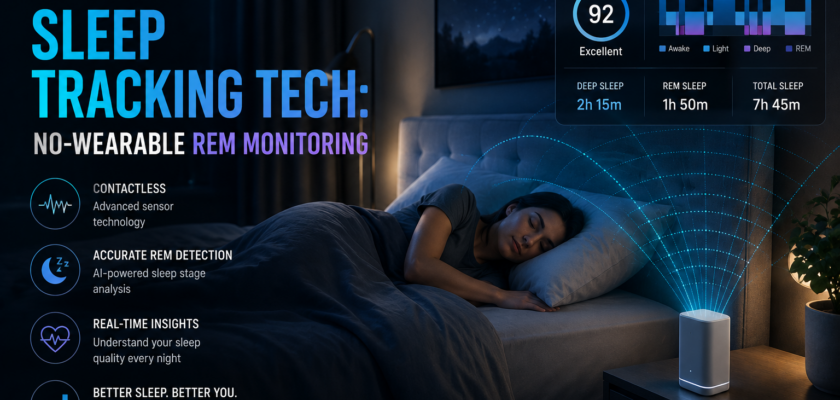
The Sleep Architecture Matrix: How Contactless Bio-Sensors Track Deep Rem Patterns Without Wearables.
The underlying roadmap directing personal wellness tracking is undergoing a rapid, structural transformation. For over a decade, consumer fitness brands focused their entire engineering capital on building heavy, wrist-worn tracking devices and smart rings. This product strategy assumed that keeping a physical sensor pinned directly to a user’s skin was the only way to log physiological data accurately overnight. However, this heavy reliance on wearable hardware created severe bedtime friction for millions of consumers, triggering skin irritation, causing battery dead-night gaps, and disrupting natural rest cycles.
Fortunately, modern biomechanical engineering is executing a sharp pivot toward non-intrusive monitoring solutions.
We have officially entered a new era marked by the rapid expansion of contactless sleep tracking tech in modern homes.
Driven by a growing demand for a device-free sleeping experience, users are embracing non-wearable bio-sensing 2026 systems.
By removing physical ties, these advanced setups analyze vital signs straight through sheets and blankets.
This profound shift is permanently changing how we deploy advanced sleep hygiene tools across contemporary households. Consequently, tech-forward households are systematically upgrading their bedrooms with smart nearable devices. This transition proves that true recovery tracking does not require wearing restrictive plastic bands to bed, but rather relies on intelligent, automated sensor fields that protect your peace.
1. The Radar Breakthrough: Measuring the Body via Millimeter Waves
The primary technological catalyst accelerating this wellness revolution centers on using advanced millimeter-wave radar to track physical biometrics. Standard wrist trackers rely on light-reflection sensors that often deliver skewed numbers if the band slips out of place during the night.
In contrast, next-generation contactless devices utilize hyper-sensitive radar frequencies to track organic movements from a distance.
                    [ The Intrusive Wearable Setup ]
     (Tight Wrist Straps ──► Skin Sweat Friction ──► Broken Sleep Telemetry Loops)
                                     │
                                     ▼
                [ The 2026 Contactless Sensing Array ]
     (60 GHz Radar Waves ──► Tracks Chest Vibrations ──► Flawless Vital Signs Monitoring)
These highly sophisticated radar systems track microscopic physical variations to map sleep states with extreme accuracy:
- Tracking Micro Movement: The system deploys specialized 60 GHz radar frequencies to map body movements down to a tiny 0.1 millimeter.
- The Cardioballistic Effect: Consequently, the sensor monitors submillimeter chest wall changes caused by heart contractions and breathing patterns.
- Reading Through Bedding: Therefore, the radar waves pass through thick winter blankets cleanly, capturing pure vital data without touching skin.
2. Inside the Lab: Polysomnography Validation Without the Wires
The real-world success of this advanced tracking architecture relies on deep artificial intelligence models trained against clinical gold standards.
A. The Multi-Sensor Fusion Core
Modern nearable systems move past basic motion tracking by combining radar data with advanced thermal array sensors.
A prime example is the new Sleepal AI Lamp by XSmart, which achieved three CES Innovation Awards for its tech.
The system utilizes thermal heat signatures—completely avoiding invasive optical cameras—to identify precise sleeping postures throughout the night.
By merging thermal positioning data with radar vital signs and environmental noise sensors, the lamp builds a complete map of your sleep environment.
B. Scoring Incredible Clinical Accuracy
Furthermore, extensive validation trials confirm that these automated nearable systems achieve near-perfect match rates against in-lab medical tests:
  [ AI Analyzes Radar Waves ] ───► [ Maps Real-Time Cardio-Respiratory States ]
                                                    │
                                                    ▼
                                     [ Elite Stage Scoring Unlocked ]
                                "Scores 92.77% Sleep/Wake Matching Accuracy"
                                                    │
                                                    ▼
                                     [ Precision REM Tracking Verified ]
                                "Captures 84.9% of Complex REM Phase Cycles"
The system’s smart pattern recognition models deliver incredible accuracy across thousands of documented study nights.
By automatically processing vital rhythms, the software achieves a striking 92.77% sleep-and-wake matching accuracy when tested against medical polysomnography.
Additionally, the software accurately tracks difficult REM sleep stages at an impressive 84.9% precision rate.
Consequently, users receive highly reliable health data without wearing a single wire, proving that smart software can replicate clinical insights right from your nightstand.
3. Strategic Matrix: Wrist-Bound Wearables vs. 2026 Contactless Sensor Fields
| Tracking Architecture Axis | Traditional Wrist-Bound Wearables | 2026 Contactless Sensor Fields |
| Physical Body Friction | High; requires tight bands or rings worn all night | Zero; tracks body biometrics passively from a distance |
| Environmental Sensors | Missing; cannot track room acoustics or light levels | Included; tracks room temperature, humidity, and noise |
| Battery Upkeep Hassle | Elevated; demands frequent charging cycles | None; plugs directly into standard wall outlets |
| Posture Analysis Ability | Poor; guesses body position based on arm angles | Excellent; maps true prone vs. supine sleep angles |
| Risk Characterization | High risk of skin allergies and lost night data | Withdrawn Risk; tech-backed passive tracking |
4. Environmental Mapping: Aligning Room Elements for Restorative Recovery
The final core trend defining advanced sleep optimization pairs biometric tracking with real-time room adjustments. By linking your body’s vitals to your smart home environment, contactless systems build an automated recovery shield.
  [ Radar Detects Sleep Onset ] ───► [ Smart Software Signals Bedroom Hubs ]
                                                    │
                                                    ▼
                                     [ Automated Environmental Sync ]
                                "Dims Smart Lamps and Tweaks AC Temperatures"
                                                    │
                                                    ▼
                                     [ Perfect Recovery Space Locked ]
                                "Gradually Brightens Lights Prior to Alarms"
Contactless monitors check ambient sound, humidity, and temperature variations continuously to safeguard your sleep environment.
When the radar array senses your heart rate slowing into deep sleep, the system automatically lowers room temperatures.
Simultaneously, the device plays gentle wind-down audio tracks to block out disruptive neighborhood noise.
Thus, proactive room management transforms your bedroom into a highly efficient sleep sanctuary. This automated balance prevents midnight awakenings, proving that long-term physical vitality is won by aligning your environment with your body’s natural recovery needs.


