
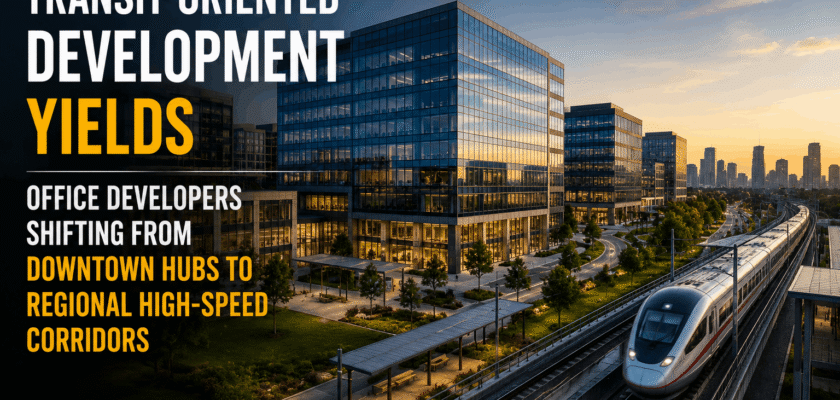
Transit-Oriented Development Yields: Why Office Location Strategy Is Changing
Transit-oriented development yields are becoming more important for corporate office developers in 2026. Earlier, most premium offices focused on downtown business districts. However, the new real estate map is changing because companies now want better connectivity, lower congestion, lower operating cost, and larger modern campuses.
This shift does not mean downtown hubs are finished. Instead, it means developers are now looking beyond traditional city centres. They are choosing regional corridors, metro-linked zones, expressway belts, airport areas, and future high-speed rail nodes.
As a result, transit access is becoming a key factor in office real estate value.
Why Transit-Oriented Development Yields Matter in 2026
Transit-oriented development yields matter because office demand no longer depends only on a central address. Today, companies want locations that help employees travel faster and help businesses operate smoothly.
A good office location must now offer:
- Fast road access
- Metro or rail connectivity
- Airport access
- Affordable housing nearby
- Food and retail support
- Flexible office space
- Lower commute stress
- Better parking and campus planning
- ESG-friendly design
- Strong digital infrastructure
Therefore, office developers are chasing corridors where transport and real estate growth move together.
What Is Transit-Oriented Development?
Transit-oriented development, or TOD, means building homes, offices, shops, public spaces, and services around strong public transport systems. The goal is simple: people should live, work, shop, and travel with less dependence on long private vehicle trips.
CBRE has described TOD as a model that can unlock development potential across asset classes, including commercial and industrial real estate. It also connects land use with transport planning, which helps cities grow in a more organized way.
In simple words, TOD creates value around movement.
Transit-Oriented Development Yields and Office Developers
Transit-oriented development yields attract office developers because better transport can increase demand, occupancy, rent potential, and long-term asset value.
If a business park sits near a metro station, expressway, airport, or rail corridor, companies may find it easier to hire and retain employees. Employees also prefer shorter and more predictable commutes.
Moreover, large office campuses need space. Downtown areas often have high land costs, traffic pressure, limited parking, and old buildings. On the other hand, corridor-based locations can offer larger land parcels and better planning.
This is why developers are moving toward smart suburban office parks.
Why Downtown Hubs Are Losing Some Advantage
Downtown business districts still carry brand value. They have banks, hotels, government offices, premium retail, and strong business history. However, they also face serious problems.
Common downtown challenges include:
- High rent
- Traffic congestion
- Limited parking
- Older buildings
- High redevelopment cost
- Long employee commute
- Limited expansion space
- Poor last-mile access in some areas
Because of this, many companies now ask whether a central address is worth the extra cost.
If a suburban corridor offers faster travel and lower cost, it becomes a strong alternative.
Infrastructure Real Estate Trends 2026: The Corridor Effect
Infrastructure real estate trends 2026 show a clear corridor effect. Roads, metro lines, airports, rapid rail, and high-speed rail plans are changing how developers choose land.
India’s Union Budget 2026–27 announced seven new high-speed rail corridors, signalling a wider push beyond the Mumbai–Ahmedabad corridor.
This matters because future mobility plans can influence long-term land value. When transport improves, nearby areas often become more attractive for offices, homes, hotels, warehousing, and retail.
Therefore, developers are not only looking at today’s traffic map. They are also studying tomorrow’s mobility map.
Smart Suburban Office Parks Are the New Growth Model
Smart suburban office parks are becoming popular because they can combine work, convenience, and better planning. These parks are usually built near highways, metro extensions, airport corridors, or emerging business districts.
A smart suburban office park may include:
- Grade A office towers
- Green open spaces
- Food courts
- Retail areas
- Co-working spaces
- EV charging
- Shuttle services
- Smart parking
- Fitness and wellness zones
- Better campus security
This model suits companies that need scale and employee-friendly infrastructure.
Why GCC Demand Supports Corridor-Based Offices
Global Capability Centers, or GCCs, are one of the strongest drivers of India’s office demand. CBRE reported that India’s office market reached record Q1 2026 performance, with GCC leasing hitting 9.1 million sq. ft. and total office absorption reaching 20.7 million sq. ft.
GCCs often need large, high-quality, tech-ready offices. Many also prefer areas where employees can reach the office from different parts of a city.
As a result, transit-linked suburban campuses can work well for GCC expansion.
Transit-Oriented Development Yields and Employee Commute
Transit-oriented development yields improve when employee commute becomes easier. In 2026, companies know that long travel time can hurt productivity, hiring, and staff satisfaction.
If an office is near a strong transit node, employees may spend less time in traffic. This can improve attendance, reduce stress, and support hybrid work planning.
Moreover, younger workers often prefer areas where housing, offices, cafes, gyms, and metro access exist together. This is why mixed-use corridor development is gaining value.
Why Housing Near Office Corridors Matters
Office corridors become stronger when housing grows nearby. Employees do not want to travel two hours every day. They prefer homes close to work, public transport, schools, and daily services.
Recent reports show young homebuyers in cities like Chennai are shifting toward suburban areas with better connectivity and proximity to IT corridors. This trend is linked with lower commute stress and better lifestyle choices.
When housing and offices grow together, the corridor becomes a stronger real estate market.
Examples of Corridor-Led Real Estate Growth
India already shows signs of corridor-led growth. In NCR, the Dwarka Expressway is changing New Gurugram’s real estate story and improving investor interest.
Similarly, Jewar Airport has increased attention toward nearby NCR and Haryana markets, including Faridabad and Greater Faridabad.
These examples show one clear pattern: when connectivity improves, real estate attention shifts.
How Developers Choose New Office Corridors
Developers do not choose corridors randomly. They study both current demand and future infrastructure.
Important factors include:
- Metro or rail planning
- Road and expressway access
- Airport distance
- Land availability
- Nearby housing demand
- Corporate tenant interest
- Local government policy
- Power and water supply
- Digital infrastructure
- Future rental growth
In addition, developers study whether the area can support food, retail, hotels, hospitals, and daily services.
What Tenants Want From Smart Office Corridors
Corporate tenants now want more than four walls and parking. They want a complete work ecosystem.
Tenants usually check:
- Employee commute time
- Building quality
- ESG standards
- Power backup
- Internet reliability
- Safety
- Nearby housing
- Cafes and retail
- Public transport access
- Expansion options
Therefore, smart suburban office parks must offer both business efficiency and employee comfort.
Risks in Transit-Oriented Development
Transit-oriented development yields can be attractive, but risks also exist. Not every corridor becomes successful.
Common risks include:
- Delayed infrastructure projects
- Poor last-mile connectivity
- Weak public transport frequency
- Water and sewage gaps
- Overpricing by developers
- Speculative land buying
- Low tenant demand
- Poor urban planning
- Traffic growth without transit use
So, investors and developers should not buy only because a corridor is “upcoming.” They should check actual execution.
Why Policy Support Matters
Policy support plays a major role in TOD success. Clear zoning, higher floor area ratio, mixed-use permissions, affordable housing, parking rules, and public-private coordination can improve outcomes.
CBRE notes that India’s national TOD policy and Smart Cities Mission guidelines promote integrated transport and sustainable urban planning.
When policy, transport, and private development work together, office corridors can grow faster and more sustainably.
What This Means for Real Estate Investors
For investors, corridor-based office markets can offer long-term opportunity. However, selection matters.
Before investing, check:
- Is the infrastructure already working or only promised?
- Are companies leasing nearby?
- Is residential demand growing?
- Are rents rising naturally?
- Is the developer credible?
- Is the area overhyped?
- Is last-mile travel easy?
- Are civic services strong?
A good corridor can create wealth. A weak corridor can trap money.
Final Verdict
Transit-oriented development yields are changing the office real estate strategy in 2026. Corporate office developers are no longer looking only at downtown hubs. They are also targeting high-speed corridors, expressway belts, metro-linked zones, airport districts, and smart suburban office parks.
This shift makes sense because companies need better connectivity, larger campuses, lower costs, and employee-friendly locations. At the same time, India’s infrastructure push and strong office demand are making corridor-based real estate more attractive.
In simple words, the future office may not sit in the oldest business district. It may rise near the fastest corridor.
For developers, tenants, and investors, the winning formula is clear: follow jobs, follow infrastructure, and follow real demand.


