


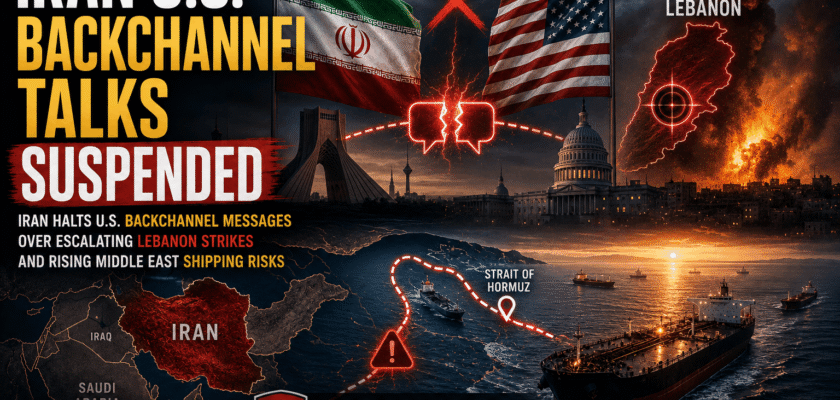
Iran U.S. Backchannel Talks Suspended: Why This Diplomatic Freeze Matters
Iran U.S. backchannel talks suspended became a major global politics development after Tehran signalled it would stop indirect message exchanges with Washington. The move came amid escalating Israeli military actions in Lebanon and rising tension around strategic oil routes.
This matters because backchannel talks are often the last quiet bridge during a crisis. When official relations are weak, indirect messages through mediators can help avoid miscalculation. If that channel freezes, both sides may lose an important safety valve.
Therefore, this is not only a diplomatic pause. It is a warning sign for the Middle East, energy markets, and global security.
Why Iran U.S. Backchannel Talks Suspended Became Big News
Iran U.S. backchannel talks suspended became big news because the region was already under pressure. Israel’s expanded operations in Lebanon, Iran’s anger over U.S. and Israeli actions, and threats around major maritime routes all came together at the same time.
Reuters reported that Iran’s Tasnim news agency said Tehran was stopping indirect message exchanges with the United States. The report linked the decision to Israeli military actions in Lebanon and warned of possible escalation around the Strait of Hormuz and Bab el-Mandeb.
This creates a bigger risk because diplomacy becomes harder when communication stops.
What Are Backchannel Talks?
Backchannel talks are unofficial or indirect communication channels between countries. They may happen through mediators, friendly governments, intelligence contacts, diplomats, or private envoys.
These talks are useful when public negotiations are politically difficult.
Backchannel talks can help countries:
- Share warnings
- Test proposals
- Avoid accidental escalation
- Exchange prisoner or asset ideas
- Discuss ceasefire terms
- Clarify red lines
- Reduce public pressure
- Keep diplomacy alive during conflict
So, when such talks stop, the crisis becomes more dangerous.
Iran U.S. Backchannel Talks Suspended Over Lebanon Strikes
Iran U.S. backchannel talks suspended because Tehran linked the diplomatic freeze to Israeli actions in Lebanon. Iran sees Israeli operations in Lebanon as part of the wider regional conflict and has blamed both Israel and the United States for the worsening situation.
Reuters also reported that Iran accused contradictory U.S. positions and Israeli attacks in Lebanon of delaying diplomacy. Iranian Foreign Ministry spokesperson Esmaeil Baghaei said talks were strained by deep mistrust and inconsistent U.S. demands.
This shows that Iran is not treating Lebanon as a separate issue. It is tying Lebanon directly to the wider U.S.-Iran negotiation track.
Why Lebanon Has Become Central to the Talks
Lebanon has become central because it is part of the wider regional conflict map. Israeli strikes and incursions against Hezbollah-linked areas can trigger a response from Iran-backed groups and create more pressure on Tehran.
Iran’s position is simple: if fighting continues in Lebanon, diplomacy with Washington becomes harder.
For Washington, the challenge is different. The U.S. may want to keep nuclear, sanctions, and shipping talks separate from every regional battlefield. However, Iran is linking these fronts together.
That difference makes the talks more complex.
Strategic Diplomatic Freeze: What It Means
A strategic diplomatic freeze means one side pauses communication to increase pressure. It can be a negotiation tactic, a political signal, or a real breakdown.
In this case, Iran may want to show that it will not continue quiet talks while Israeli operations continue in Lebanon.
This sends a message to Washington: pressure on Iran’s allies will affect the negotiation channel.
However, this strategy also carries risk. If communication stops completely, both sides may misread each other’s actions.
Why the Strait of Hormuz Risk Matters
The Strait of Hormuz is one of the world’s most important oil transit routes. Any threat to block or disrupt it can affect global energy prices quickly.
Reuters reported that Iran and allied groups have threatened to fully block the Strait of Hormuz and possibly activate other strategic points like Bab el-Mandeb.
This matters because oil and gas supply fears can spread from the Middle East to global markets within hours.
So, the diplomatic freeze has an economic impact too.
Bab el-Mandeb Adds Another Risk Layer
Bab el-Mandeb is another important maritime chokepoint. It connects the Red Sea with the Gulf of Aden and supports trade routes between Asia, Europe, and the Middle East.
If both Hormuz and Bab el-Mandeb become risky, shipping companies may face higher insurance costs, longer routes, and supply chain delays.
This can affect:
- Oil prices
- Gas shipments
- Container trade
- Shipping insurance
- Import costs
- Food and commodity supply
- Inflation pressure
- Global market confidence
Therefore, this crisis is not limited to diplomacy.
Why Oil Markets React Fast
Oil markets react fast because traders price risk before actual supply stops. Even a threat to shipping routes can push prices higher.
Earlier reports showed oil rising sharply as traders reacted to Israel’s Lebanon operations and Iran-related risk. When backchannel talks freeze, the market may add more geopolitical premium.
This premium can rise or fall depending on the next headline.
If talks resume, oil may cool. If strikes expand, oil may rise further.
This is why investors and governments watch diplomacy closely.
What Iran Wants From Washington
Iran’s demands are not limited to one issue. Reports have linked Tehran’s position with sanctions relief, frozen assets, security guarantees, and a halt to Israeli operations in Gaza and Lebanon.
Iran also wants recognition of its rights in any agreement.
From Tehran’s view, continuing talks while Israeli strikes intensify may look like weakness. So, pausing messages helps Iran show firmness to both domestic audiences and regional allies.
However, this also makes compromise harder.
What Washington Wants From Iran
Washington likely wants limits on escalation, protection of shipping lanes, nuclear-related commitments, and stability for regional allies.
The U.S. also wants to avoid a wider war while keeping pressure on Iran.
That creates a difficult balance. If Washington applies pressure, Iran may halt talks. If Washington offers relief too early, critics may call it weak.
This is why backchannel diplomacy matters. It lets both sides explore options privately before making public commitments.
Why Contradictory Signals Hurt Diplomacy
Iran has accused the U.S. of giving contradictory signals. Reuters reported that Iran said inconsistent American positions and Israeli attacks on Lebanon were delaying diplomacy.
Contradictory signals can hurt talks because negotiators need clarity.
If one U.S. official pushes a softer diplomatic line while another supports military pressure, Iran may question which message is real. Similarly, if Iran talks through mediators while allied groups threaten shipping routes, Washington may question Iran’s intent.
Diplomacy needs pressure, but it also needs predictable signals.
Why This Is Dangerous for Ceasefire Efforts
Ceasefire efforts depend on communication. If backchannel talks stop, there are fewer ways to manage violations, clarify conditions, and stop retaliation cycles.
A ceasefire is not only a signed paper. It needs constant monitoring and quick crisis communication.
Without that communication, one strike can trigger another. One statement can be misread. One proxy action can create a larger response.
That is why the diplomatic freeze is worrying.
The Role of Mediators
Mediators play a key role when countries cannot speak directly. They carry messages, test wording, reduce misunderstanding, and help both sides save face.
In U.S.-Iran diplomacy, mediators are often important because direct trust is low.
If Iran stops using mediators for message exchange, the diplomatic space becomes narrower.
However, this does not always mean talks are permanently over. Sometimes countries pause messages to create pressure and then restart communication later.
What Could Bring Talks Back?
Talks may resume if one or more conditions change.
Possible triggers include:
- Lebanon strikes reduce
- A temporary ceasefire expands
- Mediators offer new wording
- U.S. clarifies its position
- Iran receives stronger guarantees
- Shipping route risk is reduced
- Regional allies push for de-escalation
- Oil market pressure becomes too high
- Humanitarian concerns increase
- Both sides need a face-saving exit
Diplomacy often returns when the cost of silence becomes too high.
What Could Make the Crisis Worse?
The crisis could worsen if military actions expand or communication remains frozen.
Possible escalation triggers include:
- More Israeli strikes in Lebanon
- Hezbollah retaliation
- Iranian-backed group attacks
- U.S. strikes on Iranian assets
- Hormuz blockade threat increases
- Bab el-Mandeb disruption
- Oil tanker incident
- Civilian casualty surge
- Failed mediator attempt
- Public hardline statements
These events can make talks harder to restart.
Why Global Powers Are Watching Closely
Global powers are watching because Middle East instability affects energy, trade, migration, defence planning, and inflation.
Europe watches because of energy and security risk. India watches because of oil imports and diaspora safety. China watches because of trade routes and energy flows. Gulf countries watch because regional conflict can hit their security directly.
So, the Iran-U.S. diplomatic freeze has global consequences.
What It Means for India
India has strong reasons to monitor this crisis. India imports a large share of its crude oil needs, and any disruption near Hormuz can affect fuel planning and inflation.
The crisis can also affect Indian workers in the Gulf, shipping costs, airline routes, and commodity prices.
For India, stable diplomacy is better than military escalation.
Therefore, New Delhi will likely watch both oil markets and diplomatic signals closely.
What Businesses Should Watch
Businesses should watch this crisis because supply chains can be affected quickly.
Important signals include:
- Oil price movement
- Shipping insurance rates
- Hormuz updates
- Bab el-Mandeb alerts
- U.S.-Iran statements
- Lebanon military developments
- Israel-Hezbollah escalation
- Currency market movement
- Import cost changes
- Government advisories
Companies in aviation, logistics, chemicals, energy, paints, and manufacturing should be especially careful.
What Investors Should Watch
Investors should track geopolitical risk without panic. A diplomatic freeze can move oil, gold, defence stocks, shipping stocks, airlines, and currency markets.
Key watch points include:
- Brent crude
- Gold prices
- Dollar index
- Rupee movement
- Energy stocks
- Airline stocks
- Shipping rates
- Defence sector moves
- Inflation expectations
- Central bank commentary
Market reaction can change quickly if talks resume.
Why Social Media Can Make Panic Worse
Social media can make crisis news look more dramatic than official updates. During conflicts, fake videos, old photos, exaggerated claims, and unverified reports spread fast.
Readers should check trusted sources before reacting.
Avoid relying only on:
- Viral clips
- Anonymous Telegram channels
- Unverified X posts
- Edited war footage
- Old videos shown as new
- Fake oil price screenshots
- Political propaganda pages
In a crisis, verified information matters.
What to Expect Next
The next phase depends on whether Iran’s pause becomes permanent or tactical.
Watch for:
- Mediator statements
- Iran’s foreign ministry updates
- U.S. State Department response
- Israeli military activity in Lebanon
- Hezbollah response
- Hormuz shipping alerts
- Oil market movement
- Gulf security statements
- UN or regional diplomatic efforts
- Any sign of message exchange restarting
If backchannel messages restart, markets may calm. If they remain frozen, risk may rise.
Final Verdict
Iran U.S. backchannel talks suspended is a serious development because it removes one of the quiet communication bridges during a tense regional crisis. Iran’s decision to halt indirect message exchanges reflects anger over escalating Lebanon strikes and deep mistrust toward Washington.
The risk is bigger than one diplomatic channel. It affects ceasefire hopes, oil routes, maritime security, global inflation, and regional stability.
However, suspension does not always mean permanent collapse. Backchannels can restart if mediators find a face-saving path and if military escalation slows.
In simple words, when talks stop, risk starts speaking louder. The world will now watch whether diplomacy returns before the crisis spreads further.


