


CBSE Cyberattack 2026: Why the Portal Attack Became National News
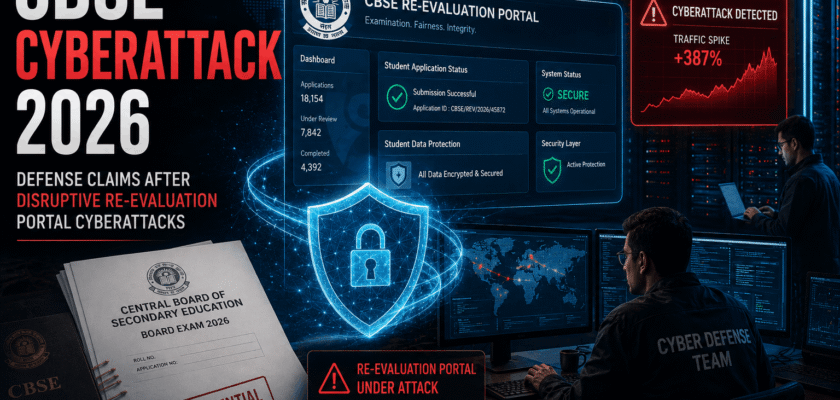
CBSE cyberattack 2026 became a major education and cybersecurity story after the board said its Class 12 re-evaluation and verification portal faced multiple attack attempts on the day it opened for students. The portal reportedly saw a huge burst of traffic, unauthorised access attempts, and a possible denial-of-service style disruption attempt.
This matters because board exam portals are not normal websites. They handle student data, marks, answer book verification requests, payment flow, and academic grievance systems. If such a portal fails during a short application window, students can face serious stress.
Therefore, the CBSE portal incident is not only a technical issue. It is a trust issue for India’s digital education infrastructure.
Why CBSE Cyberattack 2026 Matters
CBSE cyberattack 2026 matters because students depend on digital portals for post-result services. Class 12 students applying for verification of marks, scanned answer book review, and re-evaluation need stable access during fixed deadlines.
Reports said the portal received 1.5 million hits within two minutes and more than 1 lakh unauthorised access attempts after going live. CBSE said the portal continued to function and thousands of students submitted applications.
This shows two things clearly.
First, education portals are becoming high-value digital targets.
Second, public exam systems need cybersecurity planning at the same level as banking and government service platforms.
What Happened to the CBSE Re-Evaluation Portal?
The CBSE re-evaluation portal opened for Class 12 post-result services, including verification and re-evaluation applications. Soon after launch, the board said the platform faced multiple cyberattack attempts.
Economic Times reported that the portal withstood a cyberattack that generated about 1.5 million hits in two minutes, while around 16,000 students managed to apply.
Indian Express also reported that CBSE said the portal was supporting more than 8,000 concurrent users and that over 16,000 submissions were completed by 3 PM.
In simple words, attackers tried to disrupt access, but the board claimed the service remained operational.
CBSE Cyberattack 2026 and DoS-Style Traffic Flooding
CBSE cyberattack 2026 appears to include a DoS-style attempt. DoS means Denial of Service. In this type of attack, a website or portal is flooded with huge traffic so genuine users face delays or failure.
For students, this can look like:
- Portal not opening
- Payment page failing
- Slow login
- Error messages
- Session timeout
- Application form not submitting
- Uploaded documents not loading
- Multiple refresh attempts
- Confusion over deadline
- Fear of missing re-evaluation window
Even if no data is stolen, a DoS attack can still damage user trust.
That is why service continuity matters.
Board Portals Under Barrage: Why Education Systems Are Targeted
Board portals are attractive targets because they handle sensitive academic data and high public pressure. A small disruption can create big headlines.
Attackers may target education portals to:
- Disrupt services
- Create panic
- Test vulnerabilities
- Attempt unauthorised access
- Expose weak authentication
- Manipulate public trust
- Cause payment confusion
- Steal student data
- Spread misinformation
- Damage institution reputation
This is why digital education platforms need strong security before launch, not after controversy.
CBSE’s Defense Claim: Portal Stayed Active
CBSE’s main defense claim is that the portal stayed active despite attack attempts. According to reports, the portal continued supporting thousands of users, and over 16,000 students submitted applications successfully.
This is important because cybersecurity is not only about blocking attacks. It is also about keeping services available during attacks.
A strong portal should survive traffic spikes, filter malicious requests, protect payment flows, and preserve genuine user access.
If CBSE’s claim holds, the portal showed some level of operational resilience.
The Earlier OSM Portal Hacking Claim
Before the re-evaluation portal attack report, CBSE also faced claims that its On Screen Marking, or OSM, portal had been hacked. CBSE later clarified that the actual evaluation portal was not hacked.
Times of India reported that CBSE said the alleged hacking involved a testing website with sample data, not the real evaluation portal used for Class 12 answer book evaluation. The board said the actual OSM portal had a different secure URL and no breach was reported there.
This clarification matters because public confusion between a test portal and an actual evaluation portal can create unnecessary panic.
Why the OSM Clarification Was Important
The OSM clarification was important because board evaluation integrity is extremely sensitive. If students believe the actual evaluation system was compromised, trust in marks, answer books, and re-evaluation can fall quickly.
CBSE’s position was that:
- Actual evaluation portal was not hacked
- Alleged issue involved testing/sample data
- Real OSM portal used a different secure URL
- No security breach was reported on the actual evaluation portal
- Safeguards were in place
However, the controversy shows why boards must communicate clearly and quickly.
Silence creates rumours. Clear updates reduce panic.
Verification and Re-Evaluation Window: Why Timing Matters
The timing of the portal matters because students get only a limited window for post-result services. Economic Times reported that CBSE opened the Class 12 re-evaluation and answer book verification window from June 2 to June 6, 2026.
A short window increases pressure.
Students may fear that technical issues will stop them from applying on time. Parents may panic. Schools may receive repeated calls. Social media may amplify every error.
That is why portal stability is especially important during time-bound academic processes.
Payment Gateway Issues and Student Anxiety
Before the June 2 portal update, there were reports of earlier payment-related issues and abnormal fee displays. Telangana Today reported that a malicious attack on the CBSE revaluation portal’s payment system affected around 50 students and caused abnormal fee displays ranging from ₹1 to nearly ₹68,000.
Such problems can scare students because payment confirmation is part of the application process.
If the fee page behaves strangely, students may wonder:
- Did my application submit?
- Did payment fail?
- Will I get a refund?
- Is my account safe?
- Should I try again?
- Did someone access my data?
- Will deadline be extended?
This is why payment security and clear receipts matter.
Why Cybersecurity Reviews Delayed the Portal
Moneycontrol reported that CBSE activated the Class 12 verification and re-evaluation portal after delays linked to technical issues and cybersecurity checks.
This shows that the board was already under pressure before the latest attack attempt.
In high-stakes education portals, a delay can frustrate students. But launching a weak portal can create a bigger crisis.
The correct approach should be security-first, but communication must be clear. Students need to know what changed, why it changed, and how deadlines are protected.
What Students Should Do During Portal Cyber Issues
Students should stay calm and use only official channels.
Follow these steps:
- Use only official CBSE links
- Avoid unknown Telegram or WhatsApp links
- Do not share login details
- Keep payment proof
- Take screenshots of submission
- Save application number
- Avoid repeated payment without confirmation
- Check official notices daily
- Contact school or CBSE helpdesk if stuck
- Avoid believing viral screenshots blindly
During cyber incidents, fake links often spread faster than official updates.
Why Unauthorised Access Attempts Are Serious
Unauthorised access attempts are serious because they may target student data, portal files, application flow, or backend systems. Even if attackers fail, the volume of attempts shows intent.
Reports said more than 1 lakh attempts for unauthorised access were identified during the portal attack wave.
For an education board, protecting student data is critical.
Student data may include:
- Name
- Roll number
- School details
- Subject data
- Marks
- Payment details
- Scanned answer book access
- Contact information
- Application status
- Grievance records
This data must stay protected.
Cyber Defense Under Fire: What a Strong Portal Needs
Cyber defense under fire means a portal must keep working even when attacked. A strong re-evaluation portal needs multiple security layers.
Important layers include:
- Web application firewall
- DDoS protection
- Rate limiting
- Bot detection
- Multi-factor admin access
- Secure payment integration
- Encrypted data storage
- Access logs
- Real-time monitoring
- Backup infrastructure
These systems help separate genuine students from malicious traffic.
Why Load Testing Is Essential
Load testing checks whether a portal can handle high traffic. Education portals often face sudden traffic spikes when forms open, results are declared, or deadlines approach.
A proper load test should simulate:
- Normal student login
- Peak-hour traffic
- Payment flow
- Document upload
- Multiple device usage
- Slow internet users
- Concurrent submissions
- Bot-style traffic
- Retry attempts
- Deadline-day rush
If a portal fails load testing, it may fail students during real use.
Why Rate Limiting Helps
Rate limiting helps stop attackers from sending too many requests too quickly. For example, if one source sends thousands of hits in a short time, the system can slow or block it.
This protects genuine users.
A student may refresh a page a few times. An attacker may send thousands of requests per minute. The portal should know the difference.
Rate limiting is simple in idea, but very powerful in practice.
Why Bot Detection Matters
Bot detection matters because many cyberattacks use automated tools. Bots can flood forms, test login pages, scrape data, or overload servers.
A board portal should detect:
- Unusual traffic patterns
- Repeated failed logins
- Suspicious IP activity
- Abnormal file access attempts
- Automated form submissions
- High-speed requests
- Fake user agents
- Scraping attempts
- Payment abuse
- API misuse
Bot detection can reduce damage before it becomes a crisis.
Why Payment Security Is Critical
Payment security is critical because students pay fees for verification and re-evaluation services. If payment flow fails, students may lose money or miss deadlines.
A secure payment system should provide:
- Clear fee display
- Confirmation receipt
- Payment status tracking
- Refund process
- No duplicate payment confusion
- Secure gateway integration
- Error handling
- Transaction audit logs
- Helpdesk support
- Fast dispute resolution
Payment confusion creates panic faster than normal page errors.
Why Communication Matters During Cyber Incidents
Communication is as important as technical defense. If users do not know what is happening, they assume the worst.
CBSE and similar boards should communicate:
- Whether portal is working
- Whether student data is safe
- Whether payment flow is safe
- What students should do if stuck
- Whether deadline is extended
- Which links are official
- What rumours are false
- How to contact support
- What documents are needed
- When next update will come
Clear communication reduces misinformation.
Role of Schools During Portal Disruption
Schools also play a role because many students ask their schools for help during post-result processes.
Schools should:
- Share only official CBSE notices
- Help students understand deadlines
- Avoid forwarding rumours
- Guide students on documents
- Help with payment proof issues
- Keep parents calm
- Report repeated portal problems
- Encourage students to apply early
- Verify official circulars
- Maintain student support records
A calm school response can reduce student anxiety.
Why Students Should Apply Early
Students should not wait until the last day. Cyberattacks, server load, payment issues, or internet problems can happen anytime.
Applying early gives time to fix problems.
Students should:
- Fill forms in daytime if possible
- Use stable internet
- Keep documents ready
- Avoid last-hour payment
- Save receipts
- Check application status
- Download confirmation
- Keep screenshots
- Use official device/browser
- Avoid cyber café risks if possible
Early action reduces deadline stress.
Education Cybersecurity Is Now a National Issue
Education cybersecurity is now a national issue because schools, boards, universities, and exam agencies are moving many services online.
Digital education systems now handle:
- Board results
- Entrance exams
- Admit cards
- Answer book access
- Re-evaluation
- Payment
- Counselling
- Scholarships
- Student identity
- Academic records
If these systems are weak, students suffer.
Therefore, cybersecurity must become part of education governance, not only IT support.
What Government Agencies Should Learn
Government agencies should learn that education platforms need stronger pre-launch security audits. A portal used by lakhs of students should not depend only on emergency fixes.
Important lessons include:
- Test before launch
- Audit payment gateway
- Prepare DDoS protection
- Create backup access plan
- Publish official FAQs
- Train helpdesk teams
- Monitor social media rumours
- Create incident response team
- Keep logs for investigation
- Communicate transparently
Students deserve stable digital services.
What Parents Should Know
Parents should avoid panic during portal issues. They should help students follow official instructions and avoid risky links.
Parents should:
- Check official CBSE website
- Keep payment proof
- Avoid repeated transactions
- Avoid fake agents
- Help students apply early
- Avoid social media rumours
- Contact school for guidance
- Keep calm if portal slows
- Save all documents
- Track deadline updates
A calm parent can help the student make better decisions.
How Misinformation Spreads During Cyber Incidents
Misinformation spreads quickly when a portal has issues. People share screenshots, voice notes, and claims without checking facts.
During the CBSE portal controversy, claims about hacking, payment problems, and OSM portal access spread widely. CBSE later clarified that the actual evaluation portal was not hacked.
This shows why official verification matters.
Before sharing any claim, ask:
- Is the source official?
- Is the screenshot recent?
- Is the URL correct?
- Has CBSE confirmed it?
- Is it from a trusted news outlet?
- Could it be a test portal?
- Could it be old information?
Responsible sharing protects students.
What a Better Re-Evaluation Portal Should Offer
A better re-evaluation portal should be simple, secure, and transparent.
It should offer:
- Clear login flow
- Stable dashboard
- Strong server capacity
- Payment status tracker
- Application status tracker
- Downloadable receipt
- Secure document upload
- Query support
- Deadline reminders
- Official alerts inside portal
This helps students trust the system.
A good portal should feel boring and reliable, not dramatic.
Future of Board Portal Security
The future of board portal security will likely include stronger cloud protection, AI-based traffic monitoring, real-time bot detection, better payment safeguards, and clearer incident response.
Future systems may use:
- DDoS mitigation
- AI anomaly detection
- Zero-trust access
- Secure APIs
- Encrypted records
- Role-based access
- Regular bug bounty programs
- Third-party security audits
- Disaster recovery systems
- Public transparency reports
Education technology must become safer as it becomes more central to student life.
Final Verdict
CBSE cyberattack 2026 shows that India’s education portals are now critical digital infrastructure. The Class 12 re-evaluation portal reportedly faced massive traffic hits, unauthorised access attempts, and DoS-style pressure, but CBSE said the portal stayed operational and students were able to submit applications.
The incident also shows why communication, payment security, load testing, bot detection, and public trust matter. CBSE’s earlier clarification that the actual OSM evaluation portal was not hacked was important, but the wider concern remains clear: digital exam systems need stronger cybersecurity by design.
In simple words, board portals are now under barrage. The response must be stronger portals, faster communication, and safer student services.


