
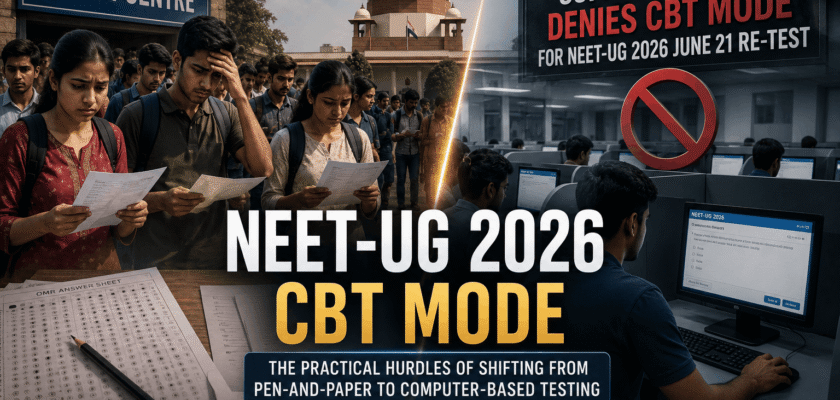
NEET-UG 2026 CBT Mode: Why the Court Decision Matters
NEET-UG 2026 CBT mode became a major national debate after students and petitioners asked the Supreme Court to conduct the June 21 re-test in computer-based format. However, the Supreme Court refused urgent relief and did not direct an immediate shift from pen-and-paper mode to CBT.
This decision means the NEET-UG 2026 re-test scheduled for June 21 will continue in offline mode. For lakhs of medical aspirants, this brings clarity, but it also raises a difficult question: why is India not shifting NEET to CBT immediately?
The answer is practical. A national exam of this size needs infrastructure, computer labs, cybersecurity, accessibility planning, city-wise capacity, and clear backup systems.
Why NEET-UG 2026 CBT Mode Became a Big Demand
NEET-UG 2026 CBT mode became a big demand after concerns over exam integrity and paper leak allegations. Many students, parents, and education observers believe computer-based testing can reduce paper handling risk.
In a CBT system, question papers do not need to move physically across many centres in the same way. The system can also use encrypted question delivery, candidate login control, camera monitoring, and digital audit trails.
Therefore, CBT looks more secure on paper.
However, security is only one part of the exam system. The bigger challenge is whether India can run such a large medical entrance exam in CBT mode without creating new problems.
What Supreme Court Said on CBT Mode Plea
The Supreme Court refused to urgently hear or accept the plea seeking a computer-based NEET-UG 2026 re-test. Reports say the court did not find enough urgency to change the exam mode at this stage.
The court’s approach suggests that changing the format just days before a national re-test can create more confusion. The June 21 exam already has a fixed schedule. A sudden move to CBT would need centre changes, student allocation changes, technical checks, and new instructions.
So, the court did not order an immediate format shift.
June 21 NEET-UG Re-Test: What Candidates Should Know
The June 21 NEET-UG re-test will be held in the existing pen-and-paper format. Candidates should not prepare for a keyboard-based exam unless NTA gives a new official update.
Students should focus on:
- Admit card updates
- Exam centre instructions
- Reporting time
- Allowed documents
- OMR sheet practice
- Time management
- Heatwave precautions
- Official NTA notices
- Transport planning
- Mental calm before exam
Union Education Minister Dharmendra Pradhan also urged states and local authorities to ensure candidate wellbeing amid heat conditions, including water, fans, washrooms, shaded waiting areas, electricity, and transport support.
Why Sudden CBT Shift Is Difficult
A sudden CBT shift is difficult because NEET-UG is one of India’s largest entrance exams. It covers candidates from metros, towns, rural areas, and remote districts.
To conduct NEET-UG 2026 CBT mode immediately, authorities would need:
- Enough computer centres
- Stable internet or secure offline server systems
- Power backup
- Trained invigilators
- Cybersecurity testing
- Candidate login systems
- Biometric verification
- Emergency technical support
- Question encryption
- Multiple shifts or very large capacity
Doing this properly takes planning.
If the system is rushed, students may face login failure, server delay, power cuts, system freezing, or unfair centre conditions.
NEET-UG 2026 CBT Mode and Accessibility Problems
NEET-UG 2026 CBT mode also creates accessibility challenges. Not every student is equally comfortable with computers. Some students from rural areas may have less exposure to computer-based exams.
This does not mean CBT should never happen. It means the transition should be planned with fairness.
A good CBT transition needs:
- Practice mock tests
- Clear interface demo
- Regional language support
- Accessible centres
- Extra support for PwD candidates
- Keyboard and mouse familiarity
- Rural centre expansion
- Helpdesk support
- Demo videos
- Transparent exam-day process
Without these steps, CBT may reduce one kind of unfairness but create another.
Why Pen-and-Paper Mode Still Continues
Pen-and-paper mode continues because it is familiar, scalable, and easier to conduct across thousands of centres. Students know OMR marking. Schools and exam centres already understand the format.
However, pen-and-paper mode also has risks. Physical question papers need printing, transport, storage, and secure handling. Any weakness in this chain can create leak concerns.
That is why the June 21 re-test will need stronger security than usual.
The issue is not simply paper vs computer. The issue is secure, fair, and manageable exam delivery.
NTA Strengthened SOP for June 21 Exam
NTA has told the Supreme Court that the June 21 re-examination will be conducted under a strengthened SOP framework. This includes multi-layer authentication, surveillance, and inter-agency coordination.
This matters because the immediate goal is to conduct the re-test safely in the current format.
Strengthened SOP may include better question paper movement, stronger centre monitoring, tighter verification, and improved coordination between agencies.
Students should follow official instructions carefully and avoid rumours.
Question Paper Security: What May Change
Reports also say the government is considering stronger transport and storage measures for NEET papers, including possible involvement of the Indian Air Force and secure storage sites beyond traditional bank premises.
This shows that authorities are trying to reduce paper movement risk.
Possible security steps may include:
- Secure paper transport
- Multi-agency monitoring
- Stronger sealed packet checks
- CCTV surveillance
- Better storage rooms
- Limited access points
- Centre-level audit trails
- Strong invigilator control
- Fast reporting systems
- Emergency response teams
These steps can help protect the pen-and-paper exam.
Why CBT From 2027 Looks More Practical
A shift to CBT from 2027 looks more practical because it gives authorities time to prepare. NDTV reported that NTA has indicated NEET-UG will move to computer-based mode from 2027, while the June 21, 2026 re-exam will follow a strengthened SOP framework.
One year of preparation can help NTA build better capacity.
It can also give students time to practice CBT mock tests. This is important because exam mode should not surprise students at the last moment.
A planned transition is better than a rushed transition.
NEET-UG 2026 CBT Mode: Student Anxiety Is Real
NEET-UG 2026 CBT mode debate has increased anxiety among students. Many candidates are already under pressure because of the re-test, legal updates, paper leak concerns, and June 21 timeline.
When exam mode confusion adds to this pressure, preparation suffers.
Therefore, students need clear communication from authorities. They should know the exam format, reporting rules, security checks, and result timeline.
Aspirants should not keep changing strategy based on viral posts. The official format remains pen-and-paper unless NTA announces otherwise.
What Students Should Do Now
Students should focus on controllable things. The court decision means preparation should continue for OMR-based testing.
Useful steps include:
- Practice full-length OMR tests
- Improve bubbling accuracy
- Revise NCERT high-weightage topics
- Track time per section
- Avoid last-minute rumours
- Sleep properly before exam
- Keep documents ready
- Check centre route early
- Carry permitted items only
- Stay calm during security checks
This is not the time to panic. It is the time to prepare with discipline.
Why OMR Practice Still Matters
OMR mistakes can cost marks. In pen-and-paper NEET, students must mark answers carefully.
Common OMR mistakes include:
- Wrong bubble filling
- Light marking
- Double marking
- Skipping question alignment
- Wrong roll number filling
- Panic bubbling at the end
- Poor time management
- Misreading question number
Since June 21 exam will continue offline, OMR practice remains essential.
Students should practice bubbling while solving mock papers, not only after solving.
Practical Hurdles Facing the June 21 Exam
The June 21 exam faces several practical hurdles. These include student anxiety, heat conditions, paper security concerns, centre management, transport, crowd control, and invigilation quality.
Authorities must manage:
- Safe question paper delivery
- Strong centre surveillance
- Candidate verification
- Proper seating plan
- Heatwave support
- Drinking water availability
- Clean washrooms
- Power supply
- Crowd control outside centres
- Fast grievance reporting
If these areas work well, student confidence can improve.
Why Heatwave Planning Is Important
June exams can become difficult because of heat. Many students travel long distances, wait outside centres, and sit in crowded classrooms.
Education Minister Dharmendra Pradhan has asked states to ensure student wellbeing during the NEET re-exam, especially amid severe heat in some regions.
Exam centres should provide:
- Drinking water
- Functional fans
- Shaded waiting areas
- Clean washrooms
- Uninterrupted electricity
- Medical support
- Transport coordination
- Crowd control
A fair exam also means a safe exam environment.
Why Parents Should Avoid Panic
Parents play an important role before a high-pressure exam. If parents panic over legal updates or social media rumours, students feel more stressed.
Parents should help with practical support:
- Check official notices
- Arrange transport
- Keep documents ready
- Encourage sleep
- Avoid comparison
- Provide light food
- Avoid over-discussion of court news
- Keep the student calm
A calm home environment can improve exam performance.
Should NEET Move to CBT in Future?
Yes, NEET can move to CBT in the future if infrastructure is ready. Many major exams already use CBT. It can reduce paper transport risk and create better digital audit systems.
However, NEET is unique because of scale, rural participation, and language diversity.
A successful CBT transition should include:
- Large centre network
- Rural computer access
- Mock test practice
- Secure software
- Reliable power backup
- Multi-shift fairness plan
- Transparent normalization policy
- Candidate support system
- Cybersecurity audit
- Accessibility support
CBT should improve fairness, not create new inequality.
Final Verdict
NEET-UG 2026 CBT mode plea has been denied for the June 21 re-test, which means candidates should prepare for the existing pen-and-paper format. The Supreme Court did not order an urgent format change, likely because a sudden CBT shift can create serious logistical and fairness problems.
However, the debate is not over. NEET may move toward CBT from 2027 if authorities build the right infrastructure, cybersecurity, accessibility, and student practice systems.
For now, students should focus on OMR practice, NCERT revision, official updates, and exam-day discipline.
In simple words, the June 21 exam is not a keyboard test. It is still a pen-and-paper battle, and students should prepare accordingly.


