


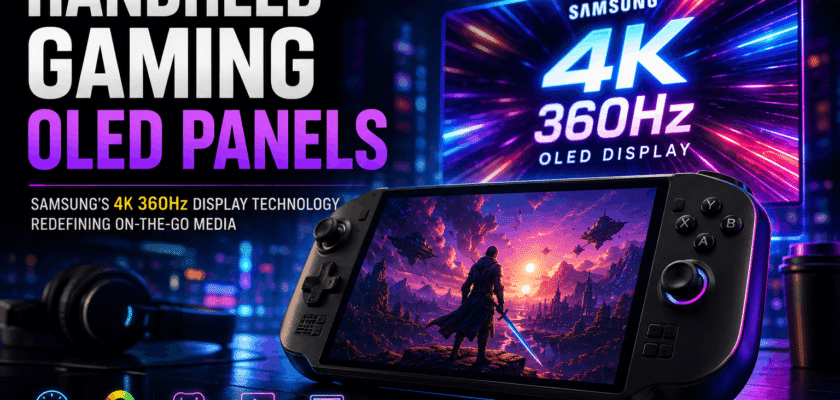
Handheld Gaming OLED Panels: Why Portable Entertainment Is Changing
Handheld gaming OLED panels are becoming a major entertainment trend because people no longer want gaming and media to stay locked to large TVs or desktop monitors. Portable gaming PCs, cloud gaming devices, handheld consoles, and compact media devices are making high-quality screens more important than ever.
Samsung Display’s Computex 2026 gaming lineup shows this shift clearly. The company is showcasing OLED and QD-OLED products for multiple gaming categories, including small OLED panels for handheld gaming PCs and high-end QD-OLED monitor panels for premium setups.
Therefore, portable immersion tech is moving from basic mobility to cinema-like visuals in the user’s hand.
Why Handheld Gaming OLED Panels Matter in 2026
Handheld gaming OLED panels matter because entertainment habits are changing. Users now watch movies, stream shows, play AAA games, follow esports, and consume short videos on portable devices.
Earlier, handheld gaming meant compromise. Smaller screens often had weaker colours, lower contrast, slower response, and lower refresh rates. Now, OLED is changing that.
OLED panels can offer:
- Better contrast
- Deeper blacks
- Faster response
- Richer colours
- Better HDR feel
- Slimmer device design
- Lower motion blur
- Stronger visual immersion
As a result, handheld gaming devices can feel more premium and more cinematic.
What Samsung Display Announced at Computex 2026
Samsung Display announced a full gaming display lineup for Computex 2026. The company said it will showcase 16 OLED and QD-OLED products designed for gaming, ranging from 8.8-inch OLED panels for handheld gaming PCs to 49-inch QD-OLED panels for monitors.
This is important because Samsung is not focusing only on desktop monitors. It is also targeting the fast-growing handheld gaming market.
A small 8.8-inch OLED panel can become useful for premium portable consoles and handheld PCs where screen quality directly affects the gaming experience.
Handheld Gaming OLED Panels and Portable Immersion Tech
Handheld gaming OLED panels are the foundation of portable immersion tech. A powerful processor matters, but the screen is what the user sees every second.
A better display can make games feel more alive.
For example:
- Dark scenes look deeper
- Neon lights look brighter
- Fast movement looks cleaner
- Character detail looks sharper
- Cinematic cutscenes feel richer
- HDR content looks more dramatic
- Racing and action games feel smoother
This is why display quality is becoming a key selling point for handheld gaming devices.
Why OLED Works Well for Handheld Gaming
OLED works well for handheld gaming because every pixel can light itself. This means black areas can become truly dark instead of grey.
That makes games, movies, and anime look more dramatic.
OLED also has very fast pixel response. This reduces ghosting and blur during fast gameplay.
For handheld users, this matters because the screen sits close to the eyes. Any blur, weak contrast, or colour dullness becomes easy to notice.
Therefore, OLED is a natural fit for premium portable media devices.
Samsung’s 4K 360Hz QD-OLED Breakthrough
Samsung Display also developed the world’s first QD-OLED monitor panel that combines 4K resolution with a 360Hz refresh rate. The company said it achieved this through optimized panel circuitry.
This panel is for larger gaming monitors, not handheld devices. However, it still matters for portable entertainment because display innovation often moves across product categories over time.
Today, the 4K 360Hz breakthrough is a premium monitor story. Tomorrow, the same display engineering can influence laptops, handhelds, and compact gaming screens.
Why 4K 360Hz Matters for Gaming
4K 360Hz matters because it combines two things gamers usually want separately: sharp resolution and ultra-fast refresh rate.
4K gives sharper image detail.
360Hz gives smoother motion.
Earlier, many gamers had to choose between high resolution or high refresh rate. Samsung’s new QD-OLED panel shows that this trade-off is shrinking.
For competitive players, smoother motion can help response. For immersive players, 4K detail improves visual quality.
Together, these features push gaming displays into a new level.
Handheld Gaming OLED Panels vs Large QD-OLED Monitors
Handheld gaming OLED panels and large QD-OLED monitors serve different users, but both are part of the same entertainment shift.
| Feature | Handheld OLED Panels | 4K 360Hz QD-OLED Monitors |
|---|---|---|
| Main use | Portable gaming | Desktop gaming |
| Screen size | Small, mobile-friendly | Large, immersive |
| Key benefit | On-the-go media | Ultra-premium performance |
| User type | Travellers, students, casual gamers | Competitive and premium gamers |
| Strength | Portability | Resolution + speed |
| Future impact | Console-like pocket gaming | Next-gen gaming benchmark |
Both categories show that display quality is becoming central to gaming identity.
Why Handheld Gaming Is Growing
Handheld gaming is growing because users want flexibility. They may not always sit at a desk or connect to a TV. A handheld device lets them play on a bed, train, flight, hostel room, café, or during travel.
Cloud gaming and PC handhelds also make the category stronger.
Users want:
- Portable AAA gaming
- Better battery life
- High-quality screen
- Fast refresh rate
- Comfortable controls
- Game streaming support
- Local storage
- Lightweight design
- Better speakers
- Easy charging
A strong OLED panel improves the emotional value of the device.
On-The-Go Media Is Bigger Than Gaming
On-the-go media is not only about gaming. A handheld OLED device can also become a personal entertainment screen.
Users may watch:
- Netflix-style streaming
- YouTube videos
- Anime
- Sports highlights
- Movies
- Cloud gaming streams
- Esports replays
- Creator content
- Music videos
- Short-form videos
This makes handheld gaming devices compete with tablets and smartphones in some use cases.
If the screen is excellent, the device becomes more than a console. It becomes a portable media hub.
Why OLED Makes Movies Better on Small Screens
OLED makes movies better because contrast is stronger. In dark scenes, OLED can show deeper black and more dramatic lighting.
This matters for action films, sci-fi shows, horror scenes, anime, and cinematic games.
A normal LCD screen can look washed out in dark content. OLED creates more depth.
For handheld devices, this can make a small screen feel more premium.
That is why OLED panels are important for both gaming and streaming entertainment.
Refresh Rate and Response Time: Simple Explanation
Refresh rate means how many times the display updates each second. A 120Hz screen updates 120 times per second. A 360Hz display updates 360 times per second.
Higher refresh rates can make motion look smoother.
Response time means how quickly pixels change from one colour to another. OLED usually has very fast response time, which helps reduce blur.
For gaming, these two features improve:
- Fast movement clarity
- Aiming smoothness
- Racing feel
- Fighting game response
- Scrolling smoothness
- Overall visual comfort
This is why display specs matter.
Why 8.8-Inch OLED Is Important for Handheld PCs
Samsung’s 8.8-inch OLED panel category is important because many handheld gaming PCs need screens larger than phones but smaller than laptops.
An 8.8-inch panel can offer a good balance.
It can provide:
- More immersive visuals than a phone
- Better portability than a laptop
- Comfortable game UI size
- Strong media viewing experience
- Better handheld PC design flexibility
- Premium display feel
This size can become attractive for next-gen portable gaming hardware.
Portable Gaming and Battery Life Challenge
OLED panels can look amazing, but battery life still matters. Handheld gaming devices need a balance between brightness, refresh rate, resolution, processor power, and battery size.
A very bright high-refresh display can use more power.
So, device makers must optimize:
- Adaptive refresh rate
- Brightness control
- Efficient OLED driving
- Game performance modes
- Battery capacity
- Thermal design
- Screen resolution scaling
- Low-power media mode
- Software optimization
- Charging speed
A great screen must not destroy portability.
Burn-In Concern: What Users Should Know
OLED burn-in is a common concern. Burn-in can happen when static images stay on screen for very long periods and leave permanent marks.
Modern OLED panels have protection features, but users should still be careful.
Useful habits include:
- Use auto brightness
- Avoid static HUD for very long sessions
- Enable screen timeout
- Use dark mode
- Avoid max brightness all day
- Keep software protection on
- Update device firmware
- Use dynamic wallpapers
- Hide static taskbars if possible
- Take breaks during long sessions
For most normal users, modern OLED is safer than before, but awareness helps.
How Samsung’s Gaming Display Lineup Affects Device Makers
Samsung’s gaming display lineup can affect handheld PC and gaming laptop makers. Better panels allow brands to design more premium devices.
Device makers can use OLED panels to improve:
- Visual quality
- Product differentiation
- Premium pricing
- Media positioning
- Gaming credibility
- Thin design
- Lower response time
- Better marketing appeal
- Esports-focused features
- Entertainment branding
This means screens are no longer a background component. They are a headline feature.
What This Means for Entertainment Brands
Entertainment brands should watch handheld OLED growth because more users may consume premium content on portable gaming devices.
Streaming platforms, game studios, anime platforms, and sports apps can optimize for these screens.
They may focus on:
- Better HDR support
- Portable-friendly UI
- Controller navigation
- Offline downloads
- Game-streaming integration
- Short-form vertical and horizontal switching
- Higher bitrate options
- Subtitle readability
- Low-latency streaming
- Cross-device watch history
Portable media is becoming more serious.
How Handheld OLED Panels Could Change Game Design
Game developers may also design differently when handheld OLED devices grow. Small OLED screens can display rich contrast, but text size and UI clarity still matter.
Developers may need to improve:
- Readable menus
- Scalable UI
- High-contrast modes
- Battery-friendly graphics settings
- Controller-first design
- Cloud save support
- Portable pause/resume
- HDR calibration
- Small-screen optimization
- Touch and button support
A game that looks good on handheld can reach more players.
Why Competitive Gaming Still Prefers Larger Screens
Handheld OLED panels are exciting, but competitive esports players may still prefer larger monitors. A desktop monitor gives better posture, larger view, more precise control, and higher refresh rates.
Samsung’s 4K 360Hz QD-OLED monitor panel is more relevant for this category.
Still, handheld gaming has its own strength. It is about convenience, travel, and personal entertainment.
So, both categories will grow together.
Could 4K Come to Handheld Gaming?
4K on handheld screens sounds attractive, but it may not always be practical. A small screen does not need the same resolution as a large monitor. Higher resolution also uses more GPU power and battery.
For handheld gaming, a balanced display may be better than chasing numbers.
Important features may include:
- OLED quality
- 90Hz or 120Hz refresh rate
- Good brightness
- HDR support
- Efficient resolution
- Low input lag
- Strong colour accuracy
- Battery-friendly tuning
- Durable glass
- Anti-reflection coating
So, the future handheld winner may not be the highest spec. It may be the best-balanced screen.
Why Portable Immersion Is the New Entertainment Battle
Portable immersion is becoming the new entertainment battle because users want premium experiences everywhere. They do not want low-quality screens just because the device is small.
This trend affects:
- Gaming handhelds
- Tablets
- Foldables
- Gaming laptops
- AR glasses
- Cloud gaming devices
- Smart TVs
- Streaming apps
- Game studios
- Display makers
Samsung’s Computex 2026 lineup shows that display companies are preparing for this demand.
What Buyers Should Check Before Buying a Handheld OLED Device
Before buying a handheld OLED gaming device, buyers should check more than screen type.
Important points include:
- Panel size
- Resolution
- Refresh rate
- Brightness
- Battery life
- Processor
- Cooling
- Weight
- Controls
- Game compatibility
- Storage
- Software support
- Warranty
- Burn-in protection
- Price
A great OLED screen is valuable, but the full device must be balanced.
Future of Handheld Gaming OLED Panels
The future of handheld gaming OLED panels looks strong. More brands may adopt premium OLED screens as portable gaming grows. Users will expect better colour, smoother motion, stronger brightness, and longer battery life.
Future panels may focus on:
- Higher efficiency
- Better HDR
- Stronger anti-reflection coating
- Adaptive refresh rates
- Lower power use
- Better durability
- Slimmer designs
- Touch improvements
- Eye comfort modes
- Wider colour accuracy
This can make handheld devices more cinematic and more practical.
Final Verdict
Handheld gaming OLED panels are redefining on-the-go media because portable devices now need premium visual quality. Samsung Display’s Computex 2026 lineup, including 8.8-inch OLED panels for handheld gaming PCs and the world’s first 4K 360Hz QD-OLED monitor panel, shows where the market is heading.
For gamers, OLED means deeper blacks, faster response, better contrast, and more immersive visuals. For entertainment users, it means handheld devices can become serious media screens, not only gaming machines.
However, the best portable devices must balance display quality with battery life, heat control, comfort, and price.
In simple words, the future of entertainment is not only bigger screens. It is better screens everywhere — even in your hands.


