

Verified Human Streaming: Why Artist Identity Now Matters More Than Ever
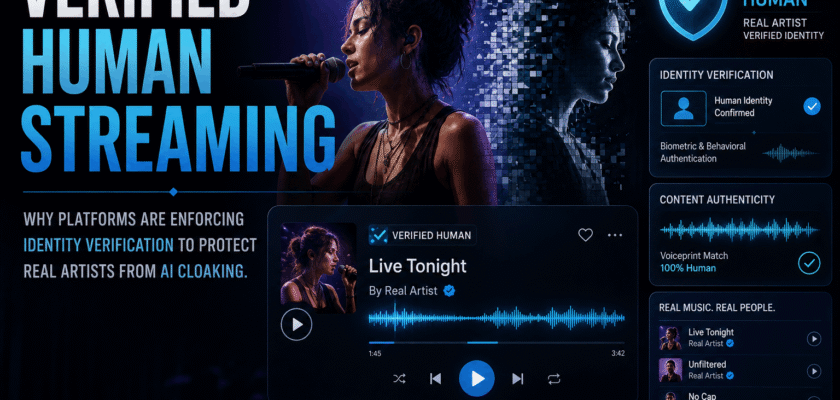
Verified human streaming is becoming one of the biggest entertainment industry trends of 2026 because AI-generated music is flooding streaming platforms. Listeners now face a difficult question: is this song made by a real artist, an AI tool, or someone pretending to be a famous musician?
This problem is called AI cloaking. It happens when AI-generated content hides behind a real artist’s name, voice, style, profile, or fanbase. In some cases, fake tracks can appear under real artist profiles. In other cases, AI voice clones can make it sound like a known singer approved a song when they did not.
Therefore, verified human streaming is not only a technical feature. It is a new trust layer for music platforms, artists, labels, and fans.
Why Verified Human Streaming Matters in 2026
Verified human streaming matters because AI music tools have made mass content creation very easy. A person can create hundreds of songs with AI, upload them to platforms, and use fake metadata or artist-like branding to attract streams.
Spotify has already introduced a stronger impersonation policy. It says music that impersonates another artist’s voice without permission can be removed, whether the imitation uses AI voice cloning or any other method.
This matters because artist identity is part of creative ownership.
A voice is not just sound.
A name is not just metadata.
A profile is not just a page.
For artists, these are part of reputation, income, and fan trust.
What Is Verified Human Streaming?
Verified human streaming is a system where platforms confirm that a creator, artist profile, or uploaded work is connected to a real human artist or authorised team. It can help listeners understand whether a track is from a verified person, an authorised label, or an AI-generated source.
It may include:
- Artist identity checks
- Profile protection
- Human-made music badges
- AI-content labels
- Voice-clone detection
- Release approval tools
- Metadata verification
- Rights ownership checks
- Provenance tracking
- Fraud monitoring
In simple words, verified human streaming helps platforms separate real artists from AI cloaking and fake uploads.
Verified Human Streaming and AI Cloaking
Verified human streaming is a response to AI cloaking. AI cloaking means AI content tries to look, sound, or behave like authentic human-created content without clear disclosure.
AI cloaking can happen through:
- Fake artist profiles
- AI voice clones
- Copycat artist names
- Misleading song credits
- AI songs uploaded under real artist pages
- Fake collaborations
- Synthetic fan engagement
- AI-generated cover art
- False “human-made” claims
- Style imitation without consent
This damages trust.
If fans cannot tell what is real, streaming platforms lose credibility.
Why Streaming Platforms Are Under Pressure
Streaming platforms are under pressure because AI content volume is rising fast. The Recording Academy’s CEO Harvey Mason Jr. recently discussed AI’s growing role in music and noted that Deezer has reported around 50,000 AI-generated songs uploaded daily.
That number shows the scale of the challenge.
Platforms must now manage:
- Real artists
- AI-assisted artists
- Fully AI-generated tracks
- Fake artist uploads
- Voice clones
- Copyright disputes
- Royalty fraud
- Listener confusion
- Label complaints
- Legal pressure
This is why identity verification is becoming a serious entertainment infrastructure issue.
Spotify’s Artist Profile Protection Tool
Spotify has been testing a tool called Artist Profile Protection. TechCrunch reported that this feature allows artists to review releases before those tracks appear on their profiles. The goal is to stop AI slop or misattributed songs from being linked to real artist pages.
Music Business Worldwide also reported that Spotify’s opt-in feature lets artists review and approve eligible releases before they go live on their profiles.
This matters because fake attribution can hurt artists quickly.
If a low-quality AI song appears under a real artist’s profile, fans may think the artist released it. That can damage brand value, playlist trust, and listener loyalty.
Spotify’s AI Voice Impersonation Policy
Spotify’s AI voice impersonation policy is one of the clearest signals that platforms are moving toward stronger artist protection. The company says vocal impersonation is only allowed when the impersonated artist has authorised it.
This is important because AI voice cloning can create fake songs that sound like real singers.
A fake voice clone can:
- Mislead fans
- Steal attention
- Damage reputation
- Trigger copyright disputes
- Create fake collaborations
- Affect royalties
- Spread harmful messages
- Hurt brand partnerships
- Confuse playlists
- Create legal conflict
So, voice protection is now part of artist identity protection.
Verified Badges for Human Artists
Verified badges may become a major part of verified human streaming. The Guardian reported that Spotify unveiled a verification system designed to help listeners distinguish human musicians from AI-generated content.
This shows the industry may move toward a trust badge model.
A verified human badge can tell listeners:
- This artist is real
- This profile is authentic
- This release is authorised
- This music is not falsely attached to someone else
- This creator identity has been checked
However, platforms must implement such badges carefully.
A badge should not punish genuine AI-assisted artists. It should clearly protect identity and disclosure.
Deezer’s AI Music Policy
Deezer has also taken action against AI music confusion. Deezer’s AI music policy focuses on tagging AI-generated content, filtering fraudulent streams, and excluding synthetic tracks from editorial playlists and algorithmic recommendations.
This is a different but related approach.
Deezer is not only asking “Who made this?”
It is also asking “Should this AI-generated track get the same promotional treatment as human-created music?”
That question matters because recommendation algorithms can shape careers.
If AI slop floods playlists, real artists may lose visibility.
Why AI Slop Is a Real Platform Problem
AI slop means low-effort AI-generated content uploaded in large quantities. It is not always illegal, but it can make platforms feel crowded, repetitive, and less authentic.
The Guardian reported that generative AI has accelerated fraudulent music-streaming activity because bad actors can create huge amounts of content quickly and replace removed songs easily.
AI slop can hurt:
- Listener experience
- Real artist discovery
- Playlist quality
- Royalty pools
- Platform trust
- Music criticism
- Human creativity
- Brand partnerships
- Label confidence
- Fan loyalty
This is why platforms cannot ignore it.
Why Real Artists Need Identity Protection
Real artists need identity protection because their name, face, voice, and style are economic assets. A singer’s voice can carry years of emotional connection with fans. A fake AI clone can misuse that connection within minutes.
Reuters recently reported that artists are exploring legal and insurance protections against AI deepfakes, including trademark strategies, media liability coverage, and deepfake-specific crisis support.
This shows how serious the threat has become.
Artists now need protection for:
- Voice
- Likeness
- Name
- Profile
- Style
- Catalogue
- Fanbase
- Brand deals
- Royalties
- Reputation
Identity is now part of the entertainment economy.
The NO FAKES Act and Artist Likeness
The NO FAKES Act is one of the major policy discussions around AI impersonation. The Recording Academy explains that the NO FAKES Act focuses on protecting a person’s voice and likeness from unauthorised AI replication.
This matters because music is not only about copyright in the song. It is also about the person behind the performance.
If AI can copy a singer’s voice without consent, the law must answer:
- Who controls the voice?
- Who gets paid?
- Who approves usage?
- Who removes fake content?
- Who is liable?
- How are fans informed?
Verified human streaming can work alongside such laws by giving platforms practical tools to protect artists.
The TRAIN Act and AI Training Transparency
The TRAIN Act is another proposed protection. The Recording Academy explains that it would give creators a way to find out if their work was used to train AI systems.
This matters because artists often do not know whether their music helped train an AI model.
If a model learns from thousands of songs and then produces similar-sounding music, artists may ask:
- Was my work used?
- Did I give permission?
- Was I paid?
- Can I audit the model?
- Can I opt out?
- Can I prove copying?
Streaming verification alone cannot solve training transparency, but both issues are connected.
Artists want control over both identity and source material.
The CLEAR Act and Disclosure
The CLEAR Act focuses on requiring AI companies to disclose copyrighted works used in training before releasing models. The Recording Academy says this can help creators get more transparency from AI developers.
Disclosure matters because hidden training creates distrust.
If platforms want verified human streaming, AI companies also need clearer disclosure about:
- Training data
- Voice usage
- Style modelling
- Dataset licensing
- Artist opt-out rules
- Compensation systems
- Attribution
- Content provenance
- Synthetic output labelling
- Rights management
Entertainment cannot build trust on hidden pipelines.
Why Labels Are Supporting Verification
Music labels are likely to support verification because fake uploads can damage catalogues and confuse royalty flows. A label invests in artist development, marketing, recording, distribution, and brand positioning. Fake AI uploads can hijack that work.
Labels need tools to:
- Verify releases
- Protect artist profiles
- Remove fake songs
- Stop voice clones
- Track royalties
- Detect fraud
- Protect brand partnerships
- Maintain catalogue trust
- Manage metadata
- Enforce takedowns
In the AI era, distribution control becomes as important as music promotion.
Why Independent Artists Need It Even More
Independent artists may need verified human streaming even more than superstars. A famous artist may have lawyers, labels, managers, and press teams. An independent artist may have none of that.
AI cloaking can harm indie artists through:
- Fake uploads under similar names
- Voice imitation
- Style copying
- Metadata confusion
- Playlist displacement
- Royalty dilution
- Fan confusion
- Low-quality AI spam
- Brand identity damage
- Search-result pollution
Verification can help indie artists prove authenticity and protect discovery.
Human-Made Music as a Premium Signal
Human-made music may become a premium signal in 2026. As AI content grows, some listeners may actively look for real human emotion, real instruments, real vocals, and real stories.
Authenticity can become a brand advantage.
A verified human artist can market:
- Real vocals
- Real songwriting
- Real studio sessions
- Real live performance
- Real creative process
- Real band collaboration
- Real cultural roots
- Real fan connection
This does not mean all AI-assisted music is bad. But it means human-made music needs a way to be visible.
AI-Assisted Music vs AI Cloaking
It is important to separate AI-assisted music from AI cloaking.
AI-Assisted Music
A real artist uses AI as a tool for ideas, mixing help, demos, stems, or workflow support.
AI Cloaking
Someone uses AI to hide behind another artist’s identity, voice, style, or profile without clear permission.
The problem is not every use of AI.
The problem is deception.
Verified human streaming should not attack creative tools. It should attack impersonation, fraud, and mislabelling.
Grammys and Human Creativity Rules
The Grammy Awards have also been dealing with AI. The Recording Academy’s Harvey Mason Jr. said AI is now common in studio sessions, but Grammy eligibility still requires more than a minimal amount of human creativity.
This is important because award systems help define cultural value.
If a song is mostly AI-generated, should it compete with human-created music?
If a human artist uses AI for support, where is the line?
If a voice is cloned, who is the performer?
These questions are changing entertainment rules.
Verified human streaming is part of the same debate.
Why Fans Want Transparency
Fans want transparency because they build emotional relationships with artists. A fan may listen to a song because they trust the artist’s story, voice, struggle, and identity.
If platforms hide AI content, fans may feel cheated.
Fans deserve to know:
- Is this a real artist?
- Is this voice cloned?
- Was AI used heavily?
- Is this officially released?
- Is this profile authentic?
- Is this collaboration real?
- Is this song human-made?
- Is this AI-generated background music?
- Who gets paid when I stream?
Transparency protects fan trust.
Why Platforms Cannot Rely Only on Labels
AI labels are useful, but they are not enough. The Verge recently criticised current AI-content labels across platforms, arguing that users still lack strong ways to filter AI content from feeds.
This is why verified human streaming may be more useful.
Instead of only marking AI content, platforms can also mark verified human creators.
That gives users a positive trust signal.
A listener can choose:
- Verified human artists
- AI-assisted music
- Fully AI-generated tracks
- Experimental AI music
- Licensed synthetic voice projects
Choice becomes clearer when labels and verification work together.
Artist Profile Hijacking
Artist profile hijacking happens when songs are wrongly attached to a real artist’s profile. This can happen because of metadata errors, distribution abuse, or intentional fraud.
Profile hijacking can cause:
- Fan confusion
- Wrong recommendations
- Damaged artist reputation
- False release alerts
- Bad playlist placement
- Royalty disputes
- Support complaints
- Search-result confusion
- Fake collaboration rumours
- Loss of trust
Spotify’s Artist Profile Protection pilot directly responds to this kind of issue by giving artists more control over releases appearing on their profiles.
This is a practical step.
Why Metadata Verification Matters
Metadata verification matters because streaming platforms depend heavily on metadata. Artist name, song title, rights owner, label, ISRC, credits, composer, and distributor data decide where a track appears and who gets paid.
Bad metadata can create big problems.
Platforms need stronger checks for:
- Artist name
- Featured artist
- Producer credits
- Label name
- Distributor identity
- Rights ownership
- AI use disclosure
- Voice permissions
- Release approval
- Revenue splits
Verified human streaming needs clean metadata.
Without metadata trust, artist verification remains weak.
Provenance Technology for Music
Provenance means the track’s origin and history. It can help prove who created the music, how it was made, and what rights are attached to it.
A 2025 research paper proposed a music AI agent architecture that embeds attribution into the creative workflow through an attribution layer and granular music blocks. The goal is more transparent provenance and real-time settlement in AI music systems.
This kind of technology may become important for streaming platforms.
Future songs may carry:
- Creation history
- Human contributor records
- AI tool disclosure
- Dataset licensing proof
- Voice permission records
- Royalty split data
- Version history
- Rights fingerprints
- Authenticity certificate
- Platform approval record
This can reduce disputes.
Why Watermarks Are Not Enough
Watermarks can help identify AI content, but they are not perfect. They can be removed, missed, or falsely detected. Some AI-generated content may not carry reliable watermarks at all.
That is why platforms need multiple layers:
- Artist verification
- Release approval
- AI disclosure
- Audio fingerprinting
- Voice-clone detection
- Metadata checks
- Distributor accountability
- User reporting
- Rights-holder takedown tools
- Human review
No single tool can solve AI cloaking.
The future will require layered trust systems.
Voice Cloning: The Biggest Emotional Risk
Voice cloning is especially risky because a voice carries identity. Fans may believe a fake song because it sounds emotionally familiar.
A cloned voice can be used for:
- Fake songs
- Fake collaborations
- Scam promotions
- Political messages
- Offensive content
- Adult content
- Fraudulent ads
- Fake apologies
- Fake unreleased tracks
- Reputation attacks
Reuters reported that artists are increasingly exploring legal and insurance tools against AI voice and likeness misuse.
This shows voice cloning is not just a creative issue. It is a security issue.
Streaming Fraud and Royalty Dilution
AI-generated mass uploads can also create streaming fraud. If bad actors generate many songs and use bots or fake engagement, they may take money from the royalty pool.
The Guardian reported that AI can act as an accelerant for fraudulent streaming because it lets bad actors create large volumes of music quickly.
This hurts real artists.
Royalty dilution can happen when:
- AI spam floods catalogues
- Fake streams inflate plays
- Short tracks game payouts
- Duplicate songs multiply
- Profile hijacking attracts streams
- Bot networks boost fake music
- Low-quality uploads overwhelm discovery
- Playlists get polluted
Verified human streaming can help platforms protect royalty fairness.
Why Playlists Need Human Verification
Playlists shape music discovery. If AI slop enters editorial or algorithmic playlists heavily, real artists may lose important exposure.
Deezer’s AI policy includes excluding synthetic tracks from editorial playlists and algorithmic recommendations.
This approach protects human discovery spaces.
Playlist verification can help ensure:
- Real artists get fair visibility
- AI tracks are labelled properly
- Fraudulent streams are reduced
- Listeners understand what they hear
- Editorial quality stays high
- Platform trust improves
- Royalties flow correctly
- Labels trust recommendations
- New human artists can still break through
Discovery is the heart of streaming.
It must remain trustworthy.
Verified Human Streaming for Video Platforms
Verified human streaming is not only about music. It also applies to video platforms, live-streaming, podcasts, and creator content.
AI cloaking can affect:
- AI influencers
- Deepfake actors
- Fake livestream hosts
- Synthetic podcasts
- Cloned creator voices
- AI reaction channels
- Fake celebrity videos
- AI-generated music videos
- Synthetic news clips
- Fake fan accounts
Platforms like YouTube, TikTok, Instagram, and Twitch may also need stronger identity and AI disclosure tools.
The problem is bigger than music.
YouTube and AI Music Attribution
YouTube’s Content ID system is powerful, but AI music creates new challenges. AI-generated songs can trigger ownership confusion, false positives, and unclear attribution when creators cannot prove source material or rights.
Industry guides around AI music and Content ID warn creators to avoid cloned voices, protected samples, and unclear ownership before claiming rights.
This matters because monetization depends on rights clarity.
If AI music lacks provenance, creators may face:
- Copyright claims
- Revenue loss
- Takedowns
- Disputes
- Channel strikes
- Monetization issues
- False ownership claims
- Licensing confusion
- Content ID conflicts
- Brand risk
Verification helps reduce this confusion.
How Platforms Can Verify Human Artists
Platforms can verify human artists through a mix of identity, rights, and release checks.
Possible methods include:
- Government ID verification
- Label or distributor confirmation
- Artist account approval
- Voice ownership records
- Release approval workflow
- Rights-holder dashboard
- Live performance proof
- Social profile linking
- Digital signature
- Provenance certificates
For bigger artists, label verification may be enough. For independent artists, platforms may need simpler creator-first tools.
The process should be strict but not impossible.
How Artists Can Protect Themselves
Artists should not wait for platforms to solve everything. They can take steps now.
Artists should:
- Claim official profiles
- Use trusted distributors
- Monitor new releases under their name
- Register trademarks where useful
- Track voice-clone misuse
- Keep project files and session records
- Use Content ID carefully
- Document human creation process
- Report fake uploads quickly
- Consult legal help for major misuse
Authenticity protection is now part of artist management.
How Fans Can Support Real Artists
Fans can also help protect real artists.
Fans should:
- Follow official artist profiles
- Check verified badges
- Avoid sharing suspicious fake tracks
- Report fake uploads
- Buy official merch
- Support concerts
- Use official links
- Read release credits
- Avoid AI clone fan uploads without consent
- Respect artist identity
Fans are part of the trust ecosystem.
If fans reward fake content, bad actors grow.
What Labels Should Demand From Platforms
Labels should demand stronger anti-cloaking tools from platforms.
These may include:
- Release pre-approval
- AI voice clone takedown process
- Verified artist badges
- Better metadata review
- Distributor penalties for abuse
- Fraud stream detection
- AI-generated content tags
- Royalty protection
- Faster dispute resolution
- Public transparency reports
Labels must protect both superstars and emerging artists.
AI-era music rights need stronger platform cooperation.
What Distributors Must Improve
Distributors are a key gatekeeper. If bad actors upload AI slop through weak distributors, platforms suffer.
Distributors should improve:
- Artist identity checks
- Rights verification
- AI disclosure forms
- Voice permission checks
- Metadata quality
- Repeat offender bans
- Track fingerprinting
- Upload limits for suspicious accounts
- Manual review for risky releases
- Takedown cooperation
A strong distribution layer reduces platform abuse.
Why Verification Should Not Block New Artists
Verification must be careful. It should protect real artists without blocking new artists who do not yet have a label or big audience.
New artists need:
- Simple verification options
- Affordable access
- Clear rules
- Fast approval
- Appeal process
- Independent artist support
- Regional language access
- Transparent rejection reasons
- Fair metadata review
- Human support when needed
If verification becomes too hard, it may protect big artists but hurt indie creators.
That would be unfair.
AI Music Can Still Be Creative
AI music is not automatically bad. Some artists use AI ethically as a tool. Some listeners enjoy AI-generated experimental sounds. Some creators clearly disclose AI use and avoid impersonation.
The issue is not AI itself.
The issue is:
- Deception
- Misattribution
- Unauthorised voice cloning
- Fake profiles
- Royalty fraud
- Hidden training
- No disclosure
- Platform flooding
- Artist identity theft
- Fan confusion
Verified human streaming should create clarity, not panic.
The Future of Streaming Badges
Streaming badges may become more detailed in the future.
Possible badges could include:
- Verified Human Artist
- AI-Assisted Release
- Fully AI-Generated Track
- Licensed Synthetic Voice
- Human Vocal Performance
- Official Label Release
- Independent Verified Artist
- Provenance Verified
- Live Recording Verified
- Rights Cleared
This can help listeners choose what they want.
Transparency creates trust.
Why “Human Verified” Could Become a Marketing Tool
“Human verified” could become a marketing tool because fans may value real creativity more in a world full of synthetic content.
Artists may promote:
- Human-written lyrics
- Human vocals
- Real instruments
- Live studio recording
- No cloned voices
- Verified release history
- Authentic credits
- Human creative process
- Original composition
- Real performance videos
This can create a premium identity.
Human-made may become a badge of quality.
Risks of Verified Human Streaming
Verified human streaming also has risks.
Platforms must avoid:
- False verification
- Wrong rejection
- Bias against small artists
- Privacy overcollection
- Slow approval
- Label favoritism
- Confusing labels
- Weak appeals
- Regional artist exclusion
- Over-policing creativity
Verification should be transparent and fair.
A bad verification system can create new problems while trying to solve old ones.
What Platforms Should Build Next
Platforms should build better tools for artists and listeners.
They should offer:
- Verified human artist badges
- AI-content filters
- Artist release approval
- Faster fake upload reporting
- Voice clone takedowns
- Provenance metadata
- Distributor accountability
- Better playlist protection
- Royalty fraud monitoring
- Fan-facing transparency
The goal should be simple: protect real creators and let listeners know what they are hearing.
What Artists Should Watch in 2026
Artists should watch the next wave of platform policy changes.
Important areas include:
- Spotify verification tools
- Deezer AI tagging
- YouTube Content ID rules
- NO FAKES Act progress
- TRAIN Act progress
- CLEAR Act progress
- Distributor AI policies
- Voice-clone lawsuits
- AI music monetization rules
- Verified human badges
The music industry is changing quickly.
Artists who understand these rules early will protect themselves better.
Final Verdict
Verified human streaming is becoming essential because AI cloaking, fake uploads, deepfake voices, and AI slop are challenging the trust structure of music platforms. Real artists need protection for their names, voices, profiles, catalogues, and fan relationships.
Spotify’s stronger impersonation policy, Artist Profile Protection pilot, and reported human verification system show that platforms are moving toward identity-based trust. Deezer’s AI tagging and filtering approach also shows that platforms are trying to separate synthetic content from human-made music discovery.
In simple words, the future of streaming will not only ask, “Is this song popular?”
It will also ask, “Who made this, and is it authentic?”
Verified human streaming can protect real artists, inform fans, reduce fraud, and make the AI era more transparent.


