


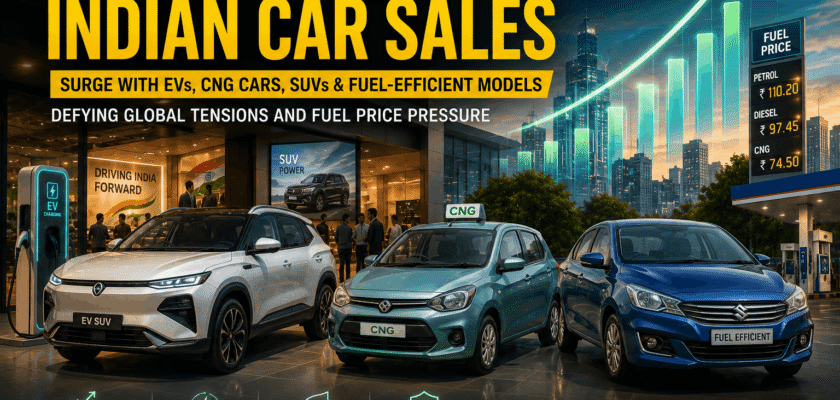
May 2026 Indian Car Sales: Why Buyers Are Still Spending
May 2026 Indian car sales surprised the market because buyers continued purchasing cars despite fuel price hikes, global tensions, and uncertainty around running costs. The month showed one clear trend: Indian customers are not stopping car purchases, but they are becoming smarter about what they buy.
Electric vehicles, CNG cars, compact cars, SUVs, and fuel-efficient models saw strong interest. This means buyers are thinking about monthly fuel cost, long-term savings, and practical ownership more seriously than before.
Therefore, May 2026 was not just a sales growth month. It was a signal that India’s car market is moving toward efficiency, affordability, and future-ready mobility.
Why May 2026 Indian Car Sales Matter
May 2026 Indian car sales matter because the growth came during a difficult period. Fuel prices moved up during the month, and global geopolitical tension kept crude oil risk high. Usually, such pressure can make buyers delay big purchases.
However, India’s passenger vehicle market stayed strong.
ETAuto reported that the industry clocked around 4.4 lakh units in May 2026, with Maruti, Mahindra, and Tata leading the market despite fuel price hikes and geopolitical uncertainty.
This shows that buyer demand is still resilient, especially for cars that promise better running cost.
The May Double-Digit Sales Surge Explained
The May double-digit sales surge was not driven by one company only. Multiple brands saw strong momentum. Maruti Suzuki hit an all-time monthly sales record, Tata Motors stayed strong, Mahindra continued to benefit from SUV demand, and Kia also recorded its strongest-ever May performance.
Economic Times reported that Maruti Suzuki reached 190,337 units in May 2026, supported by compact cars, SUVs, rising CNG bookings, and stronger EV demand.
This growth shows that buyers are responding to both practical cars and aspirational SUVs.
May 2026 Indian Car Sales and Running Cost Pressure
May 2026 Indian car sales show that running cost pressure is changing buyer behaviour. When petrol, diesel, or CNG prices rise, customers do not always stop buying cars. Instead, they look for models that reduce monthly fuel bills.
This is why EVs and CNG cars are gaining attention.
A buyer now asks:
- What is the real per-km cost?
- Is CNG available nearby?
- Can I charge an EV at home?
- What is the real-world mileage?
- How much will fuel cost every month?
- Will resale value stay strong?
- Is the car future-ready?
- Does it have low maintenance cost?
These questions now matter as much as design and features.
EV Sales Became the Biggest Surprise
EV sales became the biggest surprise of May 2026. Autocar India reported that electric car sales rose 80% year-on-year in May 2026 and set a new monthly sales record. Tata Motors crossed the 10,000-unit EV mark for the first time, while Mahindra also posted its highest-ever monthly EV sales.
This is a major signal.
EVs are no longer only early-adopter cars. They are entering mainstream family discussions, especially in cities where daily running is high and charging access is improving.
Why Tata Motors Led the EV Charge
Tata Motors remained the leader in electric passenger vehicles. The company has built a wide EV portfolio across price points, including small EVs, compact SUVs, and newer electric models.
Tata’s EV strength comes from:
- Wider EV product range
- Strong brand recall
- Better city EV acceptance
- Growing charging ecosystem
- Familiar models with EV versions
- Lower running cost appeal
- First-mover advantage
- Better dealership awareness
When Tata crossed 10,000 EV units in May, it showed that EV demand is no longer small or experimental.
Mahindra’s EV Push Is Becoming Stronger
Mahindra also became a strong EV story in May 2026. The brand has already built strong SUV demand, and its newer electric SUV strategy is helping it gain more attention.
Indian EV buyers often want SUV body style, strong road presence, long range, and modern tech. Mahindra’s electric SUV approach fits that demand.
If Mahindra continues to improve delivery, pricing, range, and charging support, it can become one of Tata’s strongest EV challengers.
This competition is good for buyers because it can improve product quality and pricing.
Maruti’s CNG and EV Demand Signal
Maruti Suzuki’s May 2026 performance was important because it showed two trends together: customers still trust fuel-efficient petrol/CNG cars, and they are also becoming curious about EVs.
Economic Times reported that Maruti’s CNG bookings jumped 40%, while EV demand doubled. The company also posted its highest-ever monthly sales.
This tells us that Indian buyers are not moving in only one direction. Some want CNG for lower running cost today. Others are preparing for EV ownership tomorrow.
Why CNG Cars Are Still Relevant
CNG cars are still relevant because they offer lower running cost than petrol for many city users. They are also familiar, easy to drive, and do not need home charging.
For buyers who drive daily in cities, CNG can still make sense.
CNG cars are popular because they offer:
- Lower per-km cost
- Familiar refuelling process
- Better resale in some markets
- Factory-fitted safety options
- Good city usability
- Lower running cost for high-mileage users
- Less range anxiety than EVs
However, CNG buyers must check pump availability and waiting time.
Why Fuel-Efficient Cars Are Defying Global Tensions
Fuel-efficient cars are defying global tensions because buyers want control over monthly expenses. When global oil prices move due to geopolitical events, petrol and diesel users feel nervous.
A fuel-efficient car gives psychological comfort.
Buyers feel safer choosing:
- High-mileage petrol cars
- Hybrid cars
- CNG cars
- EVs
- Compact SUVs with efficient engines
- Small city cars
- Low-maintenance models
This is why sales can grow even during uncertain times. People may delay luxury upgrades, but they still buy practical vehicles that protect their budget.
The SUV Factor in May Sales
SUVs continued to play a big role in May 2026 Indian car sales. Indian buyers like SUVs because they offer road presence, high seating, family practicality, and aspirational value.
Maruti, Mahindra, Tata, Hyundai, Kia, and other brands have benefited from this SUV shift.
SUV buyers are now looking for:
- Strong mileage
- Better safety
- Connected features
- Sunroof
- Automatic gearbox
- Hybrid or CNG option
- EV option
- High ground clearance
- Better boot space
- Premium cabin feel
The SUV trend is not slowing down. It is becoming more practical and fuel-conscious.
Kia’s Strong May Performance
Kia India also had a strong May 2026. Autocar India reported that Kia recorded its highest-ever May sales performance with 27,586 units, up 23.6% YoY. Demand was supported by models like Seltos and Sonet, while newer products also added momentum.
This shows that buyers still want feature-rich cars with strong design and premium feel.
Kia’s growth proves that value is not only about low price. It is also about features, design, comfort, and brand experience.
Honda Also Saw Growth
Honda also posted positive growth in May. Autocar India reported Honda sales of 5,111 units, up 29.4% YoY, supported by Amaze, Elevate, and new product attention around City and ZR-V.
Honda’s case is interesting because the brand is smaller than market leaders but still benefits from trust, refinement, and strong product reputation.
This shows that even in a competitive market, buyers still reward reliability and brand confidence.
Why Buyers Are Not Waiting Despite Price Pressure
Many buyers are not waiting because car ownership remains important in India. Families still need personal mobility for work, school, travel, safety, and comfort.
Also, some buyers may rush purchases before possible future price hikes.
Fortune India reported that May PV sales were supported by lower dealer inventories, healthy bookings, improved affordability after previous GST cuts, and pre-buying ahead of price hikes.
So, the May surge was not only emotional. It had practical reasons.
May 2026 Indian Car Sales and Dealer Inventory
Dealer inventory also affects sales. When inventory is lower and bookings are healthy, dispatches can rise. Brands send more cars to dealers to meet demand.
If inventory becomes too high, dealers may face discount pressure. If inventory is too low, customers face waiting periods.
May 2026 showed a healthier balance for many brands.
This helped companies push strong numbers while demand stayed active.
Why EV Deliveries Rose in the Second Half of May
Autocar India reported that Vahan data showed a sharp increase in EV deliveries during the second half of May, which accounted for 61% of the month’s total EV sales.
This could reflect delivery push, improved availability, consumer urgency, or stronger month-end registrations.
For EV makers, delivery timing matters because many buyers wait for variant availability, colour choice, subsidy clarity, or charging setup.
A strong second-half delivery push helped May become a record EV month.
Global EV Growth Also Supports India’s Shift
India’s EV market is still smaller than China or Europe, but the global direction is clear. The IEA’s Global EV Outlook 2026 says global electric car sales are expected to reach 23 million in 2026, representing 28% of total car sales.
This global trend affects India too.
As battery prices, charging networks, and EV model choices improve, Indian buyers will get more confidence.
However, India’s EV growth will still depend on price, charging access, range, financing, and after-sales support.
What This Means for Car Buyers
For car buyers, May 2026 Indian car sales send a clear message: the market is giving more choices, but the smart buyer should calculate ownership cost carefully.
Before buying, check:
- Real mileage or range
- Monthly running distance
- Fuel price in your city
- Charging access
- CNG pump availability
- Insurance cost
- Service cost
- Battery warranty
- Resale value
- Waiting period
Do not buy only because a model is trending. Buy according to your use case.
Which Car Type Makes Sense Now?
Different buyers need different cars.
For Low Running Users
If you drive less than 20 km daily, a petrol car may still be practical.
For City Commuters
If you drive 30–60 km daily, CNG or hybrid can make sense.
For High Running Users
If you drive 60 km or more daily and have charging access, EVs become attractive.
For Highway Users
If you drive long highways often, hybrid, diesel where available, or efficient petrol may still be more convenient.
For Fleet Users
CNG and EV running cost should be compared carefully with downtime and charging/refuelling access.
Why Real-World Mileage Matters More Than Claimed Mileage
Real-world mileage matters because company-tested figures may not match daily use. Traffic, AC, driving style, load, road condition, tyre pressure, and service quality affect actual running cost.
This is why the government’s upcoming AC-on and AC-off mileage testing rule for new cars from April 2027 is important. Times of India reported that new models will need fuel-efficiency tests under both AC-on and AC-off conditions, giving consumers more realistic mileage information.
This will help buyers make better decisions.
Running Cost Calculation Every Buyer Should Do
Use this simple formula for fuel cars:
Fuel price ÷ real mileage = cost per km
For EVs:
Electricity cost per unit × battery units used ÷ real range = cost per km
For example:
- Petrol car: ₹105/litre ÷ 15 km/l = ₹7/km
- CNG car: ₹86/kg ÷ 26 km/kg = ₹3.30/km
- EV: ₹8/unit × 35 units ÷ 300 km = ₹0.93/km
Actual numbers depend on city and vehicle.
This calculation makes buying clearer.
Why Fuel-Efficient Cars Can Protect Budgets
Fuel-efficient cars protect budgets because fuel cost repeats every month. A car may look cheaper at purchase, but if it drinks more fuel, it becomes expensive over time.
A high-mileage or low-running-cost car helps with:
- Daily commute savings
- Better monthly budget control
- Lower stress during fuel hikes
- Better fleet profitability
- Stronger resale confidence
- Lower lifetime ownership cost
This is why Indian buyers are now paying more attention to efficiency.
What Automakers Should Learn From May 2026
Automakers should learn that Indian buyers want value with efficiency. Growth is coming from brands that offer practical choices, not only flashy features.
Car companies should focus on:
- EV affordability
- CNG availability
- Real-world mileage
- Better safety
- Strong after-sales service
- Transparent running cost
- Battery warranty clarity
- Faster delivery
- Lower maintenance
- Practical SUV options
The next growth wave will reward brands that solve real ownership problems.
Key Risks Ahead
The strong May numbers do not mean the market has no risks.
Key risks include:
- Further fuel price hikes
- Higher interest rates
- Insurance cost increases
- Global supply chain issues
- Battery material volatility
- EV charging gaps
- CNG station crowding
- Waiting period frustration
- Overpriced new launches
- Weak rural demand in some areas
So, June and July sales will show whether the momentum continues.
Final Verdict
May 2026 Indian car sales show that Indian buyers are still confident, but they are becoming more cost-aware. EVs, CNG cars, SUVs, and fuel-efficient models helped the market defy fuel price hikes and global tensions.
The biggest story is the shift in mindset. Buyers are not only asking, “Which car looks best?” They are asking, “Which car saves money every month?”
EV sales rising 80% YoY, Tata crossing 10,000 EV units, Maruti hitting record sales, and CNG bookings jumping 40% all point toward one clear trend: India’s garage is becoming more efficiency-focused.
In simple words, the running cost surge is real, but Indian buyers are adapting fast. The winners will be cars that offer value, efficiency, trust, and future-ready ownership.


