


Japan Energy Subsidy EV Infrastructure: Why This Is More Than a Fuel-Price Story
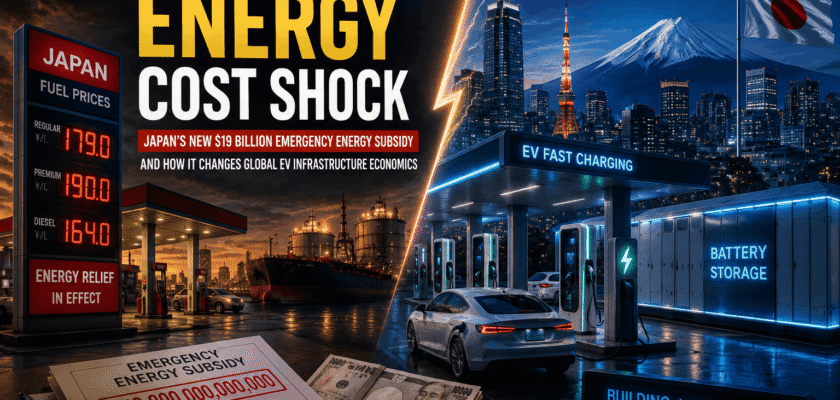
Japan energy subsidy EV infrastructure has become an important global automobile-policy story after Tokyo approved a supplementary budget worth about 3.1 trillion yen, or roughly $19.5 billion, to cushion households from higher gasoline and utility costs. The package responds to a Middle East-driven energy shock and a weak yen that has made imported fuel more expensive.
The immediate purpose is consumer relief, not a direct nationwide EV-charging programme. Most of the money is meant to replenish contingency reserves used for gasoline and utility subsidies. However, the policy still changes the global EV infrastructure calculation because it shows how expensive fossil-fuel dependence can become when geopolitical risk rises.
Japan is effectively paying billions to reduce today’s pain while still facing tomorrow’s structural question: should public money continue protecting petrol consumption, or should more of it accelerate electric vehicles, charging networks, battery storage and clean electricity?
What Japan Approved in June 2026
Japan finalised a 3.1 trillion yen supplementary budget to soften the effect of surging energy prices on households. Reuters reported that the additional spending would mainly rebuild contingency reserves used for gasoline and utility-bill subsidies. The budget is being financed through deficit-financing bonds, although the government intends to offset the market impact with stronger tax revenue and other income.
- Package size: about 3.1 trillion yen, or approximately $19.5 billion.
- Primary objective: cushion households from gasoline and utility cost increases.
- Main trigger: prolonged Middle East tension, higher imported energy costs and yen weakness.
- Fiscal concern: temporary relief increases debate about debt, inflation and long-term energy strategy.
- Automobile relevance: lower pump prices can temporarily protect petrol-car running costs and slow the financial urgency to switch to EVs.
The Important Fact Check: It Is Not a $19 Billion EV Subsidy
The headline can easily create confusion. Japan has not announced that all $19 billion will be spent on chargers, EV purchase incentives or battery factories. The package is primarily an emergency energy-cost shield.
That distinction strengthens the policy debate. A large fossil-fuel relief package can make petrol vehicles look cheaper in the short term, but it can also delay investment signals that would otherwise favour electric mobility. At the same time, the crisis itself highlights the energy-security value of vehicles powered by domestic electricity rather than imported oil.
For EV planners, the correct interpretation is indirect but powerful: every new fossil-fuel subsidy changes the payback period, customer behaviour and political budget available for charging infrastructure.
Why Japan Is So Exposed to Global Energy Shocks
Japan imports most of its fossil energy. Reuters Breakingviews noted that roughly 80% of the country’s energy needs depend on fossil-fuel imports. When oil and gas prices rise, the shock travels quickly into electricity bills, transport costs, household budgets and industrial competitiveness.
- Imported oil exposure makes petrol and logistics sensitive to war and shipping disruptions.
- A weak yen raises the local-currency cost of fuel even when global prices are unchanged.
- Higher energy bills reduce household spending on vehicles and other large purchases.
- Automakers face higher costs in factories, logistics, paint shops and component supply chains.
- Government subsidies can control prices temporarily but cannot remove import dependence.
How the Subsidy Changes EV Total-Cost-of-Ownership Math
EV buyers usually compare the higher purchase price of an electric car with lower energy and maintenance costs over several years. Gasoline subsidies change that calculation by reducing the visible fuel-price advantage of an EV.
Suppose an EV saves a household a fixed amount each month compared with a petrol car. If the government holds petrol prices down, the monthly saving becomes smaller and the EV’s break-even period becomes longer. This can weaken demand among practical buyers who care more about cost than technology.
However, subsidies are temporary. If the support ends while oil prices remain high, petrol running costs can jump suddenly. EV owners with access to stable home charging are less exposed to that specific shock. The long-term comparison therefore depends on policy durability, electricity prices, charger access and vehicle efficiency.
Japan’s Existing EV and Charging Support
Japan already supports cleaner vehicles and charging, but the scale is far smaller than recent fossil-fuel relief. Government information for fiscal 2024 listed a Clean Energy Vehicle subsidy budget of about 129.1 billion yen, with maximum vehicle-level support reaching 850,000 yen for eligible EVs. Separate programmes have supported charging and vehicle-to-home equipment.
IEEFA reported that Japan allocated an additional 36.5 billion yen in 2025 for charging infrastructure in residential buildings. It also noted that charging sites increased 41% year on year to about 68,000 by March 2025. Yet gasoline subsidies between 2022 and 2024 were far larger than combined EV and charging support.
This difference is central to the infrastructure debate. Emergency relief protects current drivers, but structural investment builds a less oil-dependent transport system.
Why Charging Infrastructure Is the Real Bottleneck
EV adoption does not depend only on vehicle subsidies. Drivers need chargers that are available, reliable and conveniently located. Japan’s dense cities, apartment living and limited private parking create special challenges.
- Apartment residents may not control their parking space or electrical connection.
- Older buildings can require costly power upgrades before chargers are installed.
- Highway fast charging must handle holiday congestion and long-distance travel.
- Urban land is expensive, so charging hubs need strong utilisation to be viable.
- Charger downtime can damage consumer confidence even when the national charger count rises.
The Apartment-Charging Problem
Home charging is one of the biggest advantages of EV ownership, but it is much easier for people living in detached houses than for residents of large apartment buildings. Shared parking, landlord approval, electricity metering and construction costs can delay installations.
Japan’s support for residential-building charging is therefore strategically important. A charger installed where a vehicle remains parked overnight can reduce dependence on expensive public fast charging and improve grid flexibility. It can also make EV ownership realistic for urban households that would otherwise remain locked into petrol or hybrid cars.
Fast Charging Economics After the Energy Shock
Public fast-charging operators face their own energy-cost shock. Their revenue depends on charging sessions, but their expenses include electricity, demand charges, land rent, equipment finance, maintenance, software and network connectivity.
When wholesale power prices rise, charging operators must decide whether to increase customer prices, absorb lower margins or use battery storage to manage peak demand. Emergency utility subsidies can reduce pressure temporarily, but private infrastructure still needs a sustainable long-term pricing model.
A healthy charging network needs enough demand to cover capital cost without making public charging so expensive that drivers prefer petrol or hybrid vehicles.
Battery Storage Becomes More Valuable
The crisis strengthens the case for pairing fast-charging hubs with battery storage. A stationary battery can charge when electricity is cheaper and discharge when several vehicles plug in at once.
- Peak-load reduction can lower grid-demand charges.
- Storage can support locations where grid upgrades are slow or expensive.
- Renewable electricity can be stored and used during evening charging demand.
- Backup capacity can improve resilience during grid disturbances.
- Smart charging can coordinate vehicles, batteries and local power prices.
Vehicle-to-Home and Vehicle-to-Grid Potential
Japan has long explored vehicle-to-home technology because earthquakes and extreme weather make backup power valuable. An EV battery can potentially support a home during an outage when the vehicle and charging system are compatible.
In a broader vehicle-to-grid model, many parked EVs could provide flexibility to the electricity system. This does not mean every car should discharge constantly. It means carefully managed fleets could help balance renewable power, reduce peaks and create new value from batteries that are parked most of the day.
The $19 billion energy shock package makes this resilience argument stronger. Public spending can either repeatedly protect consumption or help build assets that reduce future vulnerability.
Impact on Japanese Automakers
Japanese automakers operate across petrol, hybrid, plug-in hybrid, battery-electric and hydrogen technologies. Fuel subsidies can support demand for efficient petrol cars and hybrids in the short term because drivers feel less pressure at the pump.
Yet global markets are moving toward electrification at different speeds. Automakers still need competitive EV platforms, battery supply, software, charging partnerships and affordable models. A domestic policy environment that protects petrol too heavily can reduce the urgency of that transition.
- Toyota and other hybrid leaders may benefit when buyers want efficiency without charging dependence.
- Battery-electric models need stronger charging confidence and competitive purchase prices.
- Commercial fleets need depot charging, predictable energy tariffs and financing.
- Export-focused manufacturers must meet regulations and consumer demand outside Japan.
- Suppliers must prepare for batteries, power electronics, thermal systems and software-defined vehicles.
Why Hybrids May Gain in the Short Term
Japan’s emergency energy policy may indirectly strengthen hybrid demand. Hybrids reduce fuel consumption without requiring a charger, making them practical during a period of uncertain oil prices and incomplete charging coverage.
For households that cannot install home charging, a hybrid can look like the lowest-risk choice. It provides familiar refuelling, better fuel economy and no range-planning requirement. This explains why the EV transition in Japan may remain mixed rather than purely battery-electric.
Still, hybrids continue to depend on imported fuel. They reduce exposure but do not eliminate it.
Global EV Infrastructure Lesson 1: Compare Subsidies Honestly
Governments often compare EV incentives with direct purchase subsidies but ignore the scale of support used to control petrol and electricity prices. A fair transport-policy comparison should include all relevant support.
- Gasoline price subsidies
- Utility bill relief
- Oil reserve releases
- Road and parking support
- EV purchase incentives
- Charging-station grants
- Grid-upgrade subsidies
- Battery and clean-manufacturing incentives
Once all costs are counted, the claim that EV infrastructure is too expensive may look different. Repeated crisis spending can exceed the cost of long-term transition assets.
Global EV Infrastructure Lesson 2: Energy Security Has Financial Value
EV policy is usually discussed through climate targets, but energy security may be an equally strong argument. A country that powers more transport with domestic electricity can reduce exposure to oil-market shocks.
The benefit is not automatic. If electricity is generated mainly from imported fossil fuels, some dependence remains. That is why EV infrastructure and clean-power investment must grow together.
The strongest system combines efficient electric vehicles, renewable energy, nuclear power where accepted, storage, smart grids and diversified supply.
Global EV Infrastructure Lesson 3: Temporary Relief Can Delay Structural Reform
Emergency subsidies are politically understandable. Families need protection when fuel and utility bills rise suddenly. The risk begins when temporary relief becomes a permanent replacement for reform.
If consumers expect petrol prices to remain controlled, demand for efficient travel, public transport and EVs can weaken. Private investors may also hesitate to build chargers if future utilisation looks uncertain.
A balanced policy should protect vulnerable households while preserving a clear long-term signal toward cleaner and more secure mobility.
A Better Policy Mix for Japan
Japan does not need to remove emergency support overnight. A more balanced strategy could connect immediate relief with long-term infrastructure.
- Target fuel and utility relief toward vulnerable households instead of broad permanent subsidies.
- Expand apartment and workplace charging where private investment faces coordination barriers.
- Support reliable highway fast-charging corridors with uptime standards.
- Accelerate clean electricity, storage and grid modernisation.
- Use vehicle-to-home systems as part of disaster-resilience planning.
- Create transparent timelines so automakers and charging investors can plan.
- Measure policy by reduced oil dependence, not only short-term pump prices.
What This Means for India
India can learn from Japan because it also imports a large share of its crude oil and is sensitive to global energy shocks. The Indian market has different vehicle patterns, especially the importance of two-wheelers, three-wheelers, CNG and commercial fleets, but the main lesson is similar.
- Oil-price relief can protect consumers but may become fiscally expensive.
- Electric two-wheelers and three-wheelers can reduce fuel demand quickly when charging is convenient.
- Apartment and workplace charging policy is essential for urban EV adoption.
- Fleet depots need power planning before large electric vehicle orders arrive.
- Renewable energy and battery storage can improve the long-term EV cost advantage.
What EV Charging Investors Should Watch
Investors should not judge the market only by EV sales. Infrastructure returns depend on utilisation, power cost, site quality and policy consistency.
- Petrol subsidy duration and its effect on EV payback periods
- Electricity tariff changes
- Apartment charging regulations
- Fast-charger utilisation by location
- Grid connection lead times
- Battery-storage economics
- Government uptime or interoperability standards
- Automaker charging partnerships
- Commercial fleet electrification
- Consumer confidence in public charging
What EV Buyers Should Calculate
A buyer should not decide only from the current petrol price or a temporary subsidy. The better calculation includes the full ownership period.
- Purchase price after incentives
- Loan interest and monthly EMI
- Home charger and installation cost
- Electricity tariff
- Public charging use
- Annual kilometres driven
- Maintenance and insurance
- Battery warranty
- Expected resale value
- Possible fuel-subsidy withdrawal
The Risk of Fiscal Lock-In
Japan’s package also raises a fiscal question. The government is using deficit-financing bonds for the supplementary budget while trying to avoid increasing total market issuance through other revenues and savings. Even if the near-term bond-market impact is managed, repeated energy packages can create long-term pressure.
Fiscal lock-in happens when governments become politically unable to remove support. Consumers adjust expectations, businesses price around the subsidy and any withdrawal feels like a new tax. This can consume money that might otherwise build chargers, grids, public transport or clean-energy capacity.
The Risk of Inflation and Currency Pressure
Subsidies can reduce measured consumer prices in the short term, but large fiscal spending may also worry bond and currency markets. A weaker yen makes imported energy more expensive, creating the same problem the subsidy is trying to solve.
This circular risk is another reason structural energy reform matters. Domestic clean electricity and efficient electric transport cannot remove every economic shock, but they reduce the volume of imported fuel the economy must buy.
Why the Global EV Debate Is Changing
The EV debate is moving beyond tailpipe emissions. Governments and companies are now considering resilience, industrial policy, electricity demand, mineral supply, cybersecurity, charging reliability and fiscal exposure.
Japan’s emergency package shows that the cost of the old transport system is not only what drivers pay at the pump. It also includes public subsidies, currency risk, military and shipping disruptions, inflation management and repeated crisis intervention.
EV infrastructure should therefore be evaluated as national resilience infrastructure, not only as a convenience for car buyers.
Final Verdict
Japan’s $19 billion emergency subsidy provides necessary short-term protection from an energy-cost shock, but it also exposes a difficult policy contradiction. The country is spending heavily to control gasoline and utility bills while its longer-term energy security depends on reducing fossil-fuel imports.
The package is not a direct EV-infrastructure programme. Yet it changes EV economics by lowering visible petrol costs, affecting consumer payback periods and competing for public budget. At the same time, the crisis strengthens the argument for electric mobility, apartment charging, battery storage, vehicle-to-home systems and clean power.
In simple words, Japan can subsidise today’s fuel bill, but it cannot subsidise away global energy risk forever. The strongest long-term response is to combine targeted household relief with faster investment in infrastructure that makes future transport less dependent on imported oil.


