
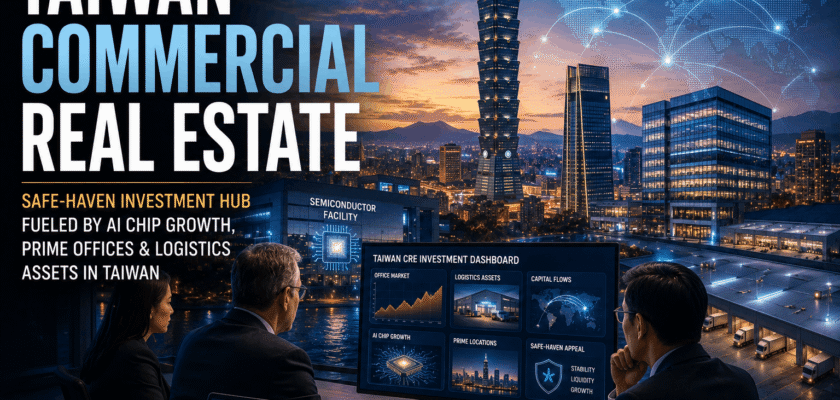
Taiwan Commercial Real Estate: Why Investors Are Paying Attention
Taiwan commercial real estate is becoming more interesting for global investors because the island sits at the centre of the AI chip economy. While many regional property markets face uncertainty from geopolitics, interest rates, and uneven office demand, Taiwan has a different story.
Its commercial real estate market is supported by semiconductor exports, advanced manufacturing, strong technology demand, and stable business districts. Global investors are watching prime offices, logistics assets, industrial parks, data-linked real estate, and retail locations tied to high-income tech workers.
Therefore, Taiwan is not only a technology story. It is also becoming a safe-haven commercial real estate story for investors who want Asia exposure with strong economic backing.
Why Taiwan Commercial Real Estate Matters in 2026
Taiwan commercial real estate matters because Asia-Pacific capital flows are recovering. CBRE’s 2026 Asia Pacific outlook says the region’s commercial real estate market is poised for another solid year, with both investment and leasing activity expected to strengthen. However, CBRE also notes that trade volatility and geopolitical tension remain major factors in real estate decision-making.
This is where Taiwan becomes interesting.
Taiwan faces geopolitical risk, but it also has a powerful technology base. Its AI chip ecosystem supports exports, corporate profits, jobs, retail spending, and business confidence.
As a result, investors see Taiwan as a market with risk, but also with strong income engines.
What Makes Taiwan a Safe Haven Investment Hub?
A safe haven investment hub does not mean a market has no risk. It means investors believe the market has enough strength, stability, and long-term demand to protect capital better than weaker alternatives.
Taiwan attracts attention because of:
- Strong semiconductor ecosystem
- TSMC-led global importance
- Advanced manufacturing clusters
- Export-driven growth
- Skilled workforce
- Strong local capital
- Stable prime office demand
- High-value industrial land demand
- Growing logistics requirements
- Wealth effects from AI chip growth
This combination gives Taiwan a different position from many regional peers.
Taiwan Commercial Real Estate and the AI Chip Boom
Taiwan commercial real estate is closely linked with the AI chip boom. Reuters reported that Asia’s AI chip surge, led by South Korea and Taiwan, is driving wider economic growth across North Asia. Taiwan’s Q1 2026 real GDP growth reached 11.8%, while retail sales grew 6–8%, supported by semiconductor profits and wealth effects.
This matters for property.
When tech companies grow, they need offices, labs, logistics facilities, housing for employees, retail areas, and supporting infrastructure. High-income workers also support malls, restaurants, hotels, and lifestyle real estate.
So, Taiwan’s property demand is not separate from the chip economy. It is connected to it.
Why Prime International CRE Flows Prefer Strong Income Markets
Prime international commercial real estate flows often prefer markets with reliable income, strong tenants, and long-term demand. Investors do not only chase cheap property. They chase quality and stability.
JLL’s May 2026 global real estate perspective says global capital markets saw continued growth in activity in Q1, supported by robust liquidity in debt markets, larger transactions, and pricing stability. It also notes strong performance across office, industrial and logistics, and retail sectors.
This trend helps markets like Taiwan where prime assets can offer income visibility.
Investors want assets that can survive volatility.
Asia-Pacific Investment Intentions Are Improving
Asia-Pacific real estate investment appetite is improving in 2026. Reuters reported that net buying intentions for APAC real estate reached a four-year high, according to a CBRE survey. The office sector became the most favoured real estate class for the first time in six years, supported by leasing recovery, easing financing conditions, and limited supply.
This recovery is important for Taiwan.
When global investors return to APAC, they compare markets. They look at Japan, Singapore, Korea, Australia, Hong Kong, India, and Taiwan. Taiwan may not always be the first name in every global portfolio, but its tech-backed economy gives it a strong niche.
Why Taiwan Can Compete With Regional Peers
Taiwan can compete with regional peers because it offers a different value proposition. Japan offers deep liquidity. Singapore offers institutional transparency. Korea offers tech and office depth. India offers growth scale. Taiwan offers semiconductor-led resilience.
Taiwan’s advantage is not only property yield. It is the economic engine behind the demand.
Global investors may like Taiwan because it has:
- High-value tenants
- Tech-related demand
- Industrial property strength
- Export-linked growth
- Stable consumer spending
- Strong local corporate buyers
- Supply discipline in prime locations
- Manufacturing-linked real estate demand
- Data and logistics opportunity
- Strategic relevance in global supply chains
This makes Taiwan stand out in selected commercial real estate categories.
Office Demand: Quality Over Quantity
Taiwan office demand is likely to favour quality assets. Global occupiers, financial firms, technology companies, and professional services tenants prefer modern buildings with better ESG standards, transport access, energy efficiency, and employee comfort.
Across APAC, investors are showing renewed interest in office assets, but they are selective. They prefer prime offices over weak secondary buildings.
For Taiwan, this means top-grade office buildings in strong business locations may attract more demand than outdated stock.
The office market is not simply “up or down.” It is splitting between quality assets and weaker assets.
Industrial and Logistics Assets Look Strong
Industrial and logistics assets are important for Taiwan because the economy depends on manufacturing, exports, electronics, and supply chains.
These assets can include:
- Logistics parks
- Warehouses
- Semiconductor supply facilities
- Light industrial buildings
- Cold chain storage
- E-commerce distribution centres
- Industrial land
- Business parks
- Data-linked facilities
- Last-mile delivery hubs
When chip exports and technology manufacturing grow, supporting real estate can also gain attention.
This is why investors often link Taiwan’s industrial property demand with global AI and semiconductor cycles.
Taiwan Commercial Real Estate and Data Infrastructure
Taiwan commercial real estate may also benefit from data infrastructure demand. AI growth needs chips, but it also needs data centres, network equipment, energy reliability, cooling systems, and secure facilities.
Taiwan’s role in advanced chips can increase interest in nearby digital infrastructure.
However, data-centre real estate also faces challenges.
Investors must check:
- Power availability
- Grid resilience
- Cooling needs
- Land supply
- Regulatory approvals
- Earthquake resilience
- Tenant demand
- Connectivity
- ESG requirements
- Long-term operating cost
Data infrastructure is attractive, but it is not simple.
Why Retail Real Estate Can Benefit From Tech Wealth
Retail real estate can benefit when tech workers and investors feel wealthier. Reuters noted that Taiwan’s chip boom has supported retail sales growth and wider economic confidence.
This can support prime malls, high-street retail, food and beverage zones, and lifestyle districts.
When salaries, bonuses, and equity wealth rise, spending can improve in:
- Restaurants
- Cafés
- Luxury retail
- Electronics stores
- Fitness centres
- Entertainment venues
- Travel services
- Fashion brands
- Premium supermarkets
- Lifestyle malls
So, the AI chip boom can indirectly support retail property.
Global Capital Redirection: Why It Is Happening
Global capital redirection means investors are moving money toward markets that look safer, stronger, or better priced compared with alternatives.
This is happening because investors face:
- Geopolitical risk
- Interest-rate uncertainty
- Inflation pressure
- Currency movement
- Supply-chain changes
- Office demand changes
- Construction cost rises
- Trade volatility
- Energy price risk
- AI-led sector shifts
In this environment, investors prefer markets where real demand supports rent.
Taiwan’s technology base gives it a clearer demand story than many weaker markets.
Middle East Tensions and Asia Property Markets
Recent Middle East conflict has also affected Asia property sentiment. Times of India reported that rising energy costs, inflation pressure, and geopolitical instability are creating uncertainty across Asia’s property market, from logistics parks to offices.
This matters because energy-importing economies can feel pressure when oil rises.
Taiwan is also an energy importer, but its AI chip boom has helped support growth and household spending. Reuters noted that strong semiconductor profits and improved trade terms are helping Taiwan and Korea absorb oil shocks better for now.
This makes Taiwan more resilient, but not risk-free.
Why Geopolitical Risk Cannot Be Ignored
Taiwan commercial real estate has one obvious risk: geopolitical tension across the Taiwan Strait. Any serious escalation can affect investor sentiment, insurance, supply chains, tenants, and capital flows.
Investors must not ignore this.
Key geopolitical risks include:
- Cross-strait tension
- Export control pressure
- U.S.-China trade conflict
- Semiconductor supply-chain risk
- Shipping disruption
- Currency volatility
- Defence-related uncertainty
- Foreign investor caution
- Insurance premium changes
- Capital exit risk
Safe haven does not mean risk-free. It means the market has strong reasons to attract capital despite risks.
Why Local Capital Is Important
Local capital is important because it can support market stability even when foreign investors hesitate. Taiwan has strong domestic corporates, insurers, family offices, and high-net-worth investors.
If global capital becomes cautious, local buyers can still support prime assets.
This matters in commercial real estate because liquidity is important. A market with strong local capital can handle volatility better than a market dependent only on foreign buyers.
Local demand can also reduce sharp price corrections in prime locations.
What Types of Assets May Attract Capital?
Taiwan commercial real estate investors may focus on assets with clear tenant demand.
Attractive categories may include:
- Prime Taipei offices
- Technology business parks
- Industrial facilities
- Logistics parks
- Semiconductor supply-chain assets
- Data infrastructure
- Prime retail locations
- Mixed-use developments
- Hotel assets in strong areas
- ESG-compliant office towers
The strongest assets will likely be those connected to income visibility and future demand.
Taipei Office Market: Why Prime Assets Matter
Taipei remains Taiwan’s most important business centre. Prime office locations can attract financial firms, technology companies, professional services, and multinational occupiers.
Investors may prefer Taipei prime offices because they offer:
- Better tenant quality
- Stronger liquidity
- Higher prestige
- Better transport access
- Limited prime supply
- Stable occupancy potential
- Easier exit options
- International investor familiarity
- ESG upgrade opportunity
- Long-term income visibility
However, pricing must still make sense.
A good location cannot fix an overpriced deal.
Industrial Parks and Semiconductor Clusters
Industrial parks linked to Taiwan’s semiconductor supply chain can be attractive because they serve real business needs. Chip manufacturing requires suppliers, precision equipment, logistics, engineering services, and clean support systems.
Real estate near these clusters can benefit from:
- Corporate expansion
- Supplier demand
- Logistics movement
- Worker housing needs
- Retail services
- Transport upgrades
- Warehousing
- Lab space
- Light manufacturing
- Business hotels
This creates a wider property ecosystem around the chip economy.
Why ESG Standards Matter
ESG standards matter more in prime international commercial real estate. Global tenants and institutional investors increasingly prefer buildings with energy efficiency, carbon reporting, water management, healthy air systems, and better workplace quality.
Taiwan assets that meet stronger ESG expectations may attract better tenants and capital.
Important ESG features include:
- Energy-efficient systems
- Green building certification
- Solar integration where possible
- Water recycling
- Smart building controls
- Better air quality
- Waste management
- Low-carbon materials
- EV charging
- Climate resilience
Older assets may need upgrades to stay competitive.
Currency and Interest Rate Risk
Currency and interest rate risk also affect global capital flows. International investors must think about returns in their home currency, not only local property yield.
If the Taiwan dollar moves sharply, foreign returns can change. If interest rates remain high, financing costs can reduce deal appetite.
Investors should check:
- Hedging cost
- Local borrowing rates
- Currency outlook
- Debt availability
- Lease escalation
- Exit yield assumptions
- Tax impact
- Transaction cost
- Repricing risk
- Capital controls, if any
Real estate return depends on more than rent.
Why Taiwan Is Not the Same as Singapore or Japan
Taiwan is different from Singapore and Japan. Singapore is a regional finance hub with deep institutional liquidity and global capital familiarity. Japan offers scale, low financing costs, and deep transaction markets.
Taiwan’s edge is technology-linked demand.
This means Taiwan may appeal to investors who want exposure to:
- AI chip growth
- Semiconductor supply chains
- Advanced manufacturing
- Tech worker consumption
- Industrial property
- Strategic Asian growth
- Export-driven corporate demand
So, Taiwan should not be judged only by the same factors as Singapore or Tokyo.
Its real estate story is tied more closely to the technology economy.
Why Investors Should Avoid Blind Safe-Haven Thinking
Investors should avoid blind safe-haven thinking. No market is automatically safe. Taiwan’s strengths are real, but investors must review each asset carefully.
Before investing, check:
- Tenant quality
- Lease duration
- Location
- Building age
- Rental growth
- Vacancy risk
- ESG standards
- Financing cost
- Exit liquidity
- Geopolitical exposure
A strong country story does not guarantee every property is a good investment.
Asset-level due diligence is essential.
What Could Increase Taiwan CRE Demand Further?
Several factors could increase demand for Taiwan commercial real estate.
These include:
- Continued AI chip demand
- TSMC ecosystem expansion
- Strong exports
- Global supply-chain diversification
- More data infrastructure
- Higher tech salaries
- Domestic capital deployment
- APAC investment recovery
- Better financing conditions
- Prime office scarcity
If these trends continue, Taiwan’s best commercial assets may remain attractive.
What Could Slow Capital Inflows?
Capital inflows can slow if risks rise.
Possible negative triggers include:
- Cross-strait tension escalation
- AI chip demand slowdown
- Export controls
- High energy prices
- Currency weakness
- Higher interest rates
- Weak tenant demand
- Office oversupply
- Global recession risk
- Investor risk-off mood
This is why Taiwan CRE should be viewed as a selective opportunity, not a guaranteed win.
Retail Investors Should Be Careful
Retail investors interested in international commercial real estate should be careful. Buying foreign property or CRE-linked products requires understanding regulations, taxation, liquidity, currency, and management risk.
Retail investors should ask:
- Is this direct property or fund exposure?
- What is the minimum investment?
- Is the product regulated?
- What fees apply?
- How liquid is the investment?
- What currency risk exists?
- Who manages the asset?
- What is the exit process?
- What is the tax impact?
- What happens during market stress?
International CRE is not as simple as buying a stock.
What Global Funds May Watch
Global funds may watch Taiwan’s commercial real estate through a more institutional lens.
They may focus on:
- Prime offices
- Logistics assets
- Industrial parks
- Semiconductor-linked real estate
- Data centre potential
- Retail linked to tech wealth
- ESG upgrade assets
- Sale-leaseback deals
- Corporate real estate monetisation
- Mixed-use urban projects
The best opportunities may come where corporate demand, infrastructure, and tenant quality meet.
Future Outlook for Taiwan Commercial Real Estate
The future outlook for Taiwan commercial real estate looks selective but strong in key categories. The AI chip economy can support offices, industrial facilities, logistics, and retail. APAC real estate investment appetite is improving, and global capital is again looking at stable income assets.
However, Taiwan’s risk profile is unique. Geopolitical tension, energy dependence, currency movement, and semiconductor cycle risk must be tracked closely.
The winning assets will likely be prime, income-backed, ESG-ready, and connected to real economic demand.
Weak assets will not automatically benefit from the Taiwan story.
Final Verdict
Taiwan commercial real estate is gaining attention because global capital wants safe-haven investment hubs with strong economic backing. Taiwan’s AI chip boom, export strength, technology workforce, and semiconductor ecosystem give its prime commercial assets a powerful demand story.
At the same time, APAC real estate investment appetite is improving, and global investors are again looking for quality office, logistics, industrial, and retail assets. Taiwan can benefit from this shift because its property market is linked to one of the world’s most important technology supply chains.
However, investors must stay realistic. Taiwan is attractive, but not risk-free. Cross-strait tension, energy costs, interest rates, and AI cycle risk still matter.
In simple words, Taiwan’s best commercial real estate assets may attract capital because they sit where technology growth, income stability, and strategic importance meet.


