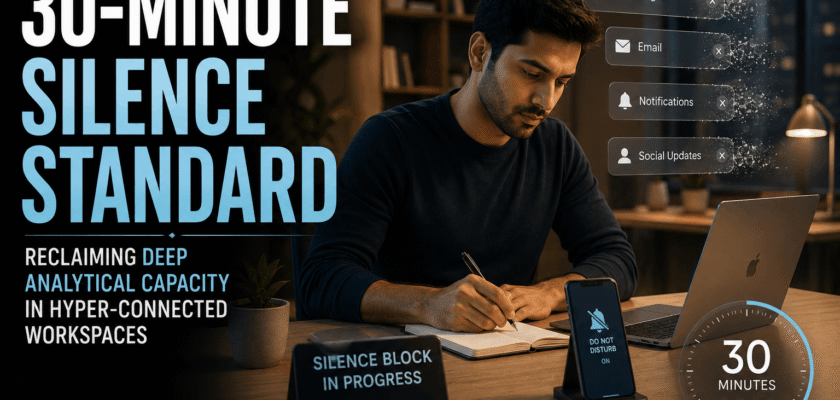
30-Minute Silence Standard: Why Modern Work Needs Quiet Again
30-minute silence standard is becoming important because modern workers are surrounded by notifications, meetings, emails, chats, AI tools, dashboards, and constant digital noise. The workday looks busy, but deep thinking often gets pushed out.
In hyper-connected workspaces, people are available all the time, but they are not always focused. A worker may switch between Slack, WhatsApp, email, Excel, calls, browser tabs, and AI prompts in the same hour. This makes serious thinking harder.
Therefore, the 30-minute silence standard is a simple rule: protect at least 30 minutes of uninterrupted quiet time for deep analytical work every day.
Why 30-Minute Silence Standard Matters in 2026
30-minute silence standard matters because workplace attention is under pressure. Microsoft’s Work Trend Index reported that employees using Microsoft 365 are interrupted on average every two minutes by a meeting, email, or notification.
That level of interruption breaks mental flow.
Scientific American also reported in May 2026 that digital distractions can weaken focus, but people’s natural capacity to pay attention has not disappeared. In simple words, attention can be trained and recovered with better habits.
This is why a daily silence window can become a practical productivity tool.
What Is the 30-Minute Silence Standard?
The 30-minute silence standard means creating one fixed block of 30 minutes where a person does not check messages, answer calls, attend meetings, scroll social media, or switch between tasks.
During this block, the goal is deep thinking.
It can be used for:
- Strategy writing
- Financial analysis
- Research
- Coding
- Study
- Planning
- Problem solving
- Report writing
- Creative thinking
- Decision review
This is not a break. It is focused work without noise.
30-Minute Silence Standard and Deep Analytical Capacity
30-minute silence standard helps rebuild deep analytical capacity because the brain needs uninterrupted time to connect ideas. Complex thinking cannot happen properly when attention keeps breaking.
Deep analytical capacity means the ability to think clearly about difficult problems.
It helps with:
- Better decisions
- Cleaner writing
- Stronger problem solving
- Deeper research
- Better planning
- Less impulsive reaction
- More original ideas
- Better memory
- Lower mental clutter
- Higher work quality
When silence protects attention, thinking becomes sharper.
Why Hyper-Connected Workspaces Reduce Focus
Hyper-connected workspaces reduce focus because they make every message feel urgent. A worker may receive meeting alerts, email pings, app notifications, phone calls, AI tool updates, calendar reminders, and team chat messages all day.
This creates fragmented attention.
Microsoft’s “infinite workday” research also found that meetings often fill peak productivity hours, leaving less space for deep focus work.
The problem is not only long work hours. The problem is broken attention inside those hours.
The Real Cost of Constant Task Switching
Task switching feels small, but it has a hidden cost. Every time a person changes from one task to another, the brain needs time to re-enter the previous task.
For example:
- Writing a report
- Checking a message
- Returning to the report
- Opening email
- Returning again
- Joining a quick call
- Returning again
This loop makes the work feel longer and harder.
A 30-minute silence block reduces this switching cost.
It gives the brain one clean direction.
Why 30 Minutes Is a Practical Starting Point
Thirty minutes is practical because it is long enough for meaningful focus but short enough for busy workplaces. Not everyone can block three hours daily. But most people can protect one 30-minute window if the team respects it.
A 30-minute block can help workers:
- Start deep work
- Finish one difficult task
- Make a clear decision
- Write a first draft
- Review data calmly
- Plan the day
- Solve one problem
- Read one important document
- Prepare a meeting properly
- Think without pressure
Small silence can create big clarity.
30-Minute Silence Standard vs Digital Detox
The 30-minute silence standard is not a full digital detox. A digital detox may mean staying away from devices for hours or days. The silence standard is smaller and more practical.
It means choosing one daily period where digital noise stops.
During this time:
- Phone stays silent
- Notifications stay off
- Email stays closed
- Chat apps stay closed
- Meetings are avoided
- Browser tabs are limited
- Social media is blocked
- Only one task stays open
This makes it easier to follow daily.
How to Start the 30-Minute Silence Standard
Starting is simple.
Follow this routine:
- Choose one fixed 30-minute slot
- Tell your team or family
- Turn off notifications
- Keep only one task open
- Put phone away
- Use a timer
- Write the task goal before starting
- Work without switching
- Note what you completed
- Repeat daily
The key is consistency.
Doing this daily is better than doing two hours once a week.
Best Time for 30-Minute Silence
The best time depends on the person’s energy. Many people focus better in the morning. Some focus better after lunch or late evening.
Good silence slots may be:
- First 30 minutes after reaching office
- Before opening email
- After lunch recovery
- Before an important meeting
- Last 30 minutes for planning
- Early morning at home
- Evening after work calls end
The best time is the one you can protect regularly.
What to Do During the Silence Block
A silence block should be used for high-value work. Do not waste it on small admin tasks.
Use it for:
- Writing strategy
- Solving a hard problem
- Reviewing important data
- Learning a difficult concept
- Planning a project
- Reading a serious document
- Making a decision
- Creating a proposal
- Analysing business metrics
- Studying without distraction
The task should be important enough to deserve silence.
What Not to Do During the Silence Block
Do not use the silence block for low-value or distracting work.
Avoid:
- Checking email
- Replying to messages
- Scrolling reels
- Reading random news
- Attending calls
- Jumping between tabs
- Organising files only
- Watching videos
- Doing shallow admin work
- Multitasking
The goal is depth, not busyness.
Silence Does Not Mean Doing Nothing
Silence does not mean laziness. It means removing noise so the mind can work properly.
Many people confuse quiet with inactivity. But some of the best thinking happens when the environment is calm.
A silence block can produce:
- Better ideas
- Clearer writing
- Stronger analysis
- Better judgement
- More thoughtful replies
- Fewer mistakes
- Faster completion
- Less stress
- Improved confidence
- Better memory
Quiet work can be powerful work.
Workplace Rules for the 30-Minute Silence Standard
A workplace should support silence with simple rules.
Teams can follow:
- No meetings during focus blocks
- No urgent tags unless truly urgent
- Respect calendar focus time
- Use async updates
- Avoid “quick call?” messages
- Keep notifications off
- Batch non-urgent questions
- Set response expectations
- Protect peak focus hours
- Encourage quiet zones
If managers respect silence, employees will also respect it.
Manager Role in Protecting Focus
Managers play a big role. If managers send constant messages and expect instant replies, the 30-minute silence standard will fail.
Managers should:
- Set focus windows
- Avoid unnecessary meetings
- Allow delayed replies
- Define urgent vs non-urgent
- Encourage deep work
- Reduce meeting overload
- Keep communication clear
- Avoid micromanagement
- Reward output, not online status
- Protect team energy
A focused team often produces better work than a constantly available team.
The 30-Minute Silence Standard for Students
Students can use the 30-minute silence standard for study. Many students lose focus because of phones, chats, gaming, short videos, and constant switching.
A student can use 30 minutes for:
- One chapter
- One difficult topic
- One writing task
- One revision session
- One maths practice set
- One coding problem
- One mock test review
- One diagram practice
- One summary note
- One exam plan
This is especially useful for students who feel they cannot focus for long.
Start with 30 minutes. Build later.
The 30-Minute Silence Standard for Creators
Creators can use silence for idea generation. Content creation needs trend awareness, but too much scrolling can destroy originality.
Creators can use 30 minutes to:
- Write scripts
- Plan blog outlines
- Review analytics
- Create thumbnails
- Study competitors
- Draft captions
- Generate title ideas
- Plan content calendar
- Edit a video section
- Think of original angles
Silence helps creators move from copying trends to building unique ideas.
The 30-Minute Silence Standard for Business Owners
Business owners need silence because they make decisions all day. Constant calls, customer issues, staff questions, and payment updates can reduce strategic thinking.
A business owner can use 30 minutes for:
- Cash flow review
- Marketing plan
- Team planning
- Client strategy
- Service improvement
- New offer design
- Sales review
- Hiring plan
- Cost control
- Long-term goals
A business grows better when the owner gets thinking time.
Why Silence Helps Emotional Control
Silence also helps emotional control. When people react instantly to every message, they may send angry replies or make rushed decisions.
A quiet block creates space.
It helps you:
- Think before replying
- Reduce emotional reaction
- Understand the real issue
- Avoid unnecessary conflict
- Write clearer messages
- Make calmer decisions
- Reduce stress
- Stop urgency addiction
- Improve patience
- Protect mental energy
Silence makes response better than reaction.
The Link Between Silence and Mental Recovery
Silence can support mental recovery because the brain gets fewer inputs. In a noisy digital day, the mind keeps processing messages, visuals, sounds, and decisions.
A low-stimulation period can help the nervous system reset.
Recent attention discussions suggest that short breaks with minimal mental stimulation, like walking or quiet daydreaming, can support recovery from distraction-heavy work.
This does not mean silence solves every mental health issue. But it can be a useful daily support habit.
Should the Silence Block Be Phone-Free?
Yes, the silence block should ideally be phone-free. Even a silent phone on the desk can pull attention because the mind expects messages.
Keep the phone:
- In another room
- Inside a drawer
- Face down
- On airplane mode
- On Do Not Disturb
- Away from your hand
If your work requires phone access, turn off all non-essential alerts.
The goal is to remove temptation.
How to Handle Urgent Work During Silence
Some jobs need urgent response. In that case, create a clear emergency rule.
For example:
- Only calls from manager bypass Do Not Disturb
- Emergency keyword is used in chat
- Team knows your 30-minute focus slot
- One backup person handles urgent issues
- You check messages immediately after the block
Most “urgent” messages are not truly urgent.
Clear rules reduce anxiety.
Silence Rooms in Modern Offices
Some offices are now creating quiet rooms, wellness spaces, focus pods, and low-stimulation zones. These spaces help workers step away from open-office noise.
A good silence room should have:
- Soft lighting
- No calls rule
- Comfortable seating
- Acoustic treatment
- Minimal décor
- No loud typing zone
- Clean air
- Simple booking system
- Clear usage rules
- Respectful culture
A silence room should not become a meeting room.
Its purpose is focus and recovery.
Why Open Offices Need Quiet Zones
Open offices support teamwork, but they also create distraction. Calls, keyboards, walking, chair noise, and side conversations can break concentration.
Quiet zones help balance collaboration with deep work.
A workplace needs both:
- Collaboration areas
- Focus areas
- Meeting rooms
- Recovery zones
- Call booths
- Quiet desks
- Social spaces
- Private thinking corners
One space cannot serve every work style.
Good office design respects attention.
The Role of AI in Focus Management
AI tools can help focus if they reduce admin work. But AI can also create more tabs, more prompts, more notifications, and more output pressure.
A 2026 workplace AI research paper found that many workplace AI incidents come from misalignment between what workers need and what systems provide, with developers often overfocusing on efficiency and speed.
This is a useful warning.
AI should reduce noise, not add more.
A 30-minute silence block can help workers use AI intentionally instead of constantly reacting to it.
How to Combine AI With the Silence Standard
AI can be used inside the silence block, but only if it supports the main task.
Good use:
- Summarising one document
- Checking one draft
- Analysing one dataset
- Creating one outline
- Asking one focused question
Bad use:
- Jumping between prompts
- Asking random questions
- Opening many AI tools
- Generating endless versions
- Letting AI distract from thinking
AI should be a tool, not a new distraction.
Deep Work Checklist Before Starting
Before starting 30 minutes of silence, prepare a simple checklist.
Check:
- Task is clear
- Phone is away
- Notifications are off
- Water is nearby
- Only one tab is open
- Timer is set
- Desk is clean
- Headphones are ready if needed
- Goal is written
- End result is defined
Preparation reduces excuses.
How to Measure Progress
You can measure the 30-minute silence standard with simple tracking.
Track:
- Days completed
- Task finished
- Distractions avoided
- Focus quality
- Energy level
- Output quality
- Mistakes reduced
- Stress level
- Time saved
- Ideas generated
Do not overcomplicate it.
A simple habit tracker is enough.
Common Mistakes to Avoid
Many people fail because they make silence too strict or too vague.
Avoid:
- Starting with two hours
- Not choosing a task
- Keeping phone nearby
- Checking messages “just once”
- Doing shallow work
- Expecting instant magic
- Changing timing daily
- Not informing team
- Using silence as avoidance
- Giving up after one bad day
Start small and repeat.
7-Day 30-Minute Silence Challenge
Try this simple 7-day challenge.
Day 1
Write one pending task.
Day 2
Read one serious document.
Day 3
Plan one project.
Day 4
Solve one difficult problem.
Day 5
Review your weekly work.
Day 6
Create one original idea.
Day 7
Reflect on what improved.
This challenge can show how much noise affects thinking.
Personal Silence Routine for Home Workers
Home workers also need silence. Remote work can feel flexible, but home distractions can be strong.
A home silence routine can include:
- Fixed table
- Phone outside room
- Door closed
- Family informed
- One task selected
- Noise reduced
- Timer set
- No household multitasking
- Short walk after block
- End note written
Working from home needs boundaries too.
The 30-Minute Silence Standard and Burnout Prevention
Silence can help reduce burnout risk by giving the mind recovery space. It does not replace rest, sleep, fair workload, or mental health care. But it can reduce daily overload.
A daily quiet block can help workers feel:
- Less scattered
- More in control
- More thoughtful
- Less reactive
- More productive
- Less overwhelmed
- More confident
- More mentally organised
Burnout prevention needs many changes, but attention protection is one important part.
What Companies Should Not Do
Companies should not turn silence into another forced productivity rule. If silence becomes pressure, it loses its value.
Avoid:
- Monitoring silence blocks aggressively
- Punishing missed days
- Forcing everyone at same time
- Calling silence “lazy time”
- Filling focus blocks with meetings
- Expecting instant output
- Ignoring workload issues
- Using silence to avoid hiring
- Treating it as a wellness gimmick
- Ignoring employee feedback
Silence should support people, not control them.
Future of Focus in Hyper-Connected Workspaces
The future of focus will depend on better digital boundaries. Workplaces may need fewer meetings, smarter notifications, quiet zones, async updates, and protected thinking windows.
Future focus culture may include:
- Meeting-free mornings
- 30-minute silence blocks
- Deep work calendars
- Focus rooms
- AI notification filters
- Async-first updates
- No-message recovery windows
- Device-free strategy sessions
- Mindful communication rules
- Attention-friendly office design
Work will not become less digital. So, attention systems must become stronger.
Final Verdict
30-minute silence standard is a simple but powerful response to hyper-connected workspaces. When notifications, meetings, emails, and chats break attention every few minutes, deep analytical capacity becomes weaker.
A daily 30-minute quiet block can help workers, students, creators, and business owners rebuild focus. It gives the mind enough space to think, write, analyse, plan, and solve problems without constant interruption.
In simple words, the future of productivity may not be more apps. It may be more protected silence.
The 30-minute silence standard is not about escaping work. It is about creating the mental space needed to do better work.


