

ESIC Digital Platform: Why Real-Time Cleanliness Tracking Matters
ESIC digital platform is becoming an important health-tech step because patient experience is not only about doctors and medicines. Cleanliness, staff behaviour, medicine availability, waiting time, and basic service quality also decide how safe and comfortable a healthcare facility feels.
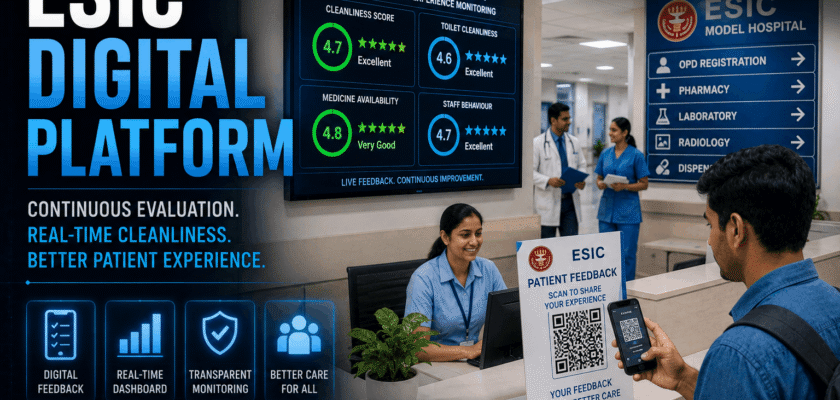
The Employees’ State Insurance Corporation has launched a centralised online patient feedback system across ESIC hospitals and dispensaries nationwide. The platform captures direct feedback from insured persons and beneficiaries on critical service areas, including cleanliness, staff behaviour, and availability of medicines.
Therefore, the ESIC digital platform can help healthcare hubs move from occasional inspection to continuous evaluation.
Why ESIC Digital Platform Matters in 2026
ESIC digital platform matters because India’s public healthcare network serves millions of workers and families. When patients visit a hospital, they often notice problems quickly. A dirty waiting area, rude staff interaction, missing medicine, or slow service can affect trust.
Earlier, such complaints could remain local or informal. Now, a centralised system can collect feedback directly and show patterns through dashboards.
The New Indian Express reported that the system includes role-based digital dashboards for continuous real-time performance monitoring across three administrative levels: headquarters, regional offices, and local ESI health facilities.
This means feedback can move faster from patient voice to administrative action.
What Is the ESIC Digital Platform?
The ESIC digital platform is a centralised online patient feedback system designed for ESIC hospitals and dispensaries. It allows insured persons and beneficiaries to share their healthcare experience, raise concerns, and provide suggestions for improvement.
The platform focuses on:
- Cleanliness of facilities
- Behaviour of medical staff
- Availability of medicines
- Overall patient experience
- Service quality
- Complaint visibility
- Real-time monitoring
- Administrative accountability
- Multilingual access
- Corrective action
In simple words, it gives patients a direct digital voice.
ESIC Digital Platform and Continuous Evaluation
ESIC digital platform supports continuous evaluation because feedback is not collected once in a year. Patients can share experience in real time through digital access points.
This is important because healthcare quality changes daily.
A hospital may look clean during inspection but may face problems during peak hours. Medicine availability may change by department. Staff behaviour may differ by shift. Waiting area hygiene may decline during crowded periods.
Continuous evaluation helps identify these daily gaps.
It turns patient feedback into a live quality signal.
How Patients Can Submit Feedback
The platform gives multiple access channels so patients can submit feedback more easily. Reports say beneficiaries can provide feedback through SMS links, QR codes, and the ESIC website.
This matters because not every patient uses the same digital method.
Some may scan a QR code at the hospital.
Some may use an SMS link after visiting.
Some may access the website directly.
Multiple access points can increase participation and reduce friction.
If feedback is easy, more patients will use it.
Why OTP Validation Is Important
OTP validation is important because healthcare feedback systems must avoid fake ratings, spam, and misuse. If anyone can submit unlimited feedback without verification, the data can become unreliable.
The ESIC system uses OTP validation to ensure authenticity.
This helps the platform collect more trustworthy patient responses.
Authentic feedback matters because hospital performance decisions may depend on it.
If data is weak, action becomes weak.
If data is trusted, action becomes stronger.
Multilingual Support Makes the System More Inclusive
Multilingual support is important because ESIC beneficiaries come from different states, languages, and work backgrounds. A worker in Rajasthan, Tamil Nadu, Bengal, Maharashtra, Kerala, Gujarat, Odisha, Punjab, or Assam may feel more comfortable giving feedback in a familiar language.
The platform includes multilingual support, which can help more beneficiaries participate.
This improves accessibility.
A feedback system should not be limited to English-speaking users. Healthcare feedback must be simple, local, and easy to understand.
Real-Time Dashboards: The Core Strength
Real-time dashboards are the core strength of the ESIC digital platform. Dashboards help administrators see feedback trends quickly instead of waiting for long paper reports.
These dashboards can help track:
- Cleanliness ratings
- Staff behaviour ratings
- Medicine availability feedback
- Facility-wise performance
- Region-wise performance
- Repeated complaints
- Low-rated services
- Corrective action status
- Patient satisfaction trends
- Priority problem areas
The New Indian Express reported that dashboards work across headquarters, regional offices, and local ESI health facilities.
This creates accountability at multiple levels.
Why Ratings Below 3 Are Flagged
A key feature of the platform is automatic flagging of low ratings. Reports say service ratings below 3 are automatically flagged for immediate corrective action.
This is useful because low ratings should not sit unnoticed.
A rating below 3 may indicate:
- Poor cleanliness
- Rude staff behaviour
- Medicine shortage
- Long waiting time
- Bad patient guidance
- Poor facility management
- Service delay
- Hygiene concern
- Communication failure
- Operational weakness
Automatic flags can help managers respond faster.
ESIC Digital Platform and Cleanliness Monitoring
ESIC digital platform can improve cleanliness monitoring because patients see facility conditions directly. They notice toilets, waiting halls, corridors, wards, drinking water areas, and registration counters.
Cleanliness feedback can show whether a facility needs:
- More cleaning staff
- Better shift planning
- Stronger supervision
- Toilet maintenance
- Waste disposal improvement
- Infection control checks
- Waiting area cleaning
- Pest control
- Linen management
- Public hygiene awareness
Clean healthcare starts with daily discipline.
Real-time feedback can push that discipline.
Why Hospital Cleanliness Is a Health Issue
Hospital cleanliness is not only about appearance. It affects patient safety, infection control, dignity, and confidence.
A clean hospital helps reduce:
- Infection risk
- Bad smell
- Patient discomfort
- Staff stress
- Complaint load
- Negative public perception
- Cross-contamination concerns
- Waste exposure
- Visitor dissatisfaction
- Fear among patients
When patients see cleanliness, they feel more confident in the facility.
That is why cleanliness tracking belongs in health quality metrics.
Staff Behaviour Is Also a Patient Experience Metric
The ESIC digital platform also tracks staff behaviour. This is important because healthcare experience depends heavily on communication.
A patient may not understand medical procedures. A calm staff member can guide them. A rude interaction can make the same visit stressful.
Staff behaviour affects:
- Patient trust
- Compliance with treatment
- Complaint levels
- Anxiety
- Facility reputation
- Patient cooperation
- Queue discipline
- Follow-up visits
- Overall satisfaction
- Public confidence
So, behaviour tracking is not cosmetic. It is part of care quality.
Medicine Availability: Why It Matters
Medicine availability is a critical service metric because patients visit ESIC facilities expecting access to required medicines. If medicines are unavailable, patients may have to buy them outside, which increases cost and frustration.
The ESIC digital platform captures feedback on medicine availability.
This can help identify:
- Frequent stock-outs
- Department-wise shortages
- Region-wise supply gaps
- Delayed procurement
- Poor inventory management
- Patient cost burden
- Repeated complaint patterns
- Emergency medicine gaps
- Pharmacy workflow issues
- Supply chain pressure
Better feedback can support better medicine planning.
Centralized Experience Metrics: What They Mean
Centralized experience metrics mean patient feedback from different facilities is collected in one structured system. Instead of isolated complaints, ESIC can compare performance across hospitals and dispensaries.
This can help answer:
- Which facility has better cleanliness?
- Which region has more complaints?
- Which hospital has medicine shortage alerts?
- Which dispensary needs staff training?
- Which issue repeats across many locations?
- Which facilities are improving?
- Which facilities need urgent attention?
- Which managers are responding quickly?
Centralized data helps leaders see the full picture.
Why Performance Ranking Can Improve Quality
Reports say the platform can help generate patient satisfaction data and support facility ranking, encouraging better service delivery.
Performance ranking can create healthy competition among healthcare facilities.
If hospitals know that cleanliness, behaviour, and medicine availability are being tracked, they may improve daily management.
However, ranking must be fair.
It should consider:
- Patient volume
- Facility size
- Location challenges
- Staff shortage
- Infrastructure limits
- Emergency load
- Medicine supply context
- Complaint severity
- Corrective action speed
- Improvement trend
The goal should be quality improvement, not blame.
How Digital Alerts Can Help Administrators
Digital alerts can help administrators act faster. If a facility gets repeated low ratings for cleanliness, the system can alert the responsible team quickly.
A digital alert can trigger:
- Local supervisor review
- Cleaning contractor check
- Pharmacy stock review
- Staff counselling
- Ward inspection
- Facility audit
- Regional office attention
- Headquarters monitoring
- Corrective action report
- Follow-up feedback review
This can reduce delay between complaint and action.
Healthcare systems improve when feedback leads to visible change.
Why Patient Feedback Must Be Actionable
Patient feedback must be actionable. Collecting ratings without fixing problems can reduce trust.
Patients should feel that their feedback matters.
A strong system should:
- Collect feedback
- Validate feedback
- Categorise complaints
- Flag urgent issues
- Assign responsibility
- Track action taken
- Close the loop
- Monitor repeated issues
- Improve policy
- Share progress
Feedback is useful only when it leads to improvement.
How ESIC Hospitals Can Use the Data
ESIC hospitals can use feedback data to improve daily operations.
For example:
- Low cleanliness score can trigger more cleaning rounds
- Low staff behaviour score can trigger training
- Medicine shortage feedback can trigger stock review
- Repeated complaints can trigger facility inspection
- Positive feedback can identify best practices
- Region-level dashboards can guide resource allocation
- Headquarters-level data can shape policy
This makes data practical.
Good dashboards should help managers solve problems, not only display numbers.
Why Healthcare Hubs Need Real-Time Feedback
Healthcare hubs need real-time feedback because delays can harm patients. If a toilet remains dirty for two days, many patients suffer. If medicines are unavailable for a week, patients may spend extra money. If staff behaviour is poor, trust falls quickly.
Real-time feedback helps reduce delay.
It can support:
- Faster issue detection
- Quicker corrective action
- Better patient satisfaction
- Higher accountability
- Improved cleanliness
- Better medicine planning
- Staff training
- Transparent monitoring
- Facility comparison
- Continuous service improvement
This is why digital feedback matters in healthcare.
Benefits for Insured Persons and Beneficiaries
The ESIC digital platform can benefit insured persons and beneficiaries by making it easier to report problems and suggest improvements.
Patients can benefit through:
- Direct complaint channel
- Easier feedback access
- Faster issue visibility
- Better cleanliness focus
- Improved staff accountability
- Better medicine tracking
- More transparent service quality
- Multilingual participation
- Greater patient voice
- Better facility management
This can make patients feel more included in healthcare improvement.
Benefits for Doctors and Staff
The platform can also benefit doctors and staff if used fairly. Feedback can show where systems are failing, not just where individuals are failing.
For example, a doctor may face patient anger because medicines are unavailable or queues are poorly managed. Better data can help administrators fix operational issues.
Staff can benefit through:
- Clear service gaps
- Better resource planning
- Cleaner work environment
- Reduced repeated complaints
- Evidence-based training
- Better facility support
- Recognition for good service
- Improved patient trust
- More structured issue reporting
- Stronger management response
A feedback system should support staff improvement, not only punish staff.
Risks of Digital Feedback Systems
Digital feedback systems also have risks. If not designed well, they can create fear, data misuse, or unfair ratings.
Possible risks include:
- Fake complaints
- Angry emotional ratings
- Staff harassment
- Data overload
- No follow-up action
- Poor dashboard use
- Ignoring non-digital patients
- Language barriers
- Technical glitches
- Blame culture
OTP validation and structured dashboards can reduce some risks, but human review is still important.
The system must be fair and balanced.
Why Feedback Should Include Context
Feedback should include context because a low rating alone may not explain the full problem. A patient may rate cleanliness low, but the issue could be toilet hygiene, ward waste, waiting area crowding, or cleaning delay.
A useful feedback form should capture:
- Facility name
- Department
- Date and time
- Service area
- Issue category
- Rating
- Short comment
- Contact option
- Follow-up status
- Action taken
Context helps managers solve the exact problem.
Digital Health and Accountability
Digital health is not only about telemedicine or apps. It is also about accountability. A feedback system creates a record of patient experience.
This record can help administrators identify weak points and improve services.
Accountability improves when:
- Data is visible
- Roles are defined
- Low ratings are flagged
- Action is tracked
- Facilities are compared
- Patients can report directly
- Leaders review trends
- Staff receive training
- Repeat problems are escalated
- Improvements are measured
The ESIC digital platform can support this model.
Why Cleanliness Needs Daily SOPs
Cleanliness cannot depend only on feedback. Hospitals need daily standard operating procedures, or SOPs.
A cleanliness SOP should include:
- Cleaning schedule
- Toilet inspection checklist
- Waste segregation
- Ward cleaning rules
- Waiting hall cleaning
- Spill response
- Biomedical waste handling
- Supervisor rounds
- Cleaning staff attendance
- Feedback-based review
Feedback can show problems, but SOPs prevent problems.
Both are needed.
Patient Rights and Patient Responsibility
Patients have the right to clean, respectful, and reliable healthcare services. But patients also have responsibility.
Patients should:
- Use feedback honestly
- Avoid fake complaints
- Keep hospital areas clean
- Follow queue rules
- Respect staff
- Report real issues clearly
- Avoid damaging property
- Use correct feedback channels
- Share medicine shortage details
- Avoid spreading rumours
A healthcare system improves when both sides act responsibly.
How ESIC Can Build Trust Through Transparency
ESIC can build trust by showing that feedback leads to action. Patients may not need every internal detail, but they should see visible improvements.
Trust can improve through:
- Cleaner facilities
- Faster response to complaints
- Regular improvement updates
- Facility-level action reports
- Better signage
- Medicine availability updates
- Staff training notices
- Public grievance support
- Feedback closure messages
- Transparent escalation process
When people see improvement, they give more honest feedback.
What Other Healthcare Systems Can Learn
Other public healthcare systems can learn from the ESIC digital platform. Patient feedback should be simple, multilingual, validated, and actionable.
Hospitals, clinics, and health departments can use similar systems for:
- Cleanliness tracking
- Staff behaviour
- Medicine availability
- Waiting time
- Registration experience
- Lab service quality
- Emergency service feedback
- OPD satisfaction
- Ward hygiene
- Discharge process
Digital feedback can improve service quality across healthcare networks.
What Patients Should Check Before Giving Feedback
Patients should give clear and useful feedback.
Before submitting feedback, check:
- Which facility did you visit?
- What was the exact issue?
- Was it cleanliness, staff behaviour, or medicine availability?
- Did it happen today?
- Which department was involved?
- Was the issue resolved?
- Do you have a suggestion?
- Are you using the official link or QR code?
Clear feedback helps faster action.
How Cleanliness Data Can Prevent Bigger Problems
Cleanliness data can prevent bigger problems because repeated low ratings may show early warning signs. A facility with regular hygiene complaints may need urgent inspection before the issue becomes serious.
Data can identify:
- Dirty toilets
- Waste disposal gaps
- Crowded waiting areas
- Poor ward cleaning
- Water leakage
- Pest issues
- Infection control risks
- Cleaning contractor failure
- Staff shortage
- Peak-hour hygiene problems
Early detection can protect patients.
Why Real-Time Feedback Supports Infection Control
Real-time feedback can support infection control because patients and attendants notice visible hygiene problems quickly. While professional infection control needs clinical audits, patient feedback can still act as an early signal.
If many patients report unclean toilets or waste mismanagement, administrators can inspect faster.
This helps improve:
- Basic hygiene
- Patient confidence
- Facility discipline
- Waste management
- Cleaning frequency
- Public health safety
- Staff awareness
- Supervisor accountability
- Maintenance planning
- Risk prevention
Cleanliness is one visible layer of healthcare safety.
Future of Patient Experience Metrics in India
The future of patient experience metrics in India will likely become more digital, real-time, multilingual, and dashboard-driven. Public healthcare systems may use patient ratings to improve facilities, compare performance, and identify urgent gaps.
Future systems may include:
- QR-based feedback
- SMS feedback
- Voice feedback
- Regional language forms
- AI complaint categorisation
- Real-time dashboards
- Facility ranking
- Corrective action tracking
- Public satisfaction summaries
- Patient safety alerts
The ESIC digital platform is a step in that direction.
Final Verdict
ESIC digital platform is an important healthcare quality step because it gives patients a direct way to share feedback on cleanliness, staff behaviour, and medicine availability. With OTP validation, multilingual support, and real-time dashboards, the platform can help ESIC hospitals and dispensaries identify problems faster and take corrective action.
The biggest strength of this system is continuous evaluation. Instead of waiting for occasional inspections, administrators can track patient experience every day.
In simple words, clean and respectful healthcare needs daily monitoring. The ESIC digital platform can turn patient feedback into a real-time improvement tool for healthcare hubs across India.
If used properly, it can improve cleanliness, accountability, transparency, and patient trust.


