
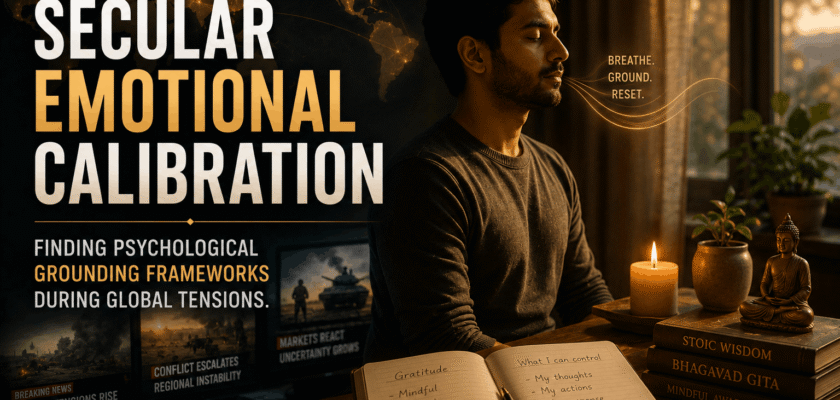
Secular Emotional Calibration: Why Grounding Matters During Global Tensions
Secular emotional calibration is becoming important because global tensions can disturb the mind even when the crisis is far away. War headlines, airport attacks, oil price fears, political uncertainty, market shocks, climate events, and social media panic can make people feel unsafe, tired, and emotionally overloaded.
This does not mean a person is weak. It means the nervous system is reacting to repeated signals of danger. When the brain sees too much crisis content, it may stay alert even during normal daily life.
Therefore, secular emotional calibration gives a practical framework for staying grounded without depending on any one religion, belief system, or spiritual label.
Why Secular Emotional Calibration Matters in 2026
Secular emotional calibration matters because people are living inside a constant information storm. A person may wake up, check the phone, see war updates, market panic, accident videos, political fights, and fear-based posts before even drinking water.
The American Psychological Association says uncertainty can increase stress, and people can cope better by focusing on what they can control, limiting exposure to distressing news, building skills, and staying connected with supportive people.
NHS Inform also explains that grounding exercises, breathing exercises, and relaxation methods can help when stress and anxiety feel overwhelming.
This makes grounding a daily skill, not only a therapy concept.
What Is Secular Emotional Calibration?
Secular emotional calibration means adjusting your emotional state through simple, non-religious practices. It helps you move from panic, confusion, or emotional overload toward stability, clarity, and practical action.
It can include:
- Breathing exercises
- Grounding techniques
- Silence periods
- Body awareness
- News boundaries
- Journaling
- Walking
- Routine building
- Focused work
- Supportive conversations
In simple words, it means training yourself to come back to the present moment when the world feels unstable.
Secular Emotional Calibration and Psychological Grounding
Secular emotional calibration works closely with psychological grounding. Grounding techniques help the mind reconnect with the present moment instead of getting trapped in fear, memory, imagination, or worst-case thinking.
Cleveland Clinic explains that grounding techniques often use the senses, such as sight, sound, touch, taste, and smell, to help people feel more present when overwhelmed.
This is why grounding is practical.
You do not need special equipment.
You do not need perfect silence.
You do not need a religious ritual.
You only need attention and a few minutes.
Why Global Tensions Affect Personal Peace
Global tensions affect personal peace because the human brain is wired to scan for danger. When news repeatedly shows conflict, missiles, protests, disasters, or economic instability, the brain may treat the world as unsafe.
This can lead to:
- Restlessness
- Doomscrolling
- Poor sleep
- Irritability
- Fear of future
- Body tension
- Overthinking
- Emotional numbness
- Panic buying
- Difficulty focusing
Even if your personal life is stable, the mind can still absorb global anxiety.
That is why emotional calibration is necessary.
Grounding Through Chaos: The Core Idea
Grounding through chaos does not mean ignoring reality. It means staying stable enough to respond wisely.
A grounded person can still care about world events.
A grounded person can still read news.
A grounded person can still feel sadness.
However, they do not let every headline control their nervous system.
The core idea is simple:
Notice the world. Then return to your body, breath, routine, and values.
This is the heart of secular emotional calibration.
The 5-4-3-2-1 Grounding Method
The 5-4-3-2-1 grounding method is one of the easiest ways to return to the present moment. It uses the senses to slow mental panic.
Try this:
- Name 5 things you can see
- Name 4 things you can feel
- Name 3 things you can hear
- Name 2 things you can smell
- Name 1 thing you can taste
This method works because it shifts attention from fear-based thoughts to real sensory details around you.
Use it after reading stressful news, before sleep, or during emotional overwhelm.
Breathing as Emotional Reset
Breathing is one of the simplest emotional reset tools. When stress rises, breathing can become fast and shallow. Slow breathing can help the body feel safer.
NCBI’s StatPearls review explains that relaxation techniques are used to decrease physical and psychological tension and can support people experiencing anxiety, stress, pain, or distress.
A simple breathing practice:
- Inhale for 4 seconds
- Hold gently for 2 seconds
- Exhale for 6 seconds
- Repeat for 3 to 5 minutes
The longer exhale helps the body move toward calm.
Silence as a Secular Spiritual Practice
Silence can work as a secular spiritual practice because it gives the mind space to settle. You do not need to chant, pray, or follow any ritual if that does not fit your belief. You can simply sit quietly and let the nervous system reduce noise.
A silence practice can be:
- 5 minutes in the morning
- 10 minutes before sleep
- 15 minutes after work
- 30 minutes on Sunday
- 3 deep breaths before news reading
Silence helps you hear your own mind again.
In a noisy world, silence becomes self-protection.
News Boundaries Are Emotional Boundaries
News boundaries are emotional boundaries. Staying informed is important, but constant exposure can create fear without action.
A healthy news boundary can include:
- Check news only twice daily
- Avoid news before sleep
- Do not watch violent clips repeatedly
- Follow trusted sources only
- Avoid forwarded panic messages
- Turn off breaking-news alerts
- Read summaries instead of live doomscrolling
- Take action where possible
- Stop when the body feels tense
- Balance news with normal life
This does not make you careless. It makes you emotionally responsible.
Secular Emotional Calibration and Control
Secular emotional calibration teaches a clear control rule.
Divide life into two lists.
What You Cannot Control
- Wars
- Global politics
- Oil prices
- Foreign leaders
- Social media panic
- Breaking news
- Other people’s reactions
What You Can Control
- Your breath
- Your schedule
- Your sleep
- Your food
- Your spending
- Your work
- Your words
- Your screen time
- Your response
- Your support system
This simple separation reduces helplessness.
Routine Is a Grounding Framework
Routine is one of the strongest grounding frameworks. When the world feels unstable, predictable daily actions tell the brain that life still has structure.
A grounding routine may include:
- Fixed wake time
- Morning water
- 10-minute walk
- Simple breakfast
- Work block
- News limit
- Evening family time
- Phone-free meal
- Night journaling
- Fixed sleep time
Routine does not remove world problems. It protects your inner stability while problems exist.
Body-Based Grounding
Body-based grounding helps when thoughts are too loud. Instead of trying to argue with the mind, you bring attention to the body.
Try:
- Press feet into the floor
- Hold a cold glass of water
- Stretch shoulders
- Wash face with cool water
- Walk slowly
- Notice hand texture
- Sit with straight spine
- Relax jaw
- Open and close fists
- Feel breathing in the chest
Body awareness can interrupt panic loops.
Journaling for Emotional Calibration
Journaling helps turn emotional noise into clear words. When feelings stay inside the mind, they may feel bigger. Writing them down can make them easier to understand.
Try three simple questions:
- What am I feeling right now?
- What triggered this feeling?
- What is one useful action I can take?
This keeps journaling practical.
You do not need perfect grammar. You only need honesty.
Spirituality Without Escapism
Spirituality should not become escapism. Some people use spiritual language to avoid real problems. That is not grounding.
Healthy spirituality says:
- I accept reality
- I calm my body
- I choose wise action
- I protect my values
- I stay kind
- I do what I can
- I release what I cannot control
Escapism says:
- I will ignore everything
- Nothing matters
- I will avoid responsibility
- I will hide from action
Secular emotional calibration supports calm action, not denial.
Emotional Calibration During War News
War news can create fear because it involves uncertainty, violence, and human suffering. You may feel sad, angry, helpless, or scared.
During war news, try this:
- Read from verified sources
- Avoid graphic videos
- Check updates at fixed times
- Donate or help if possible
- Talk to someone calm
- Do breathing after reading
- Avoid arguing online
- Focus on daily duties
- Sleep on time
- Remember that panic does not help victims
Compassion needs stability.
If you burn out emotionally, you cannot help anyone.
Emotional Calibration During Market Panic
Global tensions can create market panic, oil price fear, currency pressure, and financial anxiety. People may make rushed money decisions when fear is high.
Before reacting financially, pause.
Ask:
- Is this verified?
- Is this short-term panic?
- Do I understand the risk?
- Am I acting from fear?
- Do I need expert advice?
- Is my emergency fund safe?
- Can I wait 24 hours before deciding?
A calm mind makes better financial decisions.
Emotional Calibration During Social Media Panic
Social media panic spreads quickly because fear gets attention. A dramatic post may reach you before verified facts do.
During social media panic:
- Do not forward instantly
- Check date and source
- Avoid comment fights
- Mute panic accounts
- Report fake content
- Take screen breaks
- Remember algorithms reward emotion
- Follow experts, not loud voices
- Keep phone away during meals
- Use social media with intention
Your nervous system should not be controlled by trending hashtags.
The Role of Community Support
Community support is a major grounding tool. During uncertain times, people cope better when they feel connected.
Support can come from:
- Family
- Friends
- Teachers
- Mentors
- Faith groups
- Wellness communities
- Therapists
- Colleagues
- Neighbours
- Online support groups
You do not need to carry global stress alone.
A calm conversation can reduce emotional load.
Secular Emotional Calibration for Students
Students may feel global tensions plus exam pressure, career uncertainty, and social comparison. For students, grounding should be simple.
Try:
- 30-minute study block
- Phone away while studying
- 5-minute breathing before revision
- News only after study
- Walk after dinner
- Sleep before midnight if possible
- Talk to a trusted person
- Write next day’s plan
- Avoid comparing life online
- Focus on one chapter at a time
A stable routine protects learning.
Secular Emotional Calibration for Working Professionals
Working professionals may feel pressure from deadlines, family duties, money worries, and global news. The mind can feel overloaded.
Try:
- Start work with one priority
- Use short breathing breaks
- Do not check news during deep work
- Keep lunch phone-free
- Take a short evening walk
- Write unfinished tasks before leaving work
- Avoid doomscrolling after office
- Sleep with phone away
- Reduce caffeine late evening
- Speak calmly in tense meetings
Small rules can protect mental energy.
Secular Emotional Calibration for Creators
Creators are exposed to trends, comments, analytics, and public reactions. Global tension content can become tempting because it gets clicks, but it can also increase emotional stress.
Creators should:
- Verify before posting
- Avoid fear-based thumbnails
- Take breaks from live updates
- Balance trend coverage with wellbeing
- Avoid reading all comments
- Create from clarity, not panic
- Use calm language
- Protect sleep
- Set upload boundaries
- Remember audience responsibility
Creators influence public mood. They need grounding too.
The Three-Minute Reset
The three-minute reset is useful when you are busy.
Minute 1: Breathe slowly.
Minute 2: Notice your body and surroundings.
Minute 3: Choose one next action.
This reset can be used before calls, after stressful news, during anger, or before sleep.
It is short, but powerful.
Many people do not need a long retreat. They need small resets repeated daily.
The 24-Hour Emotional Rule
The 24-hour emotional rule says: do not make major decisions during emotional storms unless there is real emergency.
Wait 24 hours before:
- Posting angry comments
- Making big purchases
- Selling investments in panic
- Ending relationships impulsively
- Sending harsh messages
- Quitting something suddenly
- Sharing unverified news
- Making public statements
Strong emotions are real, but they are not always good advisors.
Wait. Breathe. Then decide.
Grounding With Nature
Nature is a simple grounding support. Mind UK notes that spending time outside and in green spaces can support physical and mental health.
Nature grounding can include:
- Walking near trees
- Sitting in sunlight
- Touching soil
- Watering plants
- Listening to birds
- Watching sky
- Gardening
- Walking barefoot where safe
- Sitting near a window
- Taking slow outdoor breaths
Nature reminds the body that the world is larger than the screen.
Grounding Through Service
Service is a spiritual and psychological grounding practice. When the world feels chaotic, helping someone nearby can reduce helplessness.
Service can be simple:
- Call a worried friend
- Help a neighbour
- Donate to verified relief
- Feed animals
- Support family
- Teach someone
- Volunteer locally
- Share verified information
- Listen without judging
- Offer practical help
Service turns anxiety into action.
Emotional Calibration and Faith
Secular emotional calibration can work with faith or without faith. A religious person may use prayer, scripture, or devotion alongside grounding. A non-religious person may use breathing, silence, journaling, or nature.
Both can be valid.
The key is emotional stability.
A grounded spiritual practice should make you more calm, kind, responsible, and clear.
It should not make you more fearful, hateful, or disconnected from reality.
What Not to Do During Global Tensions
Avoid habits that increase emotional instability.
Do not:
- Doomscroll all night
- Forward unverified videos
- Argue endlessly online
- Ignore sleep
- Use alcohol or substances to cope
- Panic-buy without need
- Make financial decisions in fear
- Treat every headline as personal danger
- Isolate completely
- Shame yourself for feeling stressed
Your body needs care during uncertainty.
When to Seek Professional Help
Grounding is useful, but it is not a replacement for professional help when symptoms are strong or long-lasting.
Seek help if you experience:
- Panic attacks
- Severe sleep problems
- Constant fear
- Loss of daily functioning
- Thoughts of self-harm
- Extreme hopelessness
- Trauma flashbacks
- Uncontrolled anger
- Severe depression symptoms
- Substance dependence
A trained mental health professional can provide proper support.
There is no shame in getting help.
A 7-Day Secular Emotional Calibration Plan
Try this simple 7-day plan.
Day 1
Limit news to two fixed times.
Day 2
Practice 5-4-3-2-1 grounding once.
Day 3
Walk for 10 minutes without headphones.
Day 4
Write your control list.
Day 5
Do 5 minutes of slow breathing.
Day 6
Call one supportive person.
Day 7
Sit silently for 10 minutes and reflect.
Repeat the plan whenever life feels chaotic.
Morning Grounding Routine
A morning grounding routine can set the tone for the day.
Try:
- Do not check phone for 15 minutes
- Drink water
- Take 5 slow breaths
- Stretch your body
- Write one priority
- Say one calm sentence
- Read news later
- Start with one useful action
A grounded morning reduces reactive living.
Night Grounding Routine
A night routine helps the brain close the day.
Try:
- Stop news one hour before sleep
- Dim lights
- Write worries on paper
- Write tomorrow’s first task
- Take slow breaths
- Keep phone away
- Avoid heated debates
- Read something calm
- Thank yourself for one effort
- Sleep at a fixed time
Sleep is emotional repair.
Protect it.
Secular Emotional Calibration for Families
Families can practice grounding together during global tensions.
A family can:
- Avoid fear-based news during meals
- Discuss facts calmly
- Help children understand uncertainty
- Keep routines stable
- Pray or sit quietly together if desired
- Avoid shouting over politics
- Support elderly members
- Limit graphic content
- Share responsibilities
- Create a calm evening habit
A calm home is a powerful protection system.
How Leaders Can Use Emotional Calibration
Leaders, teachers, managers, and creators should use emotional calibration because their mood affects others.
A grounded leader:
- Speaks clearly
- Avoids panic language
- Verifies facts
- Responds calmly
- Protects team focus
- Gives practical direction
- Listens to concerns
- Avoids emotional overreaction
- Keeps routines stable
- Encourages support
During crisis, calm leadership matters.
Future of Secular Grounding Practices
The future of secular grounding practices will likely grow because people need simple tools for a noisy world. Not everyone wants formal religion, and not everyone wants clinical language. Many people want practical emotional stability.
Future wellness spaces may include:
- Silence rooms
- Breathwork breaks
- Digital boundary coaching
- Grounding workshops
- Nature-based recovery
- Mindful leadership training
- School emotional skills
- Workplace focus blocks
- Community support circles
- AI-assisted wellness reminders
The need is clear: modern life needs emotional regulation systems.
Final Verdict
Secular emotional calibration is a practical way to stay grounded during global tensions. It helps people deal with uncertainty, news overload, fear, anger, and emotional fatigue without ignoring reality.
The core tools are simple: breathing, grounding, silence, routine, news boundaries, journaling, nature, service, and supportive connection. These practices do not solve global conflicts, but they help you remain stable enough to live wisely and act responsibly.
In simple words, the world may feel chaotic, but your nervous system does not have to live in permanent emergency mode.
Secular emotional calibration helps you return to the present, protect your peace, and choose your next action with clarity.


