
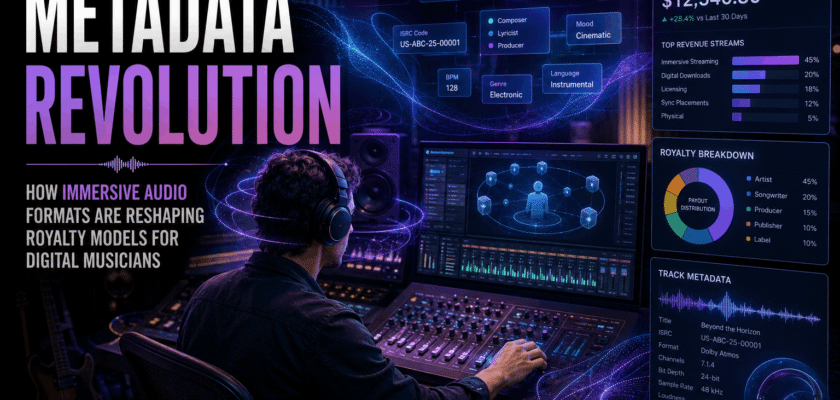
Metadata Revolution: Why Music Credits Are Becoming More Valuable Than Ever
Metadata Revolution is becoming one of the biggest entertainment industry shifts because music is no longer delivered as only one stereo file. Today, a single release may include stereo, Dolby Atmos, binaural, surround, live, radio edit, and platform-specific versions. Each version can carry different assets, technical tags, credits, and payout consequences.
For digital musicians, this changes the meaning of a release. The song is still creative, but the metadata around that song now decides how it is delivered, discovered, identified, reported, and paid. If the metadata is weak, royalties can be delayed, misallocated, or lost.
That is why immersive audio is not only a studio trend. It is becoming a royalty infrastructure trend. The better the metadata, the cleaner the payout path.
Why Metadata Revolution Matters in 2026
Metadata Revolution matters in 2026 because streaming platforms, distributors, labels, publishers, and rights organizations depend on data to know who should be paid. The more versions a song has, the more carefully those versions must be identified.
Apple Music’s Spatial Audio incentive made this more visible. Music Business Worldwide reported that Apple Music confirmed Spatial-available content would receive a royalty rate up to 10% higher than content not available in Spatial Audio. Billboard also reported that Spatial Audio tracks would receive a royalty rate up to 10% higher than non-Spatial content.
This means format availability itself can affect royalty share. A musician who treats metadata as an afterthought may miss opportunities created by new audio formats.
What Is Immersive Audio?
Immersive audio is sound designed to feel more three-dimensional than normal stereo. Instead of sound coming only from left and right, immersive formats can place vocals, instruments, effects, and ambience around the listener.
Dolby describes Dolby Atmos Music as an immersive music experience that adds space, clarity, and depth, making the listener feel like they are inside the song rather than only hearing it.
For musicians, immersive audio can create a richer experience. For platforms, it creates a premium listening feature. For royalty systems, it creates more data to manage.
Why Metadata Is Now a Royalty Engine
Metadata is now a royalty engine because streaming payouts need correct identifiers, contributor details, ownership data, version data, release data, and usage reporting. If the platform cannot identify what was used, who owns it, and who contributed, money can be delayed or misdirected.
DDEX explains that adding immersive audio recordings to a release can mean a release has ten sound recordings on one day, twelve on another day, and nineteen on another day, all potentially with different credits for royalty payments.
This is the core issue. Immersive audio multiplies versions. More versions mean more metadata. More metadata means more chances for mistakes.
Stereo vs Immersive Versions: Why Each Version Needs Clarity
A stereo version and an immersive version may sound like the same song to fans, but the royalty system may treat them as distinct recordings or distinct delivered assets depending on the delivery setup.
A digital musician should clearly track every version, including stereo master, Dolby Atmos master, binaural render, radio edit, clean version, instrumental version, live version, remix, and short-form platform version.
Each version should have correct credits, correct ISRC assignment where required, correct asset metadata, correct rights owner information, and correct release linking. Without this, reporting becomes messy.
Apple Music Spatial Audio Incentive: Why It Changed the Conversation
Apple Music’s higher royalty incentive for Spatial Audio changed the conversation because it connected immersive audio directly with money. Reports said Apple would pay up to 10% more for content available in Spatial Audio, and the bonus was tied to availability rather than only the user playing the Spatial version.
For major labels, this encouraged catalog conversion into Spatial Audio. For independent artists, it created a strategic question: is the cost of immersive mixing worth the potential royalty advantage, branding value, and listener experience?
The answer depends on budget, audience, genre, catalog size, and long-term release strategy. Not every artist should rush blindly, but every serious artist should understand the economics.
Dolby Atmos Music and the Premium Listening Layer
Dolby Atmos Music is one of the most visible immersive formats for streaming music. It is supported across services and devices, and it gives platforms a premium listening story.
For artists, Dolby Atmos can help a track feel more cinematic, spacious, and modern. It works especially well for genres with strong production layers, such as pop, electronic, hip-hop, film music, ambient, devotional music, live concerts, and experimental sound design.
But immersive audio is not only about uploading a different file. It requires proper mixing, mastering, delivery, metadata, quality control, and rights tracking.
The Digital Musician’s New Metadata Checklist
Digital musicians should now prepare metadata before release day, not after problems appear. A clean metadata checklist should include song title, artist name, featured artists, composers, lyricists, producers, mixers, mastering engineer, immersive mix engineer, label, publisher, ISRC, UPC, release date, explicit tag, language, territory rights, and contributor splits.
For immersive releases, add version type, audio format, immersive engineer credits, delivery asset details, format availability, platform requirements, and matching between stereo and immersive versions.
This checklist may look boring, but it protects money.
DDEX and the Metadata Supply Chain
DDEX standards matter because music data moves through many companies. A song may pass from studio to label, distributor, digital service provider, publisher, rights society, royalty accounting platform, and analytics tool.
DDEX says its Recording Information Notification standard enables communication of metadata about entities created and contributors taking part in a studio session. DDEX also says its Recording Data and Rights Revenue standard enables the exchange of revenue information generated from the usage of sound recordings or music videos.
In simple words, DDEX is part of the invisible plumbing that helps music data travel correctly.
How Bad Metadata Delays Royalties
Bad metadata can delay royalties because rights organizations and platforms may not know where to send money. Mistyped names, missing contributors, duplicate recordings, incorrect ISRCs, wrong publisher data, and missing split information can all create problems.
SoundExchange says more complete metadata helps it collect international royalties more effectively. It also notes that ISRCs help distinguish different sound recordings that may otherwise have similar titles or attributes.
For digital musicians, this means clean metadata is not optional. It is part of income protection.
How Immersive Audio Changes Credit Culture
Immersive audio changes credit culture because more people may contribute to the final released experience. A stereo mix engineer may not be the same person as the Dolby Atmos mixer. A mastering engineer may handle stereo while another specialist prepares immersive deliverables.
If those credits are missing, creative contributors may lose visibility and payment opportunities. In some cases, incomplete credits can also create disputes later.
Digital musicians should document immersive mix contributors clearly. This is professional, fair, and financially safer.
Why Independent Artists Must Be Careful
Independent artists may feel pressure to convert songs into immersive formats because major platforms are promoting spatial audio. But indie artists must calculate carefully.
Costs may include immersive mixing, mastering, studio time, quality control, distributor fees, metadata management, artwork updates, and catalog redelivery. If an artist has a small audience, the immediate financial return may be limited.
However, immersive audio can still be useful for brand positioning, sync licensing, fan experience, premium downloads, and future-proof catalog value. The key is not hype. The key is strategy.
Genres That Benefit Most From Immersive Audio
Not every genre benefits equally from immersive audio. Dense and cinematic productions may benefit more because there are more layers to place around the listener.
Strong candidates include electronic music, film scores, live concert albums, devotional and choir music, jazz ensembles, ambient music, orchestral music, experimental pop, progressive rock, and sound design-heavy tracks.
Simple acoustic songs can also work, but only if the immersive mix feels natural. A bad immersive mix can feel gimmicky and damage the song.
Royalty Models Are Moving Beyond Simple Stream Count
Streaming royalties have traditionally been discussed as stream count, but the industry is moving toward more complex value signals. Format availability, user engagement, premium tiers, market share, rights category, and reporting quality all matter.
Spotify explains that no major streaming service pays a fixed rate per stream and that royalties are based on streamshare. Spotify also says it pays roughly two-thirds of revenue to recording and publishing rightsholders.
This means musicians should not think only in “per stream” terms. They should think in rights, metadata, format strategy, and platform economics.
The Rise of High-Resolution Direct-to-Fan Audio
Some artists are also looking beyond streaming. In 2026, Steven Wilson launched Headphone Dust, a high-resolution digital platform offering immersive and hi-res editions outside standard streaming compromises, according to Louder Sound.
This shows another path for digital musicians. Instead of relying only on streaming payouts, artists can sell premium editions directly to fans. These editions may include Dolby Atmos, 5.1 surround, hi-res stereo, binaural mixes, visuals, PDFs, and ownership-based downloads.
For niche artists with loyal audiences, direct-to-fan immersive releases can be more valuable than chasing playlist streams alone.
Practical Release Strategy for Digital Musicians
A smart immersive audio strategy should start with the most important songs, not the entire catalog. Artists can begin with one strong single, an EP, a live session, or a fan-favorite track.
Step one is to check audience demand. Step two is to budget the immersive mix. Step three is to confirm distributor support. Step four is to prepare accurate metadata. Step five is to compare platform requirements. Step six is to promote the immersive version clearly.
The goal is not to follow a trend blindly. The goal is to create a release that sounds better, reports correctly, and supports income.
Metadata Mistakes Digital Musicians Should Avoid
Avoid using different spellings of the same artist name across platforms. Avoid missing songwriter and producer credits. Avoid reusing identifiers incorrectly. Avoid uploading immersive versions without matching them properly to the main release. Avoid forgetting split agreements. Avoid leaving publishing registration incomplete.
Also avoid assuming your distributor will fix everything. Distributors help deliver music, but artists and labels still need to provide clean source data.
The earlier metadata is fixed, the easier royalty reporting becomes.
Future of Immersive Audio Royalty Models
The future of immersive audio royalty models will likely become more detailed. Platforms may reward premium formats, fans may pay for higher-quality editions, rights systems may require more precise metadata, and creators may need stronger version control.
Future royalty systems may track format availability, version engagement, immersive mix credits, spatial listening behavior, direct fan purchases, and premium audio subscriptions.
This future will reward musicians who treat metadata as part of the creative business, not as boring admin work.
Final Verdict
Metadata Revolution is reshaping the music industry because immersive audio formats are turning one release into a multi-asset, multi-credit, multi-format royalty system. Dolby Atmos Music and Spatial Audio are not only improving listening experiences; they are also changing how artists prepare, deliver, identify, and monetize music.
Apple Music’s Spatial Audio royalty incentive made the financial link clear. DDEX guidance shows the metadata complexity behind immersive audio. SoundExchange and Spotify’s royalty explanations show why clean identifiers and accurate rights data matter.
In simple words, digital musicians who want to earn properly in the immersive audio era must master both sound and metadata. The future belongs to artists who can create great music, deliver it in modern formats, and make sure every credit, identifier, and royalty path is correct.


