
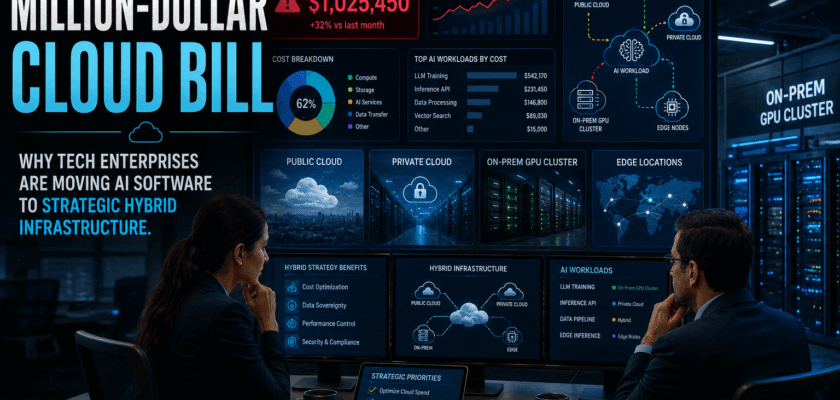
The Million-Dollar Cloud Bill: Why AI Cost Control Became a Boardroom Issue
Million-Dollar Cloud Bill is no longer a dramatic phrase for technology teams. In 2026, it is becoming a real boardroom concern as enterprises move from AI experiments to always-on AI software, agentic workflows, internal copilots, document intelligence, multimodal search, and high-volume inference.
During the first AI adoption wave, many companies used public cloud credits, small pilots, and limited API usage. But once AI moved into customer support, sales automation, fraud detection, coding assistants, analytics, and back-office workflows, usage became continuous. That changed the economics.
The result is simple: AI software can scale faster than budgets.
That is why tech enterprises are now moving from an “all-cloud by default” mindset to strategic hybrid infrastructure. They still use public cloud for speed and elasticity, but they also place predictable, sensitive, or high-volume workloads on private cloud, on-premises GPU clusters, edge devices, or specialist inference platforms.
Why Million-Dollar Cloud Bill Matters in 2026
Million-Dollar Cloud Bill matters because AI workloads are different from traditional cloud workloads. A normal web application may need CPU, storage, database, and network capacity. AI software often needs GPUs, vector databases, model routing, orchestration, data pipelines, monitoring, security layers, and inference capacity.
Reuters reported that Megaport secured four AI infrastructure contracts and plans to raise about US$594 million to build a globally distributed AI inference cloud. The company is focusing on on-demand GPU pools and locating compute closer to users to address latency, connectivity, power, and GPU availability problems.
This shows a bigger market truth: AI infrastructure is moving from simple cloud rental to workload-specific architecture.
Enterprises are asking harder questions now:
- Which AI workloads must stay in public cloud?
- Which workloads should move to private infrastructure?
- Which tasks can run on smaller models?
- Which inference jobs are too expensive at scale?
- Which data cannot leave controlled environments?
- Which use cases need low-latency edge compute?
- Which teams own AI spend?
- How do we prevent cloud bill shock?
- How do we measure cost per AI output?
- How do we keep AI reliable and compliant?
What Is Strategic Hybrid Infrastructure?
Strategic hybrid infrastructure is an architecture where an enterprise places each workload in the environment that best fits cost, performance, compliance, latency, and control. It is not random cloud mixing. It is deliberate workload placement.
A strategic hybrid setup may use public cloud for bursty training and fast experimentation, private cloud for sensitive enterprise data, on-premises GPUs for predictable high-volume inference, edge devices for low-latency local tasks, and specialist AI clouds for GPU-heavy workloads.
The goal is not to leave the cloud. The goal is to stop treating the cloud as the only answer.
| Workload Type | Best-Fit Infrastructure | Reason |
| AI experiments | Public cloud | Fast setup, flexible services, easy scaling |
| Predictable high-volume inference | Private cloud or on-prem GPU pool | Lower long-term unit cost when utilization is high |
| Sensitive regulated data | Private cloud or controlled hybrid stack | Better governance, residency, and audit control |
| Low-latency branch use cases | Edge or local inference | Faster response and lower bandwidth dependency |
| Occasional peak demand | Public cloud burst capacity | Elasticity without owning idle hardware |
| Model orchestration and monitoring | Hybrid control plane | Central governance across environments |
Why Public Cloud Alone Can Become Expensive
Public cloud is powerful, but AI can make it expensive quickly. GPU instances, storage, vector search, API calls, data egress, model monitoring, and repeated inference can add up. In many enterprises, the problem is not one huge training run. The problem is millions of small AI actions happening every day.
Costs can rise due to:
- High GPU instance pricing
- Always-on inference endpoints
- Over-provisioned model serving
- Poor workload tagging
- Uncontrolled employee AI usage
- Repeated RAG retrieval calls
- Data transfer and egress fees
- Multiple teams duplicating similar models
- No cost per use-case dashboard
- Lack of model-routing discipline
A cloud bill becomes dangerous when no one can explain which AI feature created which cost. That is why FinOps for AI is becoming important.
FinOps for AI: The New Cost Discipline
FinOps for AI means applying financial accountability to AI infrastructure. It connects engineering, finance, product, data, and operations teams so that AI spend is visible and tied to business value.
The FinOps Foundation has published guidance for FinOps practitioners managing artificial intelligence costs and resource usage. It highlights that AI workloads can create extra costs through model licensing, governance requirements, audits, compliance, training, inference, storage, and energy use.
For enterprises, FinOps for AI should track:
- Cost per AI request
- Cost per successful output
- Cost per customer interaction
- Cost per agent task
- Token usage by team
- GPU utilization rate
- Model serving idle time
- Data retrieval cost
- Storage and vector database cost
- Cloud vs private infrastructure unit economics
If a company cannot measure AI cost by business unit or use case, it cannot manage AI cost properly.
Why Enterprises Are Moving to Hybrid Infrastructure
Enterprises are moving AI software to hybrid infrastructure for five main reasons: cost control, latency, compliance, resilience, and workload optimization.
1. Cost Control
High-volume inference can become cheaper on private or dedicated infrastructure when usage is predictable and GPU utilization is high. Public cloud remains useful for burst workloads, but steady workloads need deeper cost comparison.
2. Latency
AI agents, voice systems, factory vision, healthcare workflows, and retail operations may need fast responses. Moving some inference closer to users can reduce delay and improve experience.
3. Compliance
Finance, healthcare, government, telecom, and industrial companies often have strict rules around data access, retention, audit, and residency. Hybrid infrastructure gives more control over sensitive data paths.
4. Resilience
Relying on one provider or one region can create operational risk. Hybrid infrastructure can support failover, disaster recovery, and workload mobility.
5. Workload Optimization
Not every task needs the biggest frontier model. Some tasks can run on small models, local models, or specialized models. Hybrid infrastructure makes routing more practical.
Cloud Agents, Device Agents and the Hybrid AI Pattern
A 2026 research paper on hybrid multi-agent systems described a design space between frontier cloud LLMs, which offer strong performance but high cost, and smaller on-device models, which are more cost-efficient but limited. The paper found that hybrid systems can create a middle ground, but the best design is task-dependent and more frontier compute does not always mean better performance.
This is important for enterprises.
A customer support agent may use a small model for simple classification, a medium model for drafting, and a large cloud model only for complex escalation. A retail device may run local recognition, while cloud agents handle deeper planning. A finance workflow may keep private data local but call a cloud model for non-sensitive summarization.
The winning AI architecture is not cloud-only or on-prem-only. It is intelligent routing.
IBM and Google Cloud: Enterprise AI Scaling Signal
IBM and Google Cloud announced a strategic partnership on June 4, 2026 to scale AI with human expertise and AI-powered delivery. IBM said the partnership expands IBM Consulting Advantage with industry-specific agents for Gemini Enterprise and creates a global Google Cloud practice with thousands of consultants helping clients scale AI and modernize core systems.
This is a strong market signal. Enterprises are not asking only for models. They need operating models, consulting support, governance, modernization, and hybrid cloud management.
In other words, the AI infrastructure question has moved beyond “which model is best?” The new question is “how do we run AI safely and affordably inside real enterprise systems?”
AI Inference Is Becoming the Real Cost Center
Training gets attention, but inference often becomes the long-term cost center. Training may happen periodically. Inference happens every time a user asks a question, an agent runs a task, a document is processed, a recommendation is generated, or a workflow is automated.
Inference costs rise when:
- User adoption increases
- Agents run multi-step workflows
- RAG systems retrieve many documents
- Models produce long responses
- Teams call large models for simple tasks
- Applications run 24/7
- Monitoring and guardrails add extra calls
- Companies support multiple languages
- Voice and multimodal use grows
- Retry and validation loops multiply
The million-dollar cloud bill usually comes from repeated usage, not one dramatic event.
The Model Routing Strategy
Model routing means sending each task to the right model instead of sending everything to the most expensive model. This is one of the strongest ways to control AI cost.
A smart routing setup may use:
- Small local model for classification
- Medium model for summarization
- Large model for complex reasoning
- Specialized model for coding
- Vision model only when image input is needed
- Private model for sensitive internal data
- Cloud frontier model for rare high-value tasks
- Cache for repeated answers
- Human review for high-risk outputs
- Fallback model for reliability
This strategy helps enterprises improve cost without killing quality.
The Role of On-Premises GPU Clusters
On-premises GPU clusters are becoming attractive for enterprises with predictable, high-volume workloads. They require upfront investment, operations talent, power, cooling, security, and hardware planning. But for some workloads, they can reduce long-term unit cost and improve control.
On-prem AI infrastructure makes sense when:
- Usage is predictable and high
- Data is sensitive
- Latency matters
- Public cloud GPU cost is too high
- The company has infrastructure talent
- Compliance requires stronger control
- Models can be standardized
- Power and cooling are available
- Utilization can stay high
- Long-term demand is clear
It does not make sense for every company. Small teams may still be better served by public cloud and managed platforms.
Private Cloud for Sensitive AI Workloads
Private cloud can help companies keep sensitive data inside controlled environments while still using cloud-like automation. This is useful for banks, hospitals, governments, telecom companies, legal firms, and industrial operators.
Private cloud helps with:
- Data residency
- Access control
- Audit trails
- Regulatory compliance
- Internal model hosting
- Secure document processing
- Identity management
- Custom governance
- Reduced vendor exposure
- Workload predictability
The trade-off is that private cloud requires stronger internal operations. It is not automatically cheaper unless it is well-managed.
Edge AI and Local Inference
Edge AI means running AI closer to where data is created. This can be useful in factories, hospitals, retail stores, logistics hubs, vehicles, airports, and smart buildings.
Edge AI can support:
- Computer vision inspection
- Retail shelf monitoring
- Voice assistants in branches
- Local security analytics
- Industrial anomaly detection
- Healthcare device intelligence
- Low-latency translation
- Offline field workflows
- Bandwidth reduction
- Privacy-preserving processing
Edge does not replace cloud. It reduces unnecessary cloud dependency for tasks that can run locally.
The Compliance Reason Behind Hybrid AI
Compliance is one of the strongest reasons enterprises move AI software to hybrid infrastructure. AI systems may handle customer data, employee data, financial records, health records, legal documents, intellectual property, and operational data.
Hybrid architecture helps enterprises define where data can go, which model can access it, how outputs are logged, and who can approve sensitive actions.
Compliance teams care about:
- Data lineage
- Model access control
- Audit logs
- Retention rules
- Encryption
- Vendor risk
- Cross-border data transfer
- Human approval
- Output explainability
- Incident response
A public cloud-only approach may still be compliant, but hybrid gives more design options for strict environments.
The Hidden Cost of Data Egress
Data egress is the cost of moving data out of cloud environments. AI systems can create large data movement through logs, embeddings, documents, model outputs, training data, and analytics pipelines.
Data movement costs can grow when:
- Teams move datasets between clouds
- Vector databases are hosted separately
- Apps call external model APIs repeatedly
- Logs are exported to another platform
- Backups move across regions
- Multimodal data is processed externally
- Compliance archives are duplicated
- Analytics pipelines are poorly designed
Hybrid infrastructure can reduce egress when data and compute are placed closer together.
Why Hybrid Does Not Mean Cloud Rejection
Hybrid infrastructure does not mean enterprises are rejecting public cloud. Public cloud remains critical for experimentation, managed AI services, global reach, security tooling, burst capacity, and developer speed.
The shift is more balanced:
- Use public cloud where elasticity matters
- Use private cloud where control matters
- Use on-prem where utilization is predictable
- Use edge where latency matters
- Use specialist clouds where GPU economics are better
- Use governance layer across all of them
The future is not cloud vs on-prem. It is cloud plus private plus edge plus governance.
The AI Workload Placement Checklist
Before moving AI software to hybrid infrastructure, companies should ask:
- Is the workload experimental or production?
- Is usage predictable or bursty?
- Does the workload need GPUs continuously?
- What is the cost per output?
- Does sensitive data leave the environment?
- What latency does the user need?
- Can a smaller model handle the task?
- Is the workload regulated?
- Can the team operate infrastructure safely?
- What is the fallback if one environment fails?
These questions prevent emotional infrastructure decisions.
The CFO View: AI Must Have Unit Economics
CFOs are becoming more involved in AI infrastructure because uncontrolled AI spend can damage margins. A product team may celebrate adoption, but finance will ask whether every AI action creates enough value to justify the cost.
CFOs should track:
- AI cost per customer
- AI cost per transaction
- AI cost per employee
- AI cost per support ticket
- Gross margin impact
- Cloud budget variance
- Cost of idle GPUs
- Vendor contract risk
- Cost of compliance controls
- Return on AI automation
The best AI initiatives can show both usage and economic value.
The CIO View: Architecture Must Stay Flexible
CIOs must avoid infrastructure lock-in. AI models, chips, cloud prices, and regulations are changing quickly. A rigid architecture can become expensive or outdated.
CIOs should build:
- Portable workloads
- Containerized inference services
- Model-agnostic orchestration
- Central observability
- Unified identity and access control
- Hybrid data governance
- Cost tagging standards
- Vendor exit plans
- Security baselines
- Performance benchmarks
Strategic hybrid infrastructure is valuable only when it remains manageable.
The CTO View: Bigger Models Are Not Always Better
CTOs must push teams to test model performance against cost. Many tasks do not need the largest model. A small model can classify documents, detect intent, generate simple labels, or route tickets cheaply.
Use the largest model only when the task needs deep reasoning, creativity, or complex synthesis. This prevents teams from spending premium compute on low-value tasks.
The CISO View: Hybrid AI Expands the Security Surface
Hybrid AI also increases complexity. Data, models, agents, APIs, identities, logs, and infrastructure may run across multiple locations. That can create more security paths to manage.
Security teams should enforce:
- Least-privilege access
- Model access policies
- Prompt-injection controls
- Data loss prevention
- Secrets management
- Central logging
- Runtime monitoring
- Supply-chain checks
- Incident response plans
- Regular AI security testing
Hybrid infrastructure gives control, but only if security is designed centrally.
Common Mistakes Enterprises Make
- Moving workloads to private infrastructure without utilization planning
- Buying GPUs before measuring demand
- Using large models for every task
- Ignoring data egress cost
- Forgetting employee adoption and workflow design
- Creating separate AI stacks in every department
- Skipping FinOps tagging
- Treating compliance as a final review instead of a design input
- Ignoring maintenance and hardware refresh cycles
- Assuming hybrid automatically saves money
Hybrid infrastructure is not a shortcut. It is a management discipline.
When Public Cloud Is Still the Best Option
Public cloud is still the best option for many AI needs. It is especially useful when demand is uncertain or the company lacks infrastructure talent.
Public cloud works well for:
- Early prototypes
- Short-term experiments
- Burst training
- Managed AI services
- Global deployments
- Small companies
- Teams without GPU operations skills
- Rapid model testing
- Temporary workloads
- Integration with cloud-native data services
The point is not to move everything away from public cloud. The point is to stop using public cloud blindly for every AI workload.
When Hybrid Infrastructure Is Worth It
Hybrid infrastructure is worth it when the company has enough scale, predictable usage, compliance requirements, and operational maturity.
It is strongest when:
- AI is core to product strategy
- Inference volume is high
- Sensitive data is involved
- Latency matters
- Cloud bills are rising faster than revenue
- GPU utilization can be managed well
- The company has infrastructure talent
- Regulatory audits are strict
- Business units need cost transparency
- Long-term AI demand is clear
The Future: AI Infrastructure as a Portfolio
AI infrastructure will become a portfolio, not a single platform. Enterprises will mix public cloud, private cloud, on-premises GPUs, specialist AI clouds, edge devices, and model APIs.
The competitive advantage will come from intelligent workload placement, routing, governance, and cost visibility.
Future AI infrastructure teams will manage:
- Model catalogs
- Inference gateways
- Cost dashboards
- GPU pools
- Data residency policies
- Edge deployments
- Private models
- Public cloud services
- Security controls
- Business-value metrics
The companies that win will not be the ones that spend the most on AI infrastructure. They will be the ones that spend with the most discipline.
Practical 10-Step Enterprise Checklist
- Audit current AI cloud spend by team and use case.
- Separate experimental AI from production AI.
- Measure cost per output, not only total cloud spend.
- Classify workloads by data sensitivity and latency.
- Test small, medium, and large models for each task.
- Create a model routing policy.
- Identify predictable high-volume inference workloads.
- Compare public cloud, private cloud, and on-prem unit economics.
- Add FinOps governance and budget alerts.
- Scale hybrid infrastructure only after ROI is proven.
Final Verdict
Million-Dollar Cloud Bill is the reason many enterprises are rethinking AI infrastructure in 2026. Public cloud remains essential, but AI software has changed the cost equation. Always-on inference, agentic workflows, GPU demand, vector search, governance, and data movement can turn small pilots into major budget lines.
Strategic hybrid infrastructure gives enterprises a more balanced path. It lets them use public cloud for speed, private infrastructure for control, on-prem GPUs for predictable volume, edge AI for low latency, and specialist AI clouds for performance fit.
In simple words, the future of enterprise AI will not be all-cloud or all-on-prem. It will be intelligently hybrid.
The companies that survive the million-dollar cloud bill will be the ones that treat AI infrastructure as a business architecture, not just a technical deployment.


