


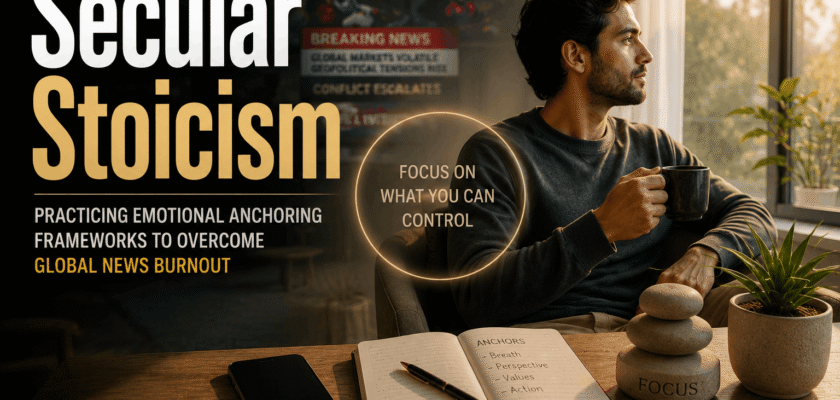
Secular Stoicism: Why It Fits the Age of Constant Crisis
Secular Stoicism is becoming useful for people who feel emotionally overwhelmed by war updates, political conflict, climate warnings, market crashes and constant breaking-news alerts.
The approach takes practical ideas from Stoic philosophy without requiring religious belief. It asks a simple question: what is within your control, what is outside your control, and what is the wisest action available right now?
This framework does not ask people to become cold or indifferent. It teaches emotional steadiness so that concern can become thoughtful action instead of endless panic.
What Global News Burnout Feels Like
Global news burnout can appear as:
- Repeated checking of headlines
- Anxiety after alerts
- Anger without action
- Difficulty sleeping
- Feeling guilty for looking away
- Emotional numbness
- Reduced concentration
- Constant fear about the future
- Loss of interest in normal life
- Helplessness
The problem is not caring too much. It is caring without boundaries, recovery or a clear response plan.
Why the Brain Struggles With Endless Global Threats
Human attention evolved to respond to immediate danger. Modern media delivers distant threats as if they are happening directly inside the room.
The nervous system may react to:
- Graphic videos
- Urgent language
- Repeated alerts
- Conflicting claims
- Uncertain outcomes
- Social-media outrage
- Continuous live coverage
This creates a loop of threat detection without physical resolution.
The Stoic Circle of Control
The circle of control is the most practical Stoic tool.
Inside your control:
- What you read
- How often you check
- How you speak
- What you share
- Where you donate
- How you vote
- How you treat people
- Your daily routine
Outside your control:
- Global events
- Other people’s opinions
- Election results after voting
- Military decisions
- Market reactions
- Weather disasters
- News algorithms
- Rumours created by others
The goal is to move energy from the outer circle to the inner one.
Emotional Anchoring: A Simple Meaning
Emotional anchoring means returning attention to something stable when the mind is pulled into fear.
Anchors can include:
- Breath
- Body sensation
- Prayer or reflection
- A written principle
- A daily routine
- A trusted person
- A meaningful task
- Nature
- Service
- Physical movement
An anchor does not erase the crisis. It stops the crisis from controlling every moment.
The Pause-Before-Reacting Rule
Before responding to a disturbing headline:
1. Stop scrolling
2. Take five slow breaths
3. Check whether the source is reliable
4. Ask whether immediate action is required
5. Decide what useful response is possible
6. Return to your planned activity
This prevents emotional reactions from becoming impulsive sharing, arguments or panic.
News Windows Instead of Constant Monitoring
A Stoic media routine can use fixed news windows.
Example:
- 15 minutes in the morning
- 15 minutes in the evening
- No breaking-news alerts
- No news during meals
- No news one hour before sleep
This keeps people informed without allowing the news cycle to occupy the whole day.
Why Repetition Creates False Importance
A story repeated 50 times may feel 50 times more dangerous, even when no new information has appeared.
Repeated exposure can create:
- Stronger fear
- Greater anger
- False urgency
- Memory distortion
- Reduced perspective
- Emotional exhaustion
A disciplined reader asks: is this new information, or only another version of the same event?
The Difference Between Concern and Rumination
Concern can lead to action. Rumination repeats fear without producing a solution.
Concern asks:
- What happened?
- What can I verify?
- What can I do?
- Who needs support?
Rumination asks:
- What if everything gets worse?
- Why can I not stop thinking about it?
- What terrible outcome might happen next?
Secular Stoicism encourages concern with boundaries.
The View From Above
The Stoic “view from above” is a perspective exercise. Imagine seeing your city, country and planet from a great height.
This can remind you that:
- Your fear is real but not the whole world
- Human history includes many periods of crisis
- Daily kindness still matters
- Life continues through ordinary routines
- One person cannot carry every global problem
Perspective reduces emotional intensity without reducing compassion.
Negative Visualization Without Catastrophizing
Stoics sometimes imagined loss to appreciate what they had. Used carefully, this can strengthen gratitude.
A healthy version asks:
- What do I value today?
- Which relationships need attention?
- What ordinary comfort am I ignoring?
- What would I regret not doing?
The purpose is appreciation, not repeated disaster imagination.
The Evening Reflection Practice
At the end of the day, write:
- What disturbed me?
- What was in my control?
- What action did I take?
- Where did I react badly?
- What will I do differently tomorrow?
- What am I grateful for?
This converts emotional noise into learning.
Why Action Reduces Helplessness
Small action can reduce the feeling of powerlessness.
Possible actions include:
- Donate to a verified organization
- Help a local family
- Volunteer
- Contact a representative
- Support responsible journalism
- Correct misinformation
- Reduce personal waste
- Join a local community effort
Action should be realistic and sustainable.
Do Not Confuse Detachment With Indifference
Stoic detachment means not being controlled by emotion. It does not mean refusing to care.
Healthy detachment allows a person to:
- Listen clearly
- Help effectively
- Avoid panic
- Remain compassionate
- Make better decisions
- Continue daily responsibilities
Indifference says, “It does not matter.” Stoic steadiness says, “It matters, so I must respond wisely.”
Doomscrolling and the Search for Certainty
People often keep scrolling because they hope one more update will make the situation clear.
But many global events remain uncertain.
The search for perfect certainty can create:
- More checking
- Less sleep
- More conflicting information
- Lower concentration
- Stronger anxiety
A Stoic response accepts uncertainty while maintaining practical readiness.
The 10-Minute Grounding Protocol
Use this when a news alert creates strong anxiety:
Minute 1-2: Put the phone down
Minute 3-4: Slow breathing
Minute 5-6: Name five things you can see and feel
Minute 7-8: Write what is within your control
Minute 9: Choose one useful action
Minute 10: Return to normal routine
This is a simple reset, not a cure.
A Secular Morning Practice
A short morning routine can include:
- Two minutes of quiet breathing
- One sentence about what you control
- One important task
- One value to practice
- No headlines before breakfast
- A short walk or stretch
This starts the day with intention rather than reaction.
A Secular Evening Practice
An evening routine can include:
- Stop news one hour before sleep
- Write three lines of reflection
- Read something slow and non-urgent
- Prepare tomorrow’s priorities
- Practice gratitude
- Keep the phone away from bed
Sleep is a major part of emotional resilience.
Why Community Matters
Stoicism is often presented as an individual philosophy, but emotional stability also grows through relationships.
Helpful community practices include:
- Talking with trusted people
- Sharing verified information
- Avoiding rage-based groups
- Helping locally
- Creating phone-free gatherings
- Listening without trying to win arguments
Grounded people help each other remain grounded.
How to Choose Better News Sources
A healthier media diet prioritizes:
- Primary reporting
- Clear corrections
- Transparent sourcing
- Less sensational language
- Context
- Separation of fact and opinion
- Limited graphic content
- Multiple reliable viewpoints
Quality reduces the need for endless checking.
The Three-Source Rule
Before believing or sharing a major claim:
1. Check the original source
2. Check one respected independent outlet
3. Check whether reliable organizations agree
This rule slows misinformation and reduces emotional manipulation.
Why Graphic Content Needs Boundaries
Graphic images can create trauma-like reactions, especially when viewed repeatedly.
People can stay informed without watching every disturbing video.
Practical boundaries include:
- Disable autoplay
- Avoid graphic accounts
- Read summaries instead of watching footage
- Do not view violent content before sleep
- Protect children from exposure
- Stop when physical distress appears
Awareness does not require repeated self-harm through media.
Secular Stoicism at Work
Professionals can use emotional anchoring during unstable news cycles.
At work:
- Keep news tabs closed
- Use fixed update times
- Avoid political arguments during deep work
- Write concerns in a notebook
- Focus on the next useful task
- Take short movement breaks
- Support affected colleagues respectfully
A crisis-aware workplace can still protect concentration.
Secular Stoicism for Parents
Parents can model calm without pretending nothing is wrong.
They can:
- Give age-appropriate explanations
- Avoid leaving alarming news on constantly
- Answer questions honestly
- Maintain routines
- Reassure children about immediate safety
- Teach kindness and practical action
- Watch for sleep or anxiety changes
Children learn emotional regulation by observing adults.
Secular Stoicism and Spiritual Practice
People can combine secular Stoic tools with their own faith or spiritual tradition.
Possible connections include:
- Prayer
- Meditation
- Service
- Gratitude
- Ethical discipline
- Compassion
- Acceptance
- Community
Secular Stoicism does not need to replace religion. It can function as a practical emotional framework alongside it.
When Stoicism Becomes Unhealthy
Stoicism can be misused when people:
- Suppress every emotion
- Refuse help
- Shame themselves for anxiety
- Avoid grief
- Ignore injustice
- Pretend nothing hurts
- Use philosophy to escape relationships
Healthy Stoicism allows emotion, then chooses a wise response.
When Professional Support Is Needed
Seek help when news-related distress causes:
- Persistent insomnia
- Panic attacks
- Depression
- Loss of appetite
- Inability to work
- Severe irritability
- Substance misuse
- Trauma symptoms
- Thoughts of self-harm
A therapist or qualified mental-health professional can provide personalized support.
A Seven-Day Secular Stoicism Reset
Day 1: Turn off breaking-news alerts
Day 2: Use two fixed news windows
Day 3: Write your circle of control
Day 4: Take a 30-minute phone-free walk
Day 5: Perform one helpful local action
Day 6: Practice the evening reflection
Day 7: Review which habits reduced anxiety
Keep the practices that feel sustainable.
A Personal News Constitution
Write simple rules such as:
- I will not share unverified claims
- I will not check news in bed
- I will stop after my news window
- I will act locally when possible
- I will protect sleep
- I will speak respectfully
- I will not confuse panic with responsibility
A written standard makes behaviour easier during emotional moments.
Final Verdict
Secular Stoicism offers a practical response to global news burnout. It does not ask people to stop caring. It teaches them to separate awareness from emotional overload.
The core tools are simple: identify what is within your control, limit repeated exposure, use emotional anchors, verify information and take realistic action.
In simple words, you do not need to carry the entire world in your nervous system to be a responsible person.
Calm attention, truthful information and meaningful action are stronger than endless panic.


