


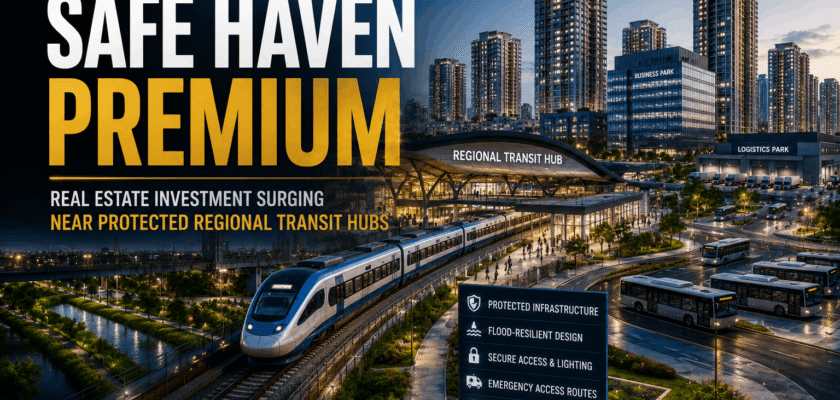
Safe Haven Premium: Why Connectivity and Resilience Now Move Together
Safe haven premium is becoming a useful way to understand why investors are looking beyond crowded city centres toward secure regional transit hubs. These locations combine transport access, emergency resilience, lower entry costs and room for mixed-use development.
In 2026, real-estate growth is increasingly following infrastructure rather than old city boundaries. Expressways, regional rail, metro extensions and multimodal terminals are creating new residential, logistics and commercial markets.
The strongest investment story is no longer simply “near a station.” It is “near a reliable, resilient and economically active transport system.”
Why Regional Transit Hubs Are Attracting Capital
Regional transit hubs reduce travel time and connect smaller cities or outer districts with employment centres.
They can support:
- Residential demand
- Logistics parks
- Warehousing
- Offices
- Retail
- Hotels
- Health facilities
- Education campuses
- Rental housing
- Industrial clusters
This variety of demand makes a well-planned hub more attractive than a single-purpose project.
The Difference Between a Transit Hub and a Protected Transit Hub
A normal transit hub moves people or goods. A protected transit hub is designed for continuity during disruption.
Protection may include:
- Redundant road and rail access
- Flood-resistant design
- Backup power
- Secure stations
- Emergency response systems
- Climate-resilient structures
- Digital monitoring
- Strong maintenance
- Alternative freight routes
- Safe pedestrian access
Investors value infrastructure that is less likely to fail during heat, floods, conflict, fuel shortages or technical breakdowns.
Infrastructure-Led Real Estate Is Expanding in India
Recent 2026 reporting shows that expressways and metro-linked corridors are creating new investment zones across India. Delhi-Mumbai, Dwarka, Yamuna, Samruddhi, Bengaluru-Mysuru and other corridors are attracting housing, industry and logistics activity.
A current KPMG-linked 2026 urban-development report also identified more than 106 million square feet of transit-oriented development potential around railway hubs, metro stations and bus terminals in major Indian cities.
This supports a wider trend: transport investment is becoming a land-value engine.
Why Investors Pay a Premium for Reliable Access
Reliable access reduces uncertainty.
A buyer or tenant may pay more because the location offers:
- Shorter commute
- Better airport access
- Easier goods movement
- Multiple transport options
- Lower delivery risk
- Better emergency evacuation
- Stronger business continuity
- Higher footfall
- Better rental demand
- Lower dependence on one road
Convenience creates demand, but resilience protects that demand.
The Role of Transit-Oriented Development
Transit-oriented development, or TOD, creates compact, mixed-use neighbourhoods around public transport.
A strong TOD district usually includes:
- Housing
- Offices
- Retail
- Public spaces
- Walkable streets
- Schools
- Health services
- Last-mile mobility
- Reduced car dependence
- Higher density near stations
OECD analysis published in 2026 noted that transit projects can attract private investment through higher land values and stable revenue opportunities.
Why City-Centre Risk Is Changing Investor Behaviour
Traditional central business districts can face:
- High prices
- Congestion
- Limited land
- Old infrastructure
- Flooding
- Security bottlenecks
- Expensive parking
- Long commutes
- High operating costs
Regional hubs may offer newer infrastructure, larger plots and lower entry prices while still providing strong connectivity.
The Logistics Advantage
Protected regional hubs are especially valuable for logistics and industrial real estate.
They can offer:
- Highway access
- Rail freight links
- Warehousing land
- Truck terminals
- Airport proximity
- Customs facilities
- Cold-chain support
- Backup routes
- Lower congestion
- Faster regional distribution
This makes them attractive to e-commerce, manufacturing, food, healthcare and retail companies.
Residential Demand Near Regional Hubs
Housing demand often rises when commuting becomes faster and more predictable.
Potential buyers include:
- Office workers
- Industrial employees
- Students
- Medical staff
- Logistics workers
- Airport employees
- Small business owners
- Families seeking lower prices
The strongest residential markets also need schools, hospitals, water, power and public spaces.
Why Security Matters to Commercial Tenants
Businesses increasingly consider continuity risk when choosing locations.
Tenants may prefer hubs with:
- Controlled access
- CCTV and monitoring
- Reliable utilities
- Emergency services
- Multiple exit routes
- Strong telecom networks
- Disaster plans
- Nearby workforce
- Safe public transport
- Backup logistics
Security does not only mean guards. It means operational reliability.
Climate Resilience and Property Value
Climate events can shut roads, damage stations and reduce access to buildings. Resilient infrastructure may protect property values by reducing downtime.
Important features include:
- Elevated roads
- Stormwater systems
- Heat-resistant materials
- Flood barriers
- Green buffers
- Backup drainage
- Solar and battery systems
- Emergency shelters
- Redundant communication
- Climate-risk mapping
A low-price site with high climate risk may be more expensive over time.
Why Investors Should Not Buy Only on Announcement
Infrastructure announcements can create speculation before construction begins.
Investors should verify:
- Funding approval
- Land acquisition
- Tender status
- Construction progress
- Completion timeline
- Station location
- Zoning rules
- Utility plans
- Environmental clearance
- Developer track record
A proposed hub and an operating hub are very different investment products.
The First-Mover Opportunity
Early investors may benefit from lower entry prices, but they accept more risk.
Potential rewards include:
- Land appreciation
- Rental growth
- Commercial demand
- Better resale liquidity
- Development partnerships
Potential risks include:
- Delays
- Route changes
- Overbuilding
- Weak local demand
- Poor last-mile access
- Legal disputes
The best first-mover strategy is based on verified progress, not rumor.
How Land Value Capture Works
Land value capture means using part of the rise in nearby land values to help fund public infrastructure.
Tools can include:
- Development charges
- Betterment levies
- Joint development
- Station-area leases
- Higher floor-space rights
- Public land auctions
- Tax-increment financing
This creates a link between transport investment and urban development.
Regional Hubs and Office Relocation
Companies may move back-office, technology, logistics or support functions to regional hubs because costs are lower.
Benefits can include:
- Lower rent
- Larger floor plates
- Better parking
- Access to new talent
- Reduced central-city congestion
- Easier expansion
- Lower employee housing costs
- Stronger business continuity
This can create long-term office demand outside major downtown areas.
Hospitality and Retail Opportunities
Transit hubs create footfall.
This supports:
- Budget hotels
- Business hotels
- Food courts
- Convenience retail
- Pharmacy
- Co-working
- Short-stay housing
- Vehicle services
- Local tourism
- Entertainment
However, retail success depends on passenger volume and surrounding population, not only station construction.
Rental Yield vs Capital Appreciation
Investors should separate two goals.
Rental yield depends on:
- Current tenant demand
- Rent level
- Vacancy
- Maintenance cost
- Property tax
- Building quality
Capital appreciation depends on:
- Future infrastructure
- New jobs
- Population growth
- Land scarcity
- Development quality
- Market sentiment
A property can appreciate without giving strong rental income, or produce rent without strong price growth.
How to Measure the Safe Haven Premium
The premium can be estimated by comparing similar properties with and without reliable transit access.
Useful indicators include:
- Price per square foot
- Rent per square foot
- Vacancy
- Absorption
- Travel time
- Number of transport modes
- Flood or disruption history
- Utility reliability
- Insurance cost
- Tenant retention
The premium should be measured, not assumed.
What Homebuyers Should Check
Homebuyers should ask:
- Is the station operational?
- How long is the last-mile journey?
- Are schools and hospitals nearby?
- Is water supply reliable?
- What is the flood risk?
- Are maintenance charges reasonable?
- Is the developer credible?
- Will noise be a problem?
- Is the area safe at night?
- Is resale demand real?
A map-pin near transit is not enough.
What Commercial Investors Should Check
Commercial investors should examine:
- Tenant profile
- Lease length
- Footfall
- Loading access
- Power backup
- Telecom redundancy
- Parking
- Security
- Expansion land
- Competing supply
Commercial value depends on business use, not just infrastructure branding.
Risks of Overbuilding Around Hubs
Too much development can create:
- High vacancy
- Traffic pressure
- Water shortages
- Weak rental growth
- Speculative pricing
- Poor public spaces
- Infrastructure overload
- Delayed resale
Good TOD requires balanced planning, not unlimited construction.
Why Smaller Cities May Benefit
Smaller cities often have:
- Lower land prices
- Less congestion
- Room for planned growth
- Growing industrial activity
- Rising demand for housing
- Better potential for integrated hubs
Regional connectivity can make these cities more attractive to businesses and families.
A 10-Point Investment Checklist
Before buying near a regional transit hub, verify:
1. Project funding
2. Construction progress
3. Exact station alignment
4. Zoning and land title
5. Utility availability
6. Local employment demand
7. Flood and climate risk
8. Existing and planned supply
9. Developer credibility
10. Exit and rental strategy
This reduces the risk of buying only on hype.
What Could Drive the Next Wave
The next wave may come from:
- Regional rapid transit
- High-speed rail
- Airport-linked corridors
- Freight terminals
- Riverfront expressways
- Industrial corridors
- Metro extensions
- Multimodal logistics parks
- Climate-resilient transport upgrades
- Smart station redevelopment
These projects can reshape real-estate geography when execution is strong.
Final Verdict
Safe haven premium describes the growing investor preference for real estate near reliable, resilient and well-connected regional transit hubs.
The investment case is supported by lower travel time, stronger logistics, mixed-use demand, climate resilience and business continuity. Current 2026 evidence also shows significant transit-oriented development potential around Indian railway, metro and bus hubs.
However, the premium is not automatic. Investors must verify construction, demand, zoning, utilities and project quality.
In simple words, the best transit-linked real estate is not the property closest to a proposed station. It is the property connected to a functioning economic ecosystem.


