
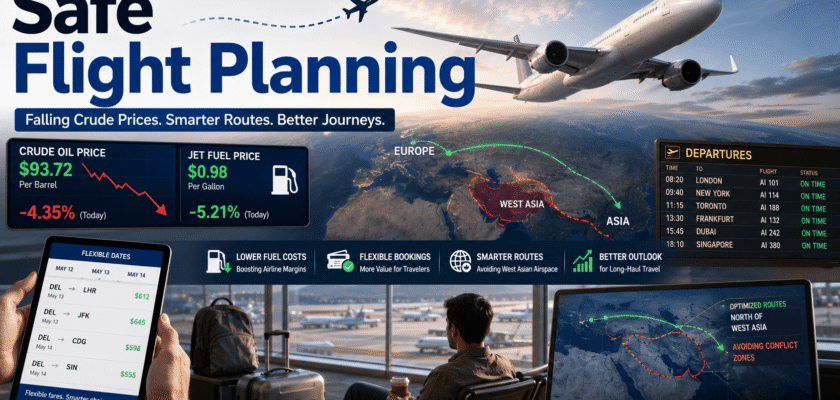
1. Safe Flight Planning Starts With the Fuel Reality
Safe flight planning matters more in 2026 because fuel prices and airspace risks can change international fares within days. Brent crude slipped below $94 after Iran and Israel paused direct attacks. That move brought short-term relief to airlines and travelers.
However, crude oil is only one part of the ticket price. Airlines buy jet fuel, not raw crude. They also pay for crews, aircraft, airport fees, maintenance, insurance and route diversions.
✓ Lower crude can reduce future fuel bills.
✓ Jet fuel may remain expensive for several weeks.
✓ Longer routes can cancel part of the saving.
✓ Airfares depend on demand and seat supply too.
2. Why Crude Below $94 Helps Airlines
Crude below $94 lowers the base cost of refining aviation fuel. Therefore, it can reduce cost pressure if the decline continues.
◆ Refinery feedstock becomes cheaper.
◆ Fuel-surcharge pressure can ease.
◆ Airline cash-flow forecasts improve.
◆ Inflation concerns become smaller.
◆ Travel demand may stay stronger.
3. Why Jet Fuel Is Still Much More Expensive
Jet fuel stayed near $146.25 per barrel even while Brent crude traded near $92.60. The gap reflects a large refining premium, also called the crack spread.
| Price Layer | June 2026 Signal | Traveler Meaning |
| Brent crude | Around $92.60/bbl | Base pressure is easing |
| Global jet fuel | Around $146.25/bbl | Airline costs remain high |
| Fuel cost share | 31.4% of expenses | Fares may stay firm |
| Airspace disruption | Still active on some routes | Longer journeys remain possible |
4. Safe Flight Planning Must Consider Route Diversions
Long-haul airlines may still avoid parts of West Asian airspace. A diversion adds distance, crew time and fuel burn.
→ Europe–Asia flights may use longer northern or southern routes.
→ Connection times can become less reliable.
→ Aircraft may carry extra reserve fuel.
→ Airlines may reduce cargo to protect range.
→ Schedule changes can happen at short notice.
5. Why Ticket Prices Do Not Fall Immediately
Airlines often buy fuel months in advance or use financial hedges. As a result, today’s crude price may affect tickets slowly.
✓ Hedged airlines may already have fixed fuel costs.
✓ Unhedged airlines feel market moves faster.
✓ Airlines first repair margins before cutting fares.
✓ High summer demand can keep tickets expensive.
✓ Limited seats on disrupted routes support higher prices.
| → QUICK TAKEAWAY: A crude-price fall improves the direction of airline costs, but it does not guarantee an instant airfare discount. |
6. Strong Airlines Benefit More Than Weak Airlines
Large network airlines can often recover fuel costs through premium cabins, loyalty programmes and corporate travel. Low-cost or highly indebted airlines have less flexibility.
◆ Premium cabins generate stronger margins.
◆ Loyalty programmes provide stable cash flow.
◆ Large fleets offer route flexibility.
◆ Strong balance sheets support new aircraft purchases.
◆ Weak carriers may cut routes instead of lowering fares.
7. What IATA’s 2026 Outlook Means for Travelers
IATA sharply reduced its 2026 airline-profit forecast because of fuel costs and Middle East disruption. It said jet fuel could account for 31.4% of total operating expenses, up from 25.4% in 2025.
⚠ Airlines will defend fares more aggressively.
⚠ Baggage and seat-selection fees may rise.
⚠ Less profitable routes may lose frequency.
⚠ Premium products may receive more investment.
⚠ Smaller airlines may face financial pressure.
8. Safe Flight Planning for Long-Haul Bookings
✓ Compare direct and connecting routes.
✓ Check the transit country’s airspace status.
✓ Choose flexible or changeable tickets.
✓ Avoid very short connections.
✓ Review airline schedule-change policies.
✓ Keep one backup route in mind.
9. When Should You Book?
Travelers should not wait only for crude prices to fall further. The correct booking time depends on route demand, travel season and seat availability.
| Travel Situation | Suggested Action | Reason |
| Fixed holiday dates | Book when fare is acceptable | Demand can rise faster than fuel falls |
| Flexible dates | Track for 7–14 days | You can compare route changes |
| Emergency travel | Prioritize reliability | The cheapest option may be risky |
| Premium cabin | Watch airline sales | Strong carriers may discount selectively |
| Gulf transit | Use flexible fare | Airspace changes remain possible |
10. Use Total Trip Cost, Not Base Fare
A cheap ticket can become expensive after baggage, seat, meal and cancellation charges.
✓ Add checked-baggage fees.
✓ Check seat-selection cost.
✓ Compare airport-transfer expenses.
✓ Review hotel cost during long layovers.
✓ Include visa or transit-document charges.
✓ Check travel-insurance coverage.
11. Travel Insurance Is More Important in 2026
Regional conflict and airspace disruption can create long delays. A useful policy should clearly explain coverage.
◆ Trip cancellation
◆ Missed connection
◆ Hotel during disruption
◆ Medical emergency
◆ War and terrorism exclusions
◆ Airline schedule changes
12. Common Booking Mistakes
✗ Waiting for crude prices to predict the exact fare bottom
✗ Choosing a one-hour connection during airspace disruption
✗ Ignoring baggage and seat fees
✗ Buying a non-refundable fare for a volatile route
✗ Assuming every airline has the same fuel hedge
✗ Booking through an unknown site to save a small amount
13. Airline Cost Outlook if Crude Stays Under $94
If Brent remains below $94 and shipping conditions improve, airline fuel bills may gradually ease. The strongest relief would appear after jet-fuel refining margins fall and airlines renew fuel purchases.
→ Fuel surcharges may stop rising.
→ Airlines may restore selected routes.
→ Promotional fares may return on competitive corridors.
→ Corporate travel budgets may improve.
→ Weak airlines may still struggle because of debt.
14. Safe Flight Planning Checklist
✓ Check the route and transit airspace.
✓ Compare total fare, not only base fare.
✓ Choose a reliable connection time.
✓ Save airline alerts on your phone.
✓ Keep passport and insurance details offline.
✓ Confirm the flight again before leaving for the airport.
✓ Carry essential medicines in cabin baggage.
✓ Maintain emergency funds for one extra night.
15. Final Verdict
Safe flight planning becomes easier when crude prices fall, but travelers should not confuse cheaper crude with immediately cheaper tickets.
| ★ FINAL TAKEAWAY: Crude below $94 creates welcome relief, yet jet fuel, route diversions and thin airline margins still shape long-haul fares. Book with flexibility, compare the full trip cost and choose reliable routes over the lowest headline price. |


