


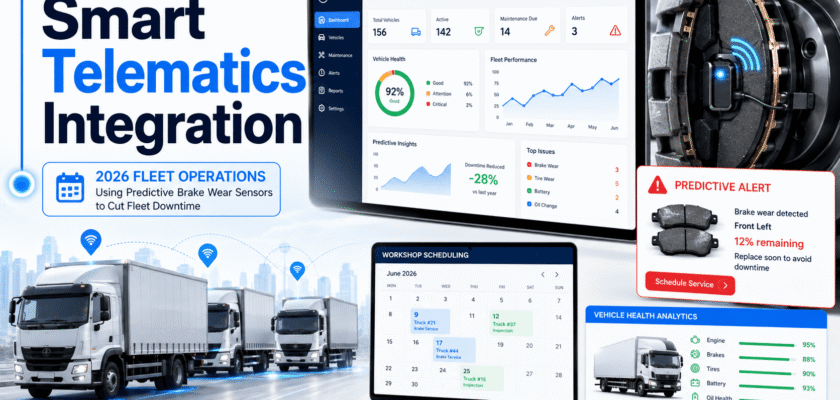
Smart Telematics Integration: Why Fleet Brake Data Matters
Smart telematics integration is becoming a practical answer to one of the oldest fleet problems: unexpected downtime. A truck, bus or delivery van can lose an entire workday because a brake problem is found too late.
In 2026, fleet operators are under pressure to keep vehicles moving while also improving safety and cost control. As a result, predictive brake wear sensors are gaining attention. These sensors can track brake-pad condition, heat patterns, pressure behavior and braking effectiveness.
Instead of waiting for a driver complaint or a fixed service date, telematics systems can send brake-health data to a dashboard. Then the maintenance team can plan service before the vehicle fails on route.
Therefore, the business value is simple. Better brake visibility can reduce emergency repairs, missed trips, towing costs and unsafe vehicle operation.
| KEY TAKEAWAYSmart telematics integration turns brake maintenance from a calendar task into a data-led decision. Fleets can service the right vehicle at the right time, not too early and not too late. |
Smart Telematics Integration and Predictive Brake Wear Sensors
Predictive brake wear sensors work best when they are connected to a wider telematics system. A sensor alone can show a warning. However, a connected system can compare that warning with mileage, route type, vehicle load, driver behavior and past repair records.
This context matters. A city bus may wear brakes faster because it stops all day. A highway truck may show a different pattern. Meanwhile, a delivery van with heavy loads may stress the braking system in shorter cycles.
Because telematics connects these signals, fleet managers can see which vehicles need attention first. Moreover, they can order parts and reserve workshop slots before the brake issue becomes a roadside breakdown.
How Predictive Brake Wear Monitoring Works
✓ Sensors track brake-pad wear, temperature, hydraulic pressure or braking effectiveness.
✓ Telematics units collect sensor data and vehicle operating data.
✓ Cloud or edge software compares current readings with past patterns.
✓ The system flags vehicles that may soon cross a safe wear limit.
✓ Maintenance teams schedule inspection, parts and depot time earlier.
✓ Fleet managers review reports to adjust routes, driver coaching and service plans.
Why 2026 Fleet Operators Are Moving Beyond Fixed Service Intervals
Fixed service intervals are easy to manage, but they are not always efficient. Some vehicles receive brake service too early, while others reach high wear before their scheduled check.
Predictive maintenance changes that model. Geotab explains that predictive maintenance uses data to predict when fleet vehicles need repairs and can help reduce maintenance costs while boosting uptime.
Recent fleet technology guides also describe predictive maintenance as a data-driven model using AI, telematics and IoT sensors to monitor vehicle health in real time. This is why brake wear is now part of a larger connected-fleet strategy.
| FLEET UPTIME BOXThe goal is not to avoid maintenance. The goal is to move maintenance into planned windows so vehicles spend less time stuck on the road or waiting for emergency parts. |
The Downtime Cost That Brake Sensors Can Reduce
Brake-related downtime can create more than one cost. The fleet may lose a delivery slot, a passenger route, a driver shift and customer trust.
Emergency service also tends to cost more than planned service. A vehicle that fails away from the depot may need towing, mobile repair, replacement transport or overtime labor.
By contrast, sensor-led maintenance can convert many brake issues into planned workshop jobs. In addition, the fleet can keep high-risk vehicles off long routes until inspection is complete.
What Data Fleet Managers Should Track
✓ Brake-pad wear trend by vehicle and axle.
✓ Brake temperature spikes on downhill or urban routes.
✓ Hard-braking events linked to driver behavior.
✓ Load weight and route type linked with faster wear.
✓ Brake fluid or pressure warnings.
✓ Rotor condition, vibration or braking imbalance where sensors support it.
✓ Days until expected service threshold.
✓ Downtime avoided and emergency repairs reduced.
Predictive Alerts Are Only Useful When Workflows Are Ready
A sensor alert is not a complete solution. The fleet must also have a maintenance workflow. Otherwise, alerts become noise.
First, the system should rank alerts by safety risk. Next, the workshop should connect alerts with parts inventory and mechanic availability. Finally, dispatch teams should know which vehicles should not be assigned to long or heavy routes.
This is why smart telematics integration matters more than a simple dashboard. The value comes when data changes daily decisions.
Benefits for Commercial Fleet Operators
✓ Fewer surprise brake failures during routes.
✓ Better workshop scheduling and parts planning.
✓ Reduced towing and emergency service exposure.
✓ More accurate replacement timing for brake pads.
✓ Improved driver safety and compliance confidence.
✓ Clearer cost-per-vehicle maintenance reporting.
✓ Better resale documentation through brake-health history.
Risks and Adoption Challenges
⚠ Poor sensor calibration can create false alerts.
⚠ Old vehicles may need aftermarket hardware.
⚠ Data overload can overwhelm small fleet teams.
⚠ Drivers may ignore alerts if policies are unclear.
⚠ Workshops need training to trust and verify sensor data.
⚠ Cybersecurity matters because vehicle data is operationally sensitive.
⚠ ROI may be weak if the fleet does not act on alerts.
How to Start a Predictive Brake Wear Sensor Pilot
A fleet does not need to connect every vehicle on day one. A small pilot is safer and easier to measure.
Start with vehicles that face heavy stop-go use, high loads or expensive downtime. Then compare planned repairs, emergency repairs and downtime hours before and after the pilot.
After the test, expand only if the data is useful. The best pilot should prove that alerts are accurate, mechanics trust the readings and dispatch teams can act early.
Pilot Checklist
✓ Pick 10 to 25 high-use vehicles.
✓ Install or activate brake wear and telematics data streams.
✓ Set clear alert thresholds with the maintenance team.
✓ Track false alerts and missed issues.
✓ Connect alerts to parts ordering and depot booking.
✓ Measure downtime hours saved after 60 to 90 days.
What This Means for Indian Fleet Operators
Indian fleet operators face tough road conditions, urban congestion and cost-sensitive maintenance decisions. Because of this, predictive brake monitoring can be useful for buses, logistics fleets, cabs, school transport and last-mile delivery vans.
However, Indian adoption will depend on hardware cost, service network support and dashboard simplicity. Small fleet owners need alerts that are clear, not complex.
Therefore, the most practical systems will not only show data. They will explain what to do next, where to service the vehicle and how urgent the brake issue is.
Organic Search Summary for Readers
Smart telematics integration helps fleet operators use predictive brake wear sensors to cut downtime. The system collects brake data, combines it with route and vehicle behavior, and sends alerts before failure.
This approach is stronger than fixed maintenance alone because it responds to actual vehicle condition. Moreover, it can improve safety, parts planning and depot scheduling.
Still, fleets must build a workflow around the alerts. Predictive maintenance only works when drivers, mechanics and dispatch teams use the same data.
Conclusion
Smart telematics integration is changing brake maintenance for commercial fleets. Predictive brake wear sensors can help operators move from reactive repairs to planned interventions.
The biggest advantage is not only lower repair cost. It is better vehicle availability. When brake service is planned early, vehicles spend more time earning and less time waiting.
As fleet operations become more connected in 2026, brake wear monitoring will become a core uptime tool. The fleets that connect data with real maintenance action will see the strongest benefit.
Frequently Asked Questions
Q. What is smart telematics integration?
Smart telematics integration connects vehicle sensors, GPS, diagnostics and maintenance software so fleets can make faster operating decisions.
Q. What do predictive brake wear sensors measure?
They may measure brake-pad wear, temperature, pressure, braking force or braking effectiveness, depending on the system.
Q. How can brake sensors reduce downtime?
They help teams schedule service before a brake issue becomes a roadside failure or emergency repair.
Q. Do old fleet vehicles support predictive brake monitoring?
Some older vehicles may need aftermarket sensors or telematics hardware, depending on the model.
Q. Is predictive maintenance better than preventive maintenance?
It can be more efficient because it uses actual vehicle condition, while preventive maintenance follows fixed intervals.


