


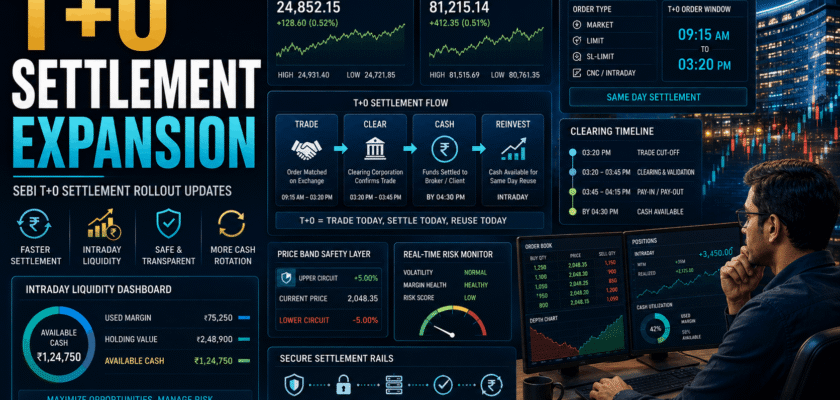
Introduction: SEBI T0 settlement rollout updates 2026
SEBI T0 settlement rollout updates 2026 are important for every active retail trader in India.
The reason is simple. Faster settlement can change how cash moves after a trade.
Earlier, many traders planned around the T+1 cycle. Now, eligible T+0 trades can settle on the same day.
That does not mean every trade becomes instant. It means the market is moving toward a faster cash and securities transfer model.
Therefore, traders must understand the new liquidity rules before using this option.
What T+0 Settlement Means
T+0 settlement means the trade is settled on the trade day itself.
In simple words, the buyer can receive securities faster. The seller can receive funds faster too.
SEBI introduced this as an optional beta framework in the equity cash market.
So, T+0 works along with the existing T+1 settlement cycle.
This choice matters. Retail traders do not need to shift every trade to T+0.
Why SEBI Is Expanding Faster Settlement
SEBI wants to reduce settlement risk and improve market efficiency.
A shorter cycle also reduces the time between trade execution and final settlement.
As a result, capital may move back into a trader account sooner.
This can help active traders who depend on quick cash rotation.
However, faster settlement needs stronger systems from brokers, exchanges, clearing corporations, and depositories.
How Intraday Trading Liquidity Pools India May Change
Intraday trading liquidity pools India may become more dynamic under T+0.
A trader who sells an eligible stock may get usable funds sooner.
That can make the trading day feel more liquid.
Also, brokers may need better real-time checks for funds and securities.
This can reduce some settlement gaps. But it can also increase system load during busy market hours.
Stock Market Settlement Clearance Timelines: The Simple View
Stock market settlement clearance timelines are the backbone of trading trust.
Under T+1, settlement happens on the next business day.
Under T+0, eligible trades are designed for same-day settlement.
NSE also displays a T+0 market area and related trading information.
That makes the framework easier for traders to track.
What Retail Traders May Gain
The biggest gain is faster access to money after selling eligible shares.
This can improve capital planning for short-term traders.
It may also reduce waiting time between exit and next opportunity.
In addition, it can give traders more control over daily liquidity.
Still, this benefit only matters when the stock, broker, and trade window support T+0.
What Retail Traders Must Watch Carefully
T+0 is not a free profit tool.
It does not guarantee better entries or exits.
It also does not remove brokerage, taxes, slippage, or emotional mistakes.
In fact, faster cash access may push some traders to overtrade.
So, traders should use strict risk rules before using faster settlement.
Broker Readiness Will Decide User Experience
Broker systems are a key part of the T+0 experience.
A trader may see different features across brokers.
Some brokers may show separate order windows or settlement choices.
Others may roll out access in a phased way.
Therefore, investors should read their broker notes before placing T+0 orders.
Possible Impact on Market Liquidity
T+0 can improve cash movement inside eligible stocks.
Yet it may also split trading interest between T+0 and T+1 segments.
This split can create price and volume differences in some cases.
That is why regulators and exchanges use controls like price bands and reporting.
Such checks help protect market quality during the transition.
A Simple Strategy Checklist for Retail Traders
First, confirm that your broker supports T+0 orders.
Next, check whether the stock is eligible for T+0 settlement.
Then, compare costs between T+0 and normal T+1 trades.
Also, avoid using faster settlement for revenge trading.
Finally, keep a written rule for trade size and daily loss.
Who Should Be Most Interested
T+0 may suit active cash market traders.
It may also help investors who need faster fund access after selling shares.
However, long-term investors may not see a major daily benefit.
For them, good stock selection still matters more than faster settlement.
So, the best use depends on trading style.
Future Outlook for SEBI T0 Settlement Rollout Updates 2026
SEBI T0 settlement rollout updates 2026 show a clear market direction.
India is making its market plumbing faster and more digital.
The next stage may focus on wider participation, smoother broker systems, and better investor education.
But the move will likely stay careful and phased.
That is good for retail traders because settlement safety is as important as speed.
Conclusion
The T+0 settlement expansion is more than a technical market update.
It can change how traders manage cash during the trading day.
It can also make settlement timelines easier and faster for eligible trades.
Still, the best trader will not chase speed alone.
The best trader will use speed with discipline, cost awareness, and risk control.
| ✅ Retail Trader Safety Box✓ Use T+0 only after checking broker rules.✓ Do not increase position size just because funds return faster.✓ Track brokerage, STT, exchange charges, GST, stamp duty, and capital gains tax.✓ Keep a stop-loss and a daily loss limit.✓ Treat this article as education, not investment advice. |
FAQs: SEBI T0 Settlement Rollout Updates 2026
Q. Is T+0 settlement compulsory?
A. No. It is an optional settlement framework for eligible trades.
Q. Does T+0 mean instant settlement for every stock?
A. No. It means same-day settlement for eligible stocks and eligible orders.
Q. Can T+0 improve intraday liquidity?
A. Yes, it may improve cash rotation. But the benefit depends on broker support and stock eligibility.
Q. Is T+0 safer for retail traders?
A. It can reduce settlement waiting time. Still, market risk and trading mistakes remain.
Q. Should beginners use T+0?
A. Beginners should first learn order types, charges, risk rules, and settlement basics.


