


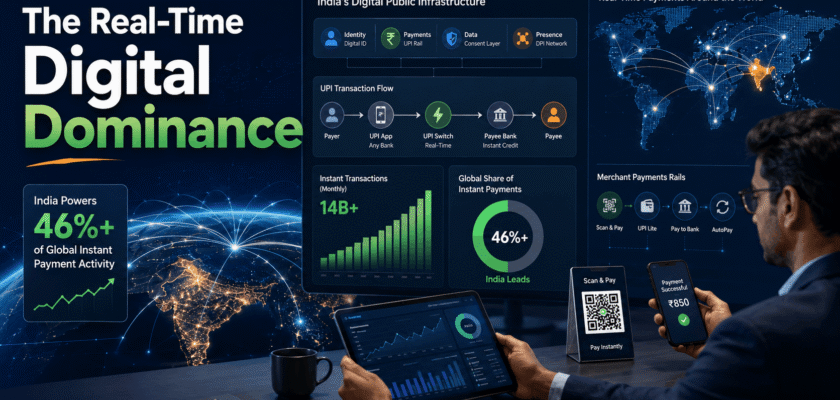
Real-Time Digital Dominance: Why India’s Payment Scale Matters
Real-time digital dominance is now one of India’s strongest finance stories. UPI has moved from a local payment rail to a global benchmark for instant retail payments.
The scale is clear. A Press Information Bureau release says UPI processed 24,161.69 crore transactions in FY 2025-26. It also says UPI handled transaction value of about ₹314 lakh crore in the same year.
The same official release places UPI’s share of global real-time payment volume at 49% for 2025. That is not officially above half. Still, it shows that India is very close to half of the world’s real-time payment volume.
This is why India’s DPI framework now matters to banks, fintechs, merchants and investors. It shows how open rails can turn daily payments into national financial infrastructure.
| KEY TAKEAWAYUPI is not only a payments app story. It is a public digital rail that lets banks, apps and merchants build on the same trusted payment layer. |
Real-Time Digital Dominance and the DPI Framework
Digital public infrastructure works like a shared base layer. It does not need every company to build a separate payment network from zero.
UPI shows this model well. Banks connect to a common system. Apps build user interfaces. Merchants accept payments with QR codes. Customers move money instantly.
This creates network power. More users bring more merchants. More merchants bring more use cases. As a result, payment habits move from cash to instant digital transfers.
Why UPI Became a Global Real-Time Payments Leader
✓ It is simple for users and merchants.
✓ It works across many banks and apps.
✓ QR payments made small merchants easier to onboard.
✓ Low-value transactions became fast and common.
✓ The system supports person-to-person and person-to-merchant flows.
✓ Policy support helped digital payments reach smaller towns.
✓ UPI Lite and AutoPay expanded everyday use cases.
The Volume Story: Small Payments, Huge Frequency
UPI’s strength comes from frequency. A single payment may be small. However, millions of small payments create massive national volume.
NPCI product statistics show UPI crossed 23,201.93 million transactions in May 2026. The value was listed at ₹29,90,424.21 crore for the month.
This high-frequency behavior matters because it changes retail finance. Consumers pay for tea, groceries, travel, bills and online orders through the same rail.
Why “Over Half” Needs Careful Wording
The title phrase is useful for search interest. However, factual writing must stay precise.
As of the latest official public figure used here, UPI accounts for about 49% of global real-time payment transaction volume. That is nearly half, not officially over half.
Because UPI volumes continued to rise in 2026, future global reports may show a higher share. Still, publishers should not present an unverified 50% plus number as a confirmed fact.
| TRUST BOXFor Google News and reader trust, use verified figures. Write “nearly half” unless a fresh official report confirms more than 50%. |
What DPI Means for Fintech Market Share
DPI changes how fintech competition works. Companies do not compete by owning the full rail. They compete by building better experiences on top of the rail.
This can help small fintechs launch faster. It can also help banks keep users inside their own apps. However, it creates pressure on revenue because payments alone may not always bring high margins.
Therefore, the next fintech market share battle may come from credit, insurance, wealth, merchant tools and cross-border payments.
The Cross-Border UPI Opportunity
UPI’s international story is still developing. Official releases say UPI is accepted in several countries. Reports also show interest in connecting UPI with other payment networks for travel and commerce.
A Reuters report in February 2026 said India was in talks about allowing Alipay+ to link with its instant payment systems for easier payments by Indian travelers abroad.
Cross-border growth can make UPI more useful. Yet it also brings security checks, foreign exchange rules and regulatory questions.
What Investors Should Watch
✓ Monthly UPI transaction volume and value.
✓ Growth in merchant QR acceptance.
✓ UPI Lite and recurring payment adoption.
✓ Cross-border UPI partnerships.
✓ Fintech revenue beyond payment processing.
✓ Fraud control, user safety and complaint resolution.
✓ RBI and NPCI rules on market concentration.
✓ Bank app adoption and merchant service innovation.
Risks Behind the Digital Dominance Story
⚠ Payment fraud can hurt trust if controls lag adoption.
⚠ Very high volume can create infrastructure pressure.
⚠ Fintech business models may struggle if payment margins stay low.
⚠ Market concentration can reduce competition if not monitored.
⚠ Cross-border expansion needs strong compliance.
⚠ Users still need simple dispute and refund systems.
⚠ Rural adoption depends on device access, language and digital literacy.
Why UPI Volume Does Not Equal Payment Value Dominance
UPI leads by transaction volume. However, volume is different from value.
Economic Times reported that UPI processed 85.5% of India’s payment transaction volumes in the second half of 2025. Yet it accounted for 9.5% of total value. RTGS handled much larger value with far fewer transactions.
This split is normal. UPI is built for daily retail payments. RTGS serves large-value settlements. Both systems support different parts of the economy.
How Businesses Can Use the UPI-DPI Shift
Businesses should not look at UPI only as a checkout option. It can also improve collections, refunds, subscriptions and cash-flow tracking.
Small merchants can use QR codes to reduce cash handling. Digital businesses can use recurring payments for subscriptions. Service firms can use payment links to close invoices faster.
The next opportunity is data discipline. Businesses that connect payments with accounting, loyalty and customer support can get more value from the same rail.
Organic Search Summary for Readers
Real-time digital dominance describes India’s rise as the world’s largest real-time payments market by volume.
UPI’s official global share is about 49%, which is nearly half of global real-time payment volume. The system also processed over 24,161 crore transactions in FY 2025-26.
The next phase will depend on cross-border use, fintech revenue models, user safety and stronger merchant tools.
Conclusion
The real-time digital dominance story is bigger than one app. It is about how India built a shared payment layer that supports banks, apps, merchants and users.
UPI has already become the world’s largest real-time payment system by volume. It also shows how digital public infrastructure can scale daily finance at national speed.
The next challenge is quality. India must keep the system fast, safe, open and useful as instant payments move into cross-border commerce and deeper fintech services.
Frequently Asked Questions
Q. What is real-time digital dominance?
It means a payment system has very high scale, speed and reach in instant digital transactions.
Q. Does UPI officially power over half of global instant payment volumes?
Current official public data says UPI accounts for about 49% of global real-time payment transaction volume. That is nearly half, not officially above half.
Q. Why is India’s DPI framework important?
It gives banks, apps and merchants a shared digital base for payments, identity-linked services and financial inclusion.
Q. Is UPI only useful in India?
UPI is strongest in India, but international acceptance and cross-border links are growing gradually.
Q. What should fintech investors watch?
They should watch UPI volume, merchant tools, cross-border partnerships, fraud controls and revenue beyond payment processing.


