


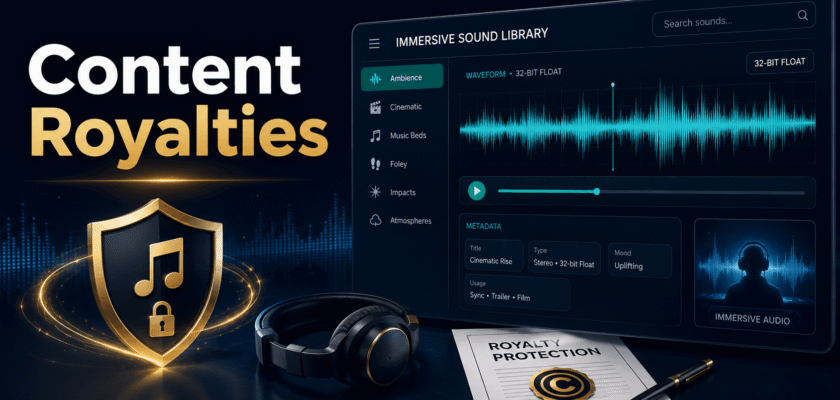
Decoupling Content Royalties: How Immersive Sound Libraries and 32-Bit Float Tech Protect Independent Audio Designers’ Streaming Assets
Independent musician digital asset protection 2026 is no longer just about copyright forms.
Now, it also depends on clean masters, clear metadata, and platform-ready formats.
That shift matters for indie musicians, audio designers, and small post-production teams.
Today, sound is not just a file. It is a rights package.
So, every stem, mix, cue, and library loop needs a better tracking system.
| ✅ Quick TakeSpatial audio can create new royalty opportunities.32-bit float can protect one-time recordings from ruined peaks.Better metadata helps creators prove ownership and collect revenue.However, technology alone does not replace legal registration or contracts. |
Why independent musician digital asset protection 2026 matters now
The streaming market rewards speed. But speed can break rights control.
A creator may upload one stereo master today.
Then, a platform may ask for Atmos, stems, clips, and short-form versions.
Therefore, a simple song folder can become a full asset library.
This is where indie teams often lose money.
They may forget one split. They may reuse an old file name.
Or, they may deliver a version without correct identifiers.
As a result, royalties can move slowly or go to the wrong place.
Spatial audio royalty distribution models are changing the math
Spatial audio is now more than a premium listening format.
For many creators, it is also a catalogue strategy.
Apple Music launched Spatial Audio with Dolby Atmos support for subscribers in 2021.
Later, industry reporting said Apple Music started paying up to 10% higher royalties for music available in Spatial Audio.
That does not mean every indie artist should rush into Atmos.
However, it does change the calculation for strong catalogues.
A good spatial mix can make a track feel fresh again.
It can also help music supervisors hear a cue in a new way.
So, independent audio designers now need clean stems and session notes.
Why 32-bit float protects raw sessions
A live take can fail in one second.
A singer may suddenly shout. A foley hit may jump too loud.
Older fixed-depth recordings can clip when peaks pass the limit.
Zoom explains that clipped data in smaller bit-depth files can be irreversible.
But with 32-bit float, the extra data can often be recovered in a DAW.
That makes the format useful for indie film sets.
It also helps field recordists capture rare sounds with less fear.
Still, 32-bit float is not magic.
Bad mic placement, noisy rooms, and weak planning can still hurt quality.
Metadata is the new rights shield
A beautiful mix still needs clean ownership data.
That data includes ISRC codes, contributor names, splits, version labels, and dates.
IFPI says ISRC helps identify the same recording, even when metadata appears in different forms.
DDEX also says standard data exchange helps the digital music chain communicate better.
That matters because royalties move through many hands.
A wrong spelling can slow payment.
A missing version code can confuse a stereo mix with an Atmos mix.
Therefore, independent musician digital asset protection 2026 starts before upload day.
A simple asset protection workflow for indie creators
First, create a master folder for every release.
Next, store the stereo master, spatial mix, stems, and instrumental versions separately.
Then, name each file with version, date, sample rate, and owner initials.
Also, keep one royalty sheet with all contributors.
After that, assign ISRCs before distribution.
Finally, save proof of creation, delivery notes, and platform receipts.
This workflow sounds boring. But it protects real money.
It also makes future licensing much faster.
Future of independent cinema post production workflows
Independent cinema is also changing fast.
Small teams now need cinema mixes, OTT mixes, shorts, trailers, and social clips.
Because of this, one sound design session can create many income paths.
A rain ambience may become a film cue.
Later, it may become a licensed library asset.
Then, it may support a spatial trailer or game scene.
So, audio teams need records that travel with the sound.
That is why metadata and clean session structure now matter as much as plug-ins.
Risks creators should not ignore
There are still limits.
A spatial mix can cost more than a stereo mix.
Some platforms may not reward it in the same way.
Also, bad metadata can still delay a payment.
Therefore, creators should avoid hype.
They should build a rights system first.
Then, they can decide which formats deserve extra production money.
Independent audio rights checklist
| Step | Why it helps |
| ✅ Keep raw 32-bit float files | They protect rare takes from ruined peaks. |
| ✅ Export clean stereo masters | They stay useful on every major platform. |
| ✅ Create spatial-ready stems | They support Atmos and future immersive mixes. |
| ✅ Add ISRC and version labels | They reduce confusion across platforms. |
| ✅ Save contributor splits early | They prevent royalty disputes later. |
Conclusion: independent musician digital asset protection 2026 is a workflow
Independent musician digital asset protection 2026 is not one tool.
It is a full workflow that starts before release day.
Spatial audio may open new royalty doors.
32-bit float may save important recordings.
Clean metadata may keep revenue attached to the right creator.
Together, these habits help indie audio designers protect their sound and their income.


