


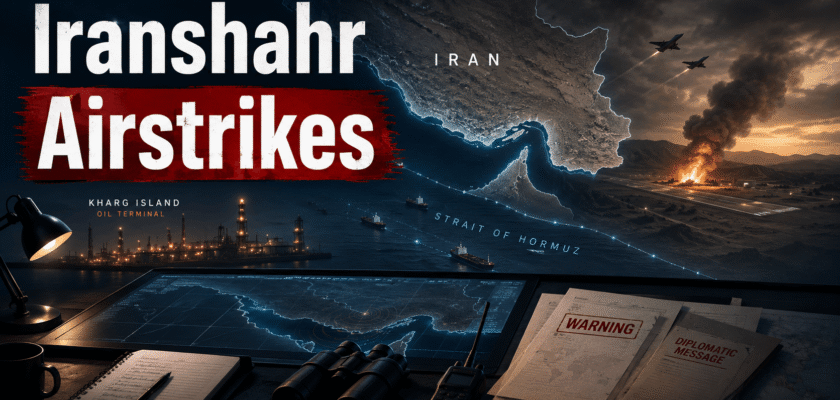
The Iranshahr Airstrikes: Trump Kharg Island Threat and West Asia Crisis Explained
US cruise missile attack Iran 2026 is now a high-search political keyword after fresh U.S. strikes on Iran raised West Asia tensions again.
The latest crisis links reported Iranshahr airstrike damage, the Strait of Hormuz shipping route, and Donald Trump’s renewed Kharg Island threat.
However, the confirmed facts must be separated from fast-moving claims.
U.S. Central Command said its forces hit Iranian military targets linked to air defence, coastal surveillance, missiles, drones, naval assets, and logistics.
Reuters also reported that Iranian media said a firefighter was killed after a strike on the airport in Iranshahr.
So, the story is serious, but it needs careful wording.
| QUICK TAKEAWAYS✓ CENTCOM said U.S. forces struck about 90 Iranian military targets in the latest round.✓ A previous July 7 round hit about 80 targets, including more than 60 IRGC small boats.✓ Reuters reported Iranshahr airport damage, citing Iranian state media.✓ Trump renewed his threat around Kharg Island, Iran’s key oil export hub.✓ Oil, shipping, and Gulf security risks are now central to the West Asia geopolitical crisis live story. |
US Cruise Missile Attack Iran 2026: What Is Confirmed?
The confirmed story begins with U.S. Central Command.
CENTCOM said U.S. forces struck about 90 Iranian military targets in the latest round of strikes.
Those targets included air defence systems, coastal surveillance assets, missile and drone storage sites, naval capabilities, and military logistics infrastructure.
CENTCOM also said an earlier July 7 round hit about 80 targets, including more than 60 IRGC small boats.
Therefore, the confirmed framing is a large U.S. military strike package against Iranian military assets.
The focus keyphrase US cruise missile attack Iran 2026 should be handled carefully because official statements use broader “precision strikes” wording.
Where Iranshahr Fits Into The Strike Reports
Iranshahr is important because Reuters reported a strike on the airport there, citing Iranian state media.
That report said a firefighter was killed in the strike.
However, CENTCOM did not give a detailed public city-by-city target list in the material reviewed for this article.
So, publishers should write “reported Iranshahr airstrike” instead of presenting every local claim as fully confirmed by Washington.
This protects accuracy and keeps the article safer for Google News-style publishing.
Donald Trump Kharg Island Statement: Why It Matters
Donald Trump Kharg Island statement became the most explosive political angle in this crisis.
Kharg Island is Iran’s main oil export hub and a strategic pressure point in the Gulf.
Al Jazeera reported that Trump again spoke about possibly taking control of Kharg Island after declaring the ceasefire effectively over.
The Guardian also reported that Trump said he had ordered strikes on Kharg Island but not fuel lines, while later softening his tone.
This matters because Kharg is not just a military site.
It is deeply tied to Iran’s oil revenue and global energy fears.
Why Kharg Island Could Change The Crisis
Kharg Island sits near Iran’s Gulf coast and supports a major share of Iranian crude export flow.
Any serious move against the island could hit oil markets fast.
It could also push Iran to target energy assets across the Gulf region.
That is why even a threat around Kharg Island can shake traders, shipping firms, and diplomats.
In simple words, Kharg Island is a small place with a very large economic shadow.
Strait Of Hormuz Is The Real Pressure Point
The Strait of Hormuz remains the centre of the crisis.
Reuters reported that the U.S. said its fresh strikes aimed to keep the strait open to shipping.
The same report said the attacks came after three cargo ships were hit while transiting the route.
The strait matters because a major share of global oil flows through or near this waterway.
Therefore, every military move quickly becomes an energy, inflation, and shipping story.
What Iran Did After The U.S. Strikes
Reuters reported that Iran responded with attacks on Kuwait and Bahrain, both home to U.S. military bases.
Kuwait said it was intercepting missiles and drones.
Bahrain and Kuwait alerts showed how quickly the conflict can spill across borders.
That is why analysts now see the crisis as regional, not only bilateral.
For India and other oil-importing countries, this matters because freight, crude prices, and insurance risk can rise together.
What Should Readers Not Overclaim?
Readers should not overclaim three points.
First, a reported Iranshahr strike does not mean every detail is independently confirmed by U.S. officials.
Second, the phrase US cruise missile attack Iran 2026 should not be used as proof of a specific weapon system unless an official source confirms it.
Third, Trump’s Kharg Island comments are a threat and political signal, not proof that a long-term occupation has started.
This careful wording keeps the article balanced and human-written.
Why This Story Matters For India
India is not a direct combatant in this crisis, but it can feel the shock quickly.
Higher crude prices can affect fuel, logistics, aviation, and inflation expectations.
Indian markets can also react when Gulf risk increases.
Also, millions of Indians live and work in Gulf countries.
So, any West Asia geopolitical crisis live update matters for families, travel, jobs, and remittances.
The Political Message Behind The Strikes
The political message is clear: Washington wants to show that attacks on commercial shipping will bring direct military costs.
At the same time, Tehran wants to show that it can create pressure across the Gulf if attacked.
Both sides are using military force and public messaging together.
That mix is dangerous because one wrong calculation can expand the conflict.
Therefore, diplomats are likely to push for a controlled climbdown even while public statements sound hard.
What Happens Next
The next few days will matter more than the first headlines.
Watch for official CENTCOM updates, Iranian casualty reports, Gulf airspace alerts, tanker route changes, and oil price moves.
Also watch whether Trump repeats or softens his Kharg Island language.
If both sides keep strikes limited, markets may calm slowly.
But if Kharg Island or Gulf energy sites become direct targets, the crisis can turn much bigger.
| EDITOR BOX: SAFE WORDING FOR PUBLISHING✓ Use “reported Iranshahr airstrike,” not “confirmed U.S. admission of Iranshahr strike.”✓ Use “precision strikes” for official U.S. language unless weapon type is confirmed.✓ Use “Trump threatened / suggested / said,” not “U.S. has taken Kharg Island.”✓ Keep casualty figures linked to the reporting source and update later if officials revise them. |
Simple Timeline: Iranshahr, Hormuz, And Kharg Island
| Date | What Happened |
| July 7, 2026 | CENTCOM said U.S. forces hit about 80 Iranian targets after attacks on commercial vessels in the Strait of Hormuz. |
| July 8, 2026 | Reuters reported fresh U.S. strikes aimed at keeping the Strait of Hormuz open to shipping. |
| July 8, 2026 | Reuters reported Iranshahr airport damage, citing Iranian state media. |
| July 8, 2026 | Trump renewed his Kharg Island threat while speaking around the NATO summit in Turkiye. |
| July 9, 2026 | The crisis remained active, with shipping security, oil prices, and diplomatic talks under close watch. |
Conclusion: A Crisis Built On Oil, Shipping, And Signalling
US cruise missile attack Iran 2026 is a powerful search phrase, but the real story needs careful facts.
The confirmed picture shows major U.S. precision strikes, Iranian retaliation, reported Iranshahr damage, and a renewed Trump threat around Kharg Island.
The risk is not only military.
It is also about oil, shipping, inflation, Gulf security, and political pressure before the next diplomatic move.
For now, the safest summary is simple: the West Asia crisis has entered a sharper phase, and Kharg Island has become the symbol of how dangerous the next step could be.


