
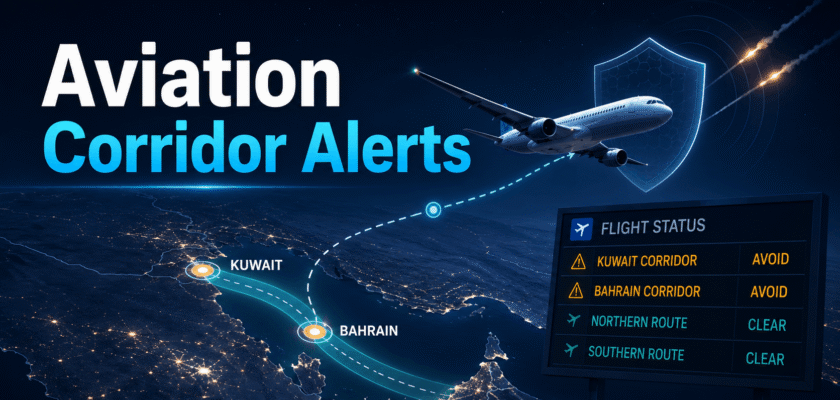
Aviation Corridor Alerts: Air Travel Rerouting Frameworks Following Ballistic Missile Interceptions Over Kuwait and Bahrain Airspace
Middle East flight cancellations delays updates 2026 are now a major concern for passengers using Gulf connections. The latest US-Iran escalation has pushed airlines to review routes, hold extra fuel buffers, and watch Kuwait and Bahrain airspace more closely.
However, this is not a blanket travel ban. It is a fast-changing aviation safety situation. Therefore, passengers should check airline status, airport alerts, and government travel advice before leaving for the airport.
| ⚠️ Quick Take Kuwait and Bahrain remain important Gulf aviation corridors.Some routes may change at short notice because of conflict-zone risk checks.Travellers should avoid military areas and depend on airline alerts, not social media rumors. |
Middle East Flight Cancellations Delays Updates 2026: What Changed?
The situation changed after renewed strikes and missile alerts in the Gulf region. Reports linked the escalation to Iranian attacks on US-linked military targets in Kuwait, Bahrain, Qatar, and Jordan after fresh US strikes on Iran.
For aviation, the biggest issue is not only one flight cancellation. The deeper issue is route confidence. Airlines must decide whether a corridor is safe enough for normal flying, limited flying, or rerouting.
Why Kuwait and Bahrain Airspace Matters
Kuwait and Bahrain sit near busy Gulf routing lanes. Many flights between India, Europe, West Asia, and North America use nearby air corridors. So even a short airspace alert can create wide delays.
Also, airlines do not wait for a full closure every time. They may add extra distance, avoid risky zones, or slow new bookings when conflict-zone warnings rise.
| ✓ Passenger Meaning Your aircraft may still fly, but the route may be longer.A connection may remain valid, but the layover could become tight.A ticket may look normal online, but the airline can still revise timing later. |
Kuwait Airport International Flight Advisory: What Travellers Should Watch
A Kuwait airport international flight advisory should be checked directly from the airline, airport, or official aviation authority. Third-party apps are useful, but they can lag during sudden airspace changes.
Travellers should check three things before travel: departure status, arrival status, and aircraft rotation. If the incoming aircraft is delayed by a reroute, your flight can be delayed even when your airport looks calm.
Before leaving home, check this:
✓ Flight status on your airline app.
✓ Airport departure board for Kuwait, Bahrain, Doha, Abu Dhabi, Dubai, or Muscat connections.
✓ SMS and email alerts from the airline.
✓ Government travel advisory for the destination and transit country.
✓ Travel insurance rules for war-risk and airspace disruption.
Safe Commercial Travel Route Planners Post US Iran Strikes
Safe commercial travel route planners post US Iran strikes should not mean panic booking. Instead, travellers need a simple decision framework. This helps them move safely without wasting money.
1. Choose flexible tickets when the route crosses high-alert Gulf corridors.
2. Keep at least four to six hours between international connections during the alert period.
3. Prefer one-airline or same-alliance bookings for easier rebooking.
4. Avoid separate PNR bookings when crossing West Asia airspace.
5. Keep a backup night stay plan near the transit airport.
6. Save embassy, airline, hotel, and insurance contacts offline.
How Airlines Build Rerouting Frameworks
Airlines use security risk reports, NOTAMs, air traffic control instructions, fuel planning, crew timing, and airport capacity data. If one corridor becomes risky, the airline may shift to a longer route.
That longer route can raise fuel burn. It can also disturb crew duty limits. As a result, even a safe flight may still face schedule changes.
| ✓ Simple ExampleA flight from India to Europe may avoid a sensitive corridor.The new route may add distance and fuel burn.The aircraft may arrive late, affecting the next scheduled flight. |
What Indian Passengers Should Do Now
Indian passengers should stay practical. The goal is to reduce surprise, not cancel every plan. If your trip is urgent, keep documents ready and follow airline instructions.
If your trip is flexible, compare routes through lower-risk transit hubs. Also, avoid tight same-day return plans until the aviation corridor stabilizes.
Best booking habits during this alert
✓ Book directly with the airline where possible.
✓ Avoid very short layovers in the Gulf region.
✓ Keep passport, visa, hotel, and insurance copies offline.
✓ Take a power bank and basic medicines in cabin baggage.
✓ Track flight status twice: once before leaving and once before check-in closes.
Business Travellers Need Extra Backup
Business travellers should not depend on one route. A missed connection can affect meetings, hotel costs, and visa validity. So, they should keep a second route and a flexible meeting plan ready.
Companies should also brief employees about insurance limits. Many policies treat war-linked delays differently from normal weather delays.
Tourists Should Avoid Rumour-Based Decisions
During regional conflict, fake screenshots move faster than official airport notices. So, do not rely on viral posts alone. Confirm every alert through the airline, airport, or government advisory page.
Also, one airport delay does not mean every Gulf route is closed. Some corridors may stay open while others use flow control or tactical routing.
Conclusion: Middle East Flight Cancellations Delays Updates 2026
Middle East flight cancellations delays updates 2026 show why aviation corridor planning now matters more than ever. Kuwait and Bahrain airspace alerts may not stop every flight. But they can still reshape timing, routing, connections, and passenger safety choices.
Therefore, travellers should stay calm, check official updates, choose flexible tickets, and build wider connection buffers. In a volatile corridor, smart planning is the safest travel upgrade.


