
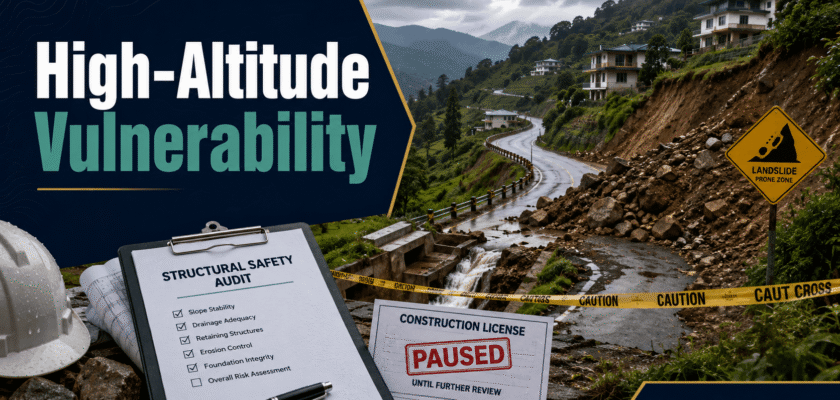
High-Altitude Vulnerability: Why the Wayanad and Sirmaur Landslides Demand an Immediate Freeze on Eco-Sensitive Real Estate Licenses
| ⚠️ Fact-Safe Editorial NoteThis article treats a license freeze as a policy recommendation, not as an official order.It avoids final blame because probes and inspections are still moving forward.The goal is public-interest real estate risk analysis, not political accusation. |
Intro: The hill market cannot ignore the warning
Wayanad landslide real estate safety audit 2026 is no longer a niche planning topic.
It is now a serious real estate risk signal.
The latest landslide near the Kalladi tunnel project in Wayanad again shows one hard truth.
Hill construction cannot run on normal-city rules during extreme monsoon weeks.
At the same time, Sirmaur in Himachal Pradesh is facing heavy rain alerts, landslide reports, and road blockages.
Together, both regions show why eco-sensitive licenses need stricter checks before fresh commercial work expands.
Why Wayanad changed the risk conversation
The Wayanad incident was reported near the Anakkampoyil-Kalladi-Meppadi tunnel road project.
Work at the site was later put on hold as authorities ordered probes.
Reports also said the death toll rose as rescue teams recovered more bodies.
That makes this more than a local tragedy.
It has become a warning for every developer, lender, buyer, and civic planner working in hill districts.
Therefore, the first question is simple.
Should fragile slopes receive new real estate approvals before safety audits are updated?
Sirmaur shows the same pressure pattern
Sirmaur is not the same market as Wayanad.
Still, the risk pattern looks familiar.
Heavy rain closed schools in Solan and Sirmaur as reports of landslides and road blockages disrupted life.
Earlier, Himachal also saw road closures as monsoon rain increased flash flood and landslide risk.
For real estate, this matters a lot.
A property can look attractive in summer.
However, its real test comes during long rain spells, falling debris, blocked roads, and weak drainage.
Wayanad landslide real estate safety audit 2026 must start before licensing
Wayanad landslide real estate safety audit 2026 should begin before new licenses, not after damage.
A good audit must check slope stability, soil type, drainage paths, dumping sites, retaining walls, and emergency access.
It should also review whether construction staging is safe during heavy rain.
That point is important.
Many hill failures do not happen only because of rain.
They also worsen when water flow, debris dumping, and slope cutting are handled badly.
So, a license pause during red-alert windows can save both money and lives.
Why buyers should care about hill licenses
Buyers often check view, price, parking, and rental return.
However, hill property needs deeper checks.
Buyers must ask for geological reports, drainage maps, retaining-wall approvals, and disaster access plans.
They should also ask if the plot falls in a landslide-prone belt.
If the builder cannot answer clearly, the project carries hidden risk.
In monsoon districts, a beautiful location can become a stranded asset very fast.
Why developers need a new monsoon playbook
Developers should not treat hill construction like flat urban construction.
They need rain-trigger stop-work rules.
They also need sensor-based slope checks, covered material storage, and controlled muck disposal.
Moreover, worker housing must stay outside debris-flow paths.
Access roads should have alternate routes.
Insurance must include landslide, flash flood, and business interruption clauses.
This is not extra paperwork.
It is basic risk control.
What a temporary license freeze could mean
A freeze does not mean development should stop forever.
It means approvals should pause in high-risk zones until updated safety screens are complete.
The pause can cover new hill resorts, commercial complexes, road-linked warehouses, and large housing projects.
Small repairs and emergency works can continue under strict supervision.
This balanced approach protects residents without shutting the local economy.
It also forces the market to price risk honestly.
Key checklist for eco-sensitive real estate approvals
✅ Mandatory landslide hazard mapping before approval.
✅ Independent structural and slope audit.
✅ Drainage plan checked by district engineers.
✅ No debris dumping near streams or unstable slopes.
✅ Monsoon stop-work trigger for extreme rain alerts.
✅ Emergency evacuation road map for workers and residents.
✅ Public disclosure of safety audit summaries.
✅ Annual renewal for high-altitude commercial licenses.
What banks and insurers should change
Banks and insurers also need to update risk models.
A loan file should not only measure land value.
It should also measure climate and slope risk.
Insurers should ask for maintenance records, drainage inspections, and hazard compliance.
If lenders price unsafe projects higher, the market will slowly correct itself.
That can push developers toward safer designs.
Conclusion: Hill real estate needs caution before ambition
Wayanad landslide real estate safety audit 2026 should become a turning point.
Wayanad and Sirmaur both show that monsoon risk is no longer seasonal noise.
It is a core real estate valuation factor.
Therefore, eco-sensitive licenses need a pause, a proper audit, and public transparency.
Only then can hill development stay useful, legal, and safe.
Growth is important.
However, in fragile mountains, safety must come before speed.


