
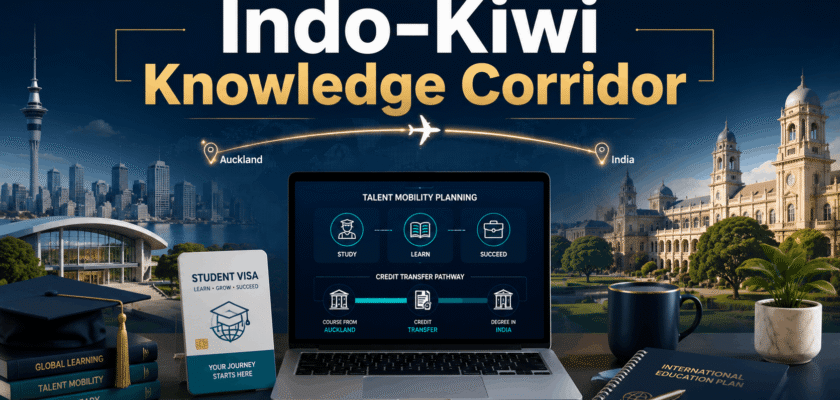
| ✓ Quick Summary India and New Zealand have upgraded ties to a Strategic Partnership. For Indian students, the bigger story is clearer mobility, stronger education links, post-study work clarity, and better planning for global credit transfers. This is not an automatic admission guarantee. It is a policy corridor that students must use smartly. |
India New Zealand Educational Agreements 2026: What Changed?
India New Zealand educational agreements 2026 are now more than a normal study-abroad update.
They sit inside a wider Strategic Partnership between the two countries.
Prime Minister Narendra Modi visited Auckland on 10 and 11 July 2026. It was the first visit by an Indian Prime Minister to New Zealand in 40 years.
During the visit, both sides endorsed a Roadmap to 2030. They also recalled earlier memorandums in education, defence, customs, horticulture, forestry, and sport.
For students, this matters because education is now linked with talent mobility, skills, research, and long-term workforce planning.
Why This Corridor Matters for Indian Students
The old study-abroad model was simple. Students picked a university, applied for a visa, and hoped for work options later.
Now, the corridor is more structured.
The India-New Zealand Free Trade Agreement gives education a stronger policy base. It also connects student mobility with post-study work rights and skilled employment pathways.
As a result, Indian students can plan with better visibility. However, they still need to check course rules, visa conditions, fees, and job-market demand before applying.
| ✓ Key Point This is a planning advantage, not a shortcut. Admission, visa approval, scholarship selection, and credit acceptance still depend on official rules and individual institutions. |
Post-Study Work Visa Clarity Gets Stronger
One major part of India New Zealand educational agreements 2026 is post-study work clarity.
According to the official FTA note, New Zealand signed an annex on student mobility and post-study work visas with India.
The same note says Indian students can work up to 20 hours per week while studying, even if future policy changes take place.
It also lists extended post-study work periods for key qualification levels.
- STEM bachelor graduates: up to 3 years.
- Master’s graduates: up to 3 years.
- Doctorate graduates: up to 4 years.
- Skilled Indian professionals: a new Temporary Employment Entry route with 5,000 visas.
- Young Indians: 1,000 Working Holiday visas annually.
This gives students a clearer return-on-investment path. Still, students must verify their course level and visa eligibility before paying fees.
Global Credit Transfers Need Careful Planning
Higher education global credit transfers are a big part of the conversation.
Yet students must understand one important fact. A government partnership does not automatically transfer every credit from one university to another.
Credit transfer usually depends on course equivalence, learning outcomes, institution rules, and documentation.
So, Indian students should ask direct questions before choosing a programme.
- Will my Indian credits be accepted by this New Zealand institution?
- How many credits can transfer into the selected degree?
- Will transferred credits reduce the total study duration?
- Will the credit transfer affect my post-study work visa eligibility?
- Will my transcript and syllabus need official verification?
India’s Academic Bank of Credits and digital academic records can support smoother planning. However, the final decision still rests with the receiving university.
Pathway Student Visa Changes Add More Flexibility
New Zealand is also changing its Pathway Student Visa from 20 July 2026.
Immigration New Zealand says school students moving toward tertiary study will no longer need to state the exact tertiary discipline at the beginning.
This gives students more room to change disciplines without applying for a new student visa in some cases.
The update also allows more pathways at NZQCF levels 1 to 4. In addition, the maximum English language study period rises from 20 weeks to 30 weeks.
For families, this is useful. It makes the education journey less rigid, especially when students are still deciding their exact subject path.
Talent Exchange Is Bigger Than Student Visas
The Indo-Kiwi knowledge corridor is not only about classroom study.
It also supports skills, research, agriculture education, sports science, maritime training, and professional mobility.
This is important because both countries need skilled talent in practical sectors.
For example, the wider partnership mentions cooperation in skills, innovation, sport, clean energy, agriculture, and education-linked industry collaboration.
That can help universities create more applied programmes. It can also help Indian students choose courses with stronger job alignment.
What Indian Students Should Do Now
Students should not rush only because a new agreement sounds attractive.
Instead, they should build a clean plan.
- Choose a course that matches your long-term work goal.
- Check whether the course qualifies for post-study work options.
- Ask the university about credit transfer before applying.
- Keep syllabus, marksheets, degree records, and transcripts ready.
- Check visa wait times and apply at least three months before travel when advised.
- Avoid fake agents and verify every claim on official portals.
| ✓ Student Safety NoteDo not trust social-media claims promising guaranteed jobs, guaranteed visas, or automatic credit transfers. Always confirm details through official New Zealand immigration pages and university admission teams. |
Why Colleges in India Should Pay Attention
Indian colleges can also benefit from this corridor.
They can build dual-degree pathways, research links, summer schools, and skill-based exchange programmes.
However, Indian institutions must make their academic records cleaner and easier to verify.
This is where digital records, course outcome mapping, and transparent credit systems become useful.
If colleges prepare well, more students can move abroad without losing time, credits, or money.
Risks Students Must Not Ignore
The opportunity is real. But the risks are also real.
- Living costs in New Zealand can be high.
- Part-time work may not cover all expenses.
- Post-study work depends on qualification and visa rules.
- Credit transfer is not automatic.
- Job demand can change by sector and location.
Therefore, students should calculate total cost before taking an education loan.
They should also keep a backup plan in India. A smart global education plan should not depend on one visa rule only.
Conclusion: India New Zealand Educational Agreements 2026 Open a Smarter Route
India New Zealand educational agreements 2026 can become a strong bridge for Indian students.
The Strategic Partnership gives the relationship a bigger frame. The FTA gives student mobility more structure. The Pathway Student Visa update adds flexibility.
Still, the best results will come to students who verify every rule, choose the right course, and plan credit transfers early.In simple words, this is not just a study-abroad headline. It is a new education corridor for skills, careers, and long-term talent exchange.


