
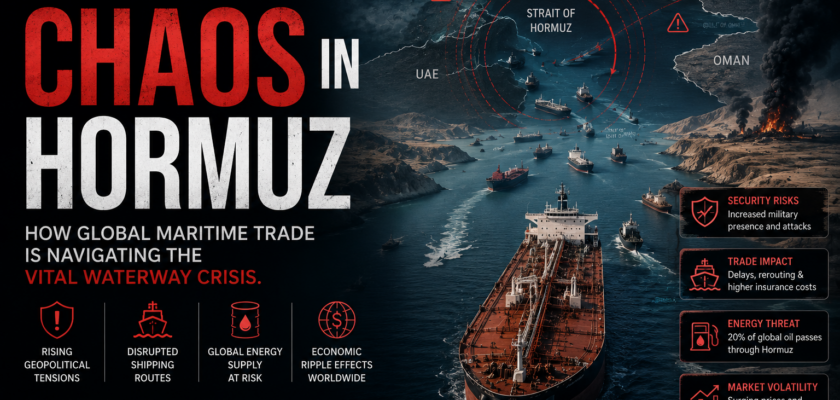
Chaos in Hormuz: How Global Maritime Trade is Navigating the Vital Waterway Crisis.
The global shipping industry is facing an unprecedented operational emergency. As of May 20, 2026, the Strait of Hormuz Crisis 2026 has entirely dismantled the conventional frameworks of maritime logistics. What began earlier this year as an intense geopolitical confrontation has locked the world’s most critical energy and cargo chokepoint into a state of prolonged, high-severity disruption.
Historically handling roughly one-fifth of global oil supplies alongside massive volumes of Liquified Natural Gas (LNG), the narrow 33-kilometer waterway is now a volatile conflict zone. Commercial vessel transits have plummeted by more than 90% below normal baselines—dropping from an average of over 100 ships per day to a fragile, highly unpredictable trickle.
With both the Red Sea and the Persian Gulf routes facing severe parallel blockades for the first time in modern history, supply chain managers are abandoning short-term crisis fixes. They are actively executing aggressive, high-cost alternative routing strategies to survive the most restrictive logistics climate since the pandemic.
1. The Mechanics of the Blockade: Chaos on the Water
The Strait of Hormuz Crisis 2026 is characterized by extreme structural fragility and unmanaged risk. While selective diplomatic truces and temporary ceasefires are periodically announced, they have entirely failed to restore a predictable, normal operating environment for global carrier fleets.
                     [ Legacy Gulf Route Blocked ]
              (90%+ Decline in Standard Daily Transits)
                                  │
         ┌────────────────────────┴────────────────────────┐
         ▼                                                 ▼
┌─────────────────────────────────┐               ┌─────────────────────────────────┐
│  The Long Cape Detour           │               │  Overland Multimodal Corridors  │
│  • Around Africa's Southern Tip │               │  • Saudi Arabia East-West Pipe  │
│  • Adds 10–14 Days to Voyages   │               │  • Rail/Trucking to Yanbu Port  │
│  • 3,500+ Extra Nautical Miles  │               │  • Severe Capacity Constraints  │
└─────────────────────────────────┘               └─────────────────────────────────┘
         │                                                 │
         ▼                                                 ▼
[ Massive Surcharges & Delay Loops ]              [ High-Tariff Fractional Relief ]
- The Sea Mine Threat: Navigating the main zone of the strait has become an operational liability due to the widespread threat of sea mines. Though Iran’s Revolutionary Guards (IRGC) designated tight, alternative entry and exit lanes under the banner of maritime safety, commercial operators remain highly exposed to attacks, drone boats, and illegal seizures.
- The “Passage Toll” Burden: Control over the remaining flow has shifted heavily toward military surveillance. Ships attempting transit face aggressive radio profiling, forced cooperation with naval forces, and a highly controversial, illegal tolling system scaling up to $2 million per vessel for safe passage.
- The Toll on Seafarers: The human cost of the blockade is mounting. Multiple merchant ships have been struck by projectiles or drone boats, resulting in severe fires, ship sinkings, and the loss of innocent seafarers. This has forced major global insurance pools to declare the region a high-risk zone, causing war-risk premiums to skyrocket.
2. Survival Routing: How the Global Fleet is Adapting
Faced with a blocked Gulf, maritime networks are restructuring global transit paths using an outcome-based framework of absolute diversification.
A. The Cape of Good Hope Long Haul
The primary alternative for cargo moving between Asia, the Middle East, and Europe is the sweeping detour around the southern tip of Africa. By bypassing the Middle Eastern chokepoints completely, carriers achieve a safer path, but it comes at a brutal premium. The Cape route adds 3,500 to 4,000 nautical miles and up to 14 days of extra voyage time, stretching global fleet capacity to its absolute limit and driving up bunker fuel consumption.
B. The Overland Cross-Border Bridge
To alleviate pressure on stranded container ships, logistics networks are utilizing land-bridge shortcuts through the Arabian Peninsula. Cargo is routed to unblocked ports, transferred onto rail networks and overland trucking corridors across Saudi Arabia, and brought directly to the Red Sea port of Yanbu. While this avoids the maritime crossfire, the route suffers from severe capacity limitations and high overland tariffs.
3. Strategic Matrix: Traditional Transit vs. 2026 Crisis Logistics
| Shipping Parameter | Pre-Crisis Standard Operations | Strait of Hormuz Crisis 2026 Logistics |
| Daily Vessel Transits | 100 to 140 commercial ships | Fluctuating between 2 and 16 ships (90% reduction) |
| Primary Route Taken | Direct through the Strait of Hormuz | Cape of Good Hope detour or overland transshipment |
| Transit Timelines | Optimized, high-speed scheduled arrivals | Extended by 10 to 14 days minimum via Africa |
| Financial Risk Layer | Standard maritime hull & cargo coverage | War-risk premium spikes; multi-million dollar tolls |
| Supply Chain Impact | Just-in-time predictable cargo delivery | Widespread Force Majeure; data center & fuel delays |
4. Downstream Macro Fallout: Inflation and Structural Attrition
The prolonged nature of the Strait of Hormuz Crisis 2026 is transmitting deep economic shocks far beyond the shores of the Middle East. Every single product consumed globally has logistics built into its final cost, and the compounding cost-push pressures are sparking a cost-of-living crisis across developing nations.
The sudden removal of 20% of global LNG supplies due to Force Majeure declarations on major refining facilities has forced heavy industries worldwide to absorb massive energy surcharges. Financial institutions have downgraded global economic growth projections for 2026 to a stalled 2.5%, warning that if the blockade persists through the second half of the year, global energy inflation could rapidly spiral toward double digits.
The crisis is already claiming corporate casualties. Major low-cost transport operators and airlines are falling into liquidation, entirely crushed by compounding debt and volatile fuel shocks.
Conclusion
The Strait of Hormuz Crisis 2026 marks a permanent end to supply chain complacency. Global maritime trade is no longer a simple equation of tracking the shortest, cheapest route on a map; it has evolved into a complex exercise in geopolitical survival and structural asset hardening.
As transshipment hubs like Jebel Ali face severe congestion from stranded cargo, the international business landscape is receiving an aggressive wake-up call. To survive this era of attention and asset bankruptcy, enterprises must build absolute redundancy into their logistics networks—diversifying into multimodal rail corridors, fast-tracking subsea bypass pipelines, and securing long-term contract alternatives. The fragile abacus of global trade has broken, and only those who build un-bottlenecked, adaptive supply chains will successfully navigate the stormy waters of this new economic reality.


