
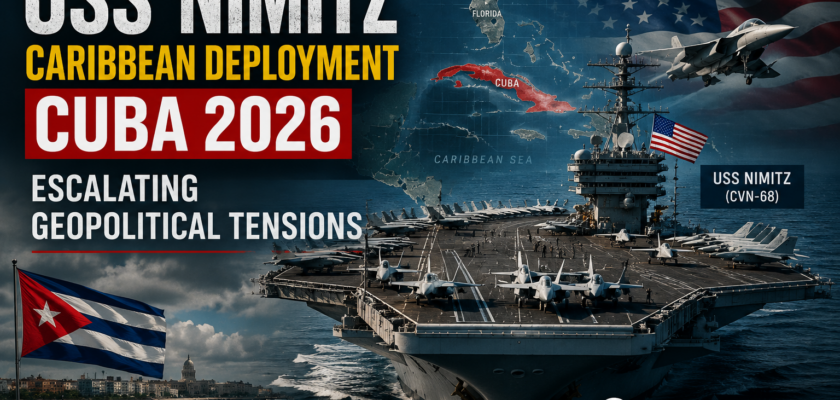
The Caribbean Deployment: Why the USS Nimitz Move is Escalating Geopolitical Tensions with Cuba.
The geopolitical chessboard of the Western Hemisphere has suddenly locked into an intense, high-stakes naval standoff. On Wednesday, May 20, 2026, U.S. Southern Command (SOUTHCOM) officially confirmed that the nuclear-powered aircraft carrier USS Nimitz (CVN 68) and its massive carrier strike group have crossed into the Caribbean Sea.
Operating under the banner of the scheduled Southern Seas 2026 deployment—which recently saw the strike group conducting joint exercises with the Brazilian Navy—the carrier’s tactical placement has shifted entirely from a routine regional tour to an aggressive show of geopolitical force.
The military hardware now lingering off the coast of Havana is unmatched in its strike capacity. Flanked by the Arleigh Burke-class destroyer USS Gridley (DDG 101) and the replenishment oiler USNS Patuxent (T-AO 201), the USS Nimitz carries Carrier Air Wing 17 (CVW-17)—a massive airborne strike component packed with F/A-18E Super Hornets, EA-18G Growler electronic warfare assets, and Seahawk helicopters.
While SOUTHCOM publicly frames the deployment as a mechanism for “ensuring stability and defending democracy,” the reality on the ground point to a dangerous, rapid breakdown in U.S.–Cuba relations. Here is an inside analysis of the four critical flashpoints driving this sudden military escalation in the Caribbean.
1. The Raúl Castro Indictment: Opening a 30-Year Legal Front
The immediate diplomatic fuse that turned the USS Nimitz deployment into an active security crisis was an extraordinary legal maneuver by the U.S. Department of Justice.
                    [ The US-Cuba Standoff Matrix: May 2026 ]
                                        │
         ┌──────────────────────────────┴──────────────────────────────┐
         ▼                                                             ▼
┌───────────────────────────────────┐               ┌───────────────────────────────────┐
│     The U.S. Pressure Stacks      │               │     The Cuban Defensive Stance    │
│ • Raúl Castro Murder Indictment  │               │ • Declaration of "Fierce Resistance"│
│ • Comprehensive Fuel Blockade     │               │ • Deployment of Defensive Drones  │
│ • 25 Surveillance Flights Near Coast│             │ • Severe 22-Hour Energy Blackouts │
└───────────────────────────────────┘               └───────────────────────────────────┘
         │                                                             │
         └──────────────────────────────┬──────────────────────────────┘
                                        ▼
                         [ Geopolitical Chokepoint ]
On the exact same day that the Nimitz Strike Group arrived in the southern Caribbean, U.S. federal prosecutors unsealed a historic criminal indictment against 94-year-old former Cuban President Raúl Castro.
The charges accuse Castro of ordering the 1996 military shoot-down of two unarmed civilian planes operated by the Miami-based exile group Brothers to the Rescue, an action that resulted in the deaths of four individuals.
The timing of the indictment—deliberately unveiled on Cuba’s Independence Day—was immediately backed by a public statement from President Trump, who declared that the administration has “Cuba on our mind,” signaling to voters and regional allies that the indictment serves as a clear prelude to a broader geopolitical shift.
2. The Threat of “Fierce Resistance” and Legal Precedents
Havana has responded to the naval buildup and the legal charges with fierce diplomatic and military pushback, refusing to back down under the shadow of the American aircraft carrier.
Cuban Deputy Foreign Minister Carlos Fernández de Cossío delivered an urgent national address warning that the Raúl Castro indictment is a clear attempt to manufacture a legal excuse for direct physical intervention. Cossío stated that the move follows a dark, well-known history of the U.S. using criminal accusations to justify military actions against sovereign states. He made it explicitly clear that any attempt to use the indictment as a lever for hostile actions inside Cuba will be met with “fierce resistance from the Cuban people.”
To back this claim, Cuban defense networks are rapidly mobilizing. Havana has recently finalized emergency acquisitions of defensive drone technologies explicitly designed to counter potential naval or airborne incursions, turning the waters surrounding the island into a highly monitored defense corridor.
3. Strategic Matrix: Routine Regional Training vs. 2026 Caribbean Standoff
| Strategic Parameter | Standard Southern Seas Exercises | Active May 2026 Caribbean Deployment |
| Primary Naval Flagship | Varied cruiser/destroyer detachments | USS Nimitz Nuclear Carrier Strike Group (CSG-11) |
| Intelligence Footprint | Baseline maritime radar monitoring | 25+ advanced Navy/Air Force surveillance flights |
| Economic Backdrop | Open regional trade and standard logistics | Aggressive fuel blockade & punishing oil tariffs |
| Diplomatic Context | Standard international defense exchanges | Raúl Castro murder indictment & “friendly takeover” rhetoric |
| Risk Characterization | Low-impact collaborative partnership loops | Minimized Risk via containment; high friction default |
4. The Fuel Blockade and Attention Bankruptcy
Beyond the military maneuvers, the underlying engine driving this crisis is a state of intense economic attrition designed to weaken Cuba’s state capacity from the inside out.
The island is currently facing an unprecedented economic crisis, marked by severe food scarcity, hyper-inflation, and crumbling public utilities. This collapse is directly linked to an aggressive U.S. fuel blockade and an executive order signed earlier this year that penalizes any nation selling oil to Havana.
  [ U.S. Fuel Blockade & Sanctions ] ───► [ Crippled Oil & Refining Imports ]
                                                      │
                                                      ▼
                                       [ Severe Grid Infrastructure Collapse ]
                                       "22-Hour Daily Regional Blackouts"
                                                      │
                                                      ▼
                                       [ Severe Resource & Food Scarcity ]
U.S. Secretary of State Marco Rubio defended the fuel blockade in a recent Spanish-language address to the Cuban people, blaming the island’s communist government for the rolling 22-hour blackouts paralyzing the population.
While Rubio has publicly offered a conditional $100 million de-communization and aid package to the island, the concurrent deployment of the Nimitz Strike Group indicates that Washington is prioritizing military pressure over diplomatic dialogue.
CIA Director John Ratcliffe recently traveled to Havana to issue a stern warning to Cuban officials, stating that the window for diplomatic talks “would not remain open indefinitely” as the island continues to explore strategic security agreements with international adversaries like Russia and China.
Conclusion
The deployment of the USS Nimitz Caribbean Deployment Cuba 2026 wave marks a definitive end to decades of passive deterrence in the region. By shifting a nuclear aircraft carrier directly into Havana’s backyard alongside a high-profile criminal indictment, the U.S. government has made it clear that it is actively pursuing a policy of absolute geopolitical containment.
While President Trump has attempted to downplay immediate fears of a hot military conflict—stating to reporters that “there won’t be escalation… the place is falling apart”—the combination of severe economic blockades, intense surveillance flights, and high-stakes legal indictments has pushed regional stability to its thinnest margin in decades.
Chasing short-term balance-sheet predictions in this volatile environment is a massive liability. In this new era of intense geopolitical friction, the Caribbean is no longer just a holiday corridor; it has transformed into a critical, highly monitored front line where a single tactical miscalculation could set off an international crisis right on America’s doorstep.


