
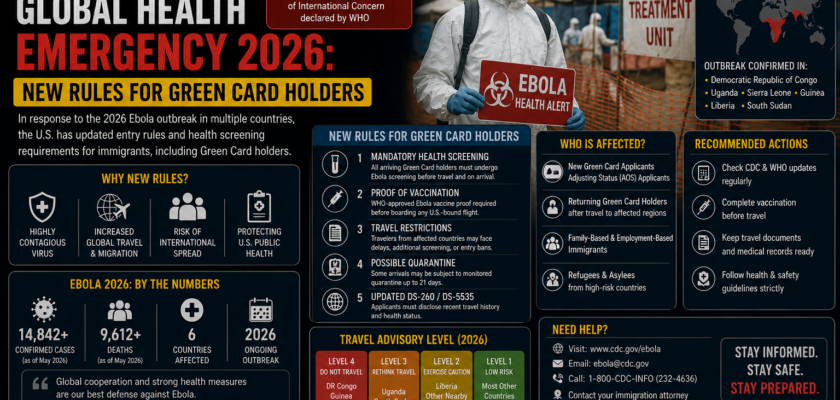
Managing Global Outbreaks: The Crucial Health Rules Restricting International Entry for Green Card Holders.
International travel boundaries have locked down under a strict new regime of medical surveillance. For nearly a decade, Lawful Permanent Residents (LPRs) of the United States—commonly known as Green Card holders—operated under a highly predictable cross-border framework. As long as a permanent resident maintained an un-expired physical I-551 card, avoided committing major legal infractions, and kept their stays outside the U.S. under a continuous six-month window, re-entering the country was a standard, low-friction customs process.
But as we advance through May 2026, that traditional immigration baseline has been heavily modified by international health mandates.
Following the formal declaration of a full-scale Ebola Global Health Emergency 2026 by the World Health Organization (WHO), the global health landscape has entered an active crisis phase.
In a decisive move to insulate domestic populations from international viral vectors, the Centers for Disease Control and Prevention (CDC), in coordination with the Department of Homeland Security (DHS), has deployed emergency statutory health restrictions. These new regulations completely dismantle old travel exemptions—enforcing unprecedented biometric, diagnostic, and quarantine mandates on Green Card holders returning from affected international corridors.
1. The Statutory Framework: Demystifying the Emergency Orders
The administrative engine overriding standard immigration entry lines is rooted in federal public health preservation laws. Under the authority of Section 361 of the Public Health Service Act, the CDC retains the absolute legal right to enforce sweeping entry bans and diagnostic mandates to prevent the introduction of communicable diseases into the United States.
                  [ The 2026 Public Health Entry Loop ]
                                    │
         ┌──────────────────────────┴──────────────────────────┐
         ▼                                                     ▼
┌─────────────────────────────────┐               ┌─────────────────────────────────┐
│    The Pre-Departure Barrier    │               │    The Re-Entry Screening Hub   │
│ • Mandatory WHO-certified PCR   │               │ • Multi-point thermal scans     │
│ • Upload to digital health portal│               │ • Dynamic biosensor checking    │
│ • Secure, verified QR code pass │               │ • High-Hz biometric verification│
└─────────────────────────────────┘               └─────────────────────────────────┘
         │                                                     │
         └──────────────────────────┬──────────────────────────┘
                                    ▼
                     [ The Conditional Entry Outcome ]
         (Mandatory 14-Day Home Quarantine with Active Monitoring)
The newest mandate explicitly targets returning travelers who have spent any time within designated hyper-risk transmission zones over a rolling 21-day window.
While the U.S. Constitution strongly protects citizens from outright entry bans, permanent residents are subject to strict, conditional health clearances.
Failure to comply with these real-time screening protocols will not lead to an immediate loss of your permanent residency status, but it will result in an immediate, mandatory federal quarantine order at an isolation facility near your port of entry, completely bypassing standard customs processing speeds.
2. The Tri-Layer Screening Protocol at Border Controls
Returning to a U.S. port of entry from an international corridor now requires navigating a rigorous, high-tech health evaluation checkpoint. The CDC has transformed international arrival terminals into advanced biometric screening centers.
A. Digital Health Passport Vetting
Before boarding a U.S.-bound aircraft, Green Card holders must upload a negative, certified molecular diagnostic test result directly to an official digital health portal. The system generates a secure, authenticated health pass. This clearance must be presented to customs officials alongside your physical green card, creating a dual-layer credential check.
B. Real-Time Thermal and Sensor Tracking
Upon stepping into the arrival hall, travelers walk through advanced screening lanes equipped with multi-point thermal imaging cameras.
  [ Passenger Entrance ] ───► [ Multi-Point Thermal Scanning ]
                                            │
                                            ▼
                             [ Continuous Biosensor Analysis ]
                         "Detects Elevated Core Heat and Stress Signs"
                                            │
                                            ▼
                             [ Micro-Enforcement Sorting ]
                       "Flags At-Risk Travelers for Medical Review"
These sensors continuously scan moving crowds to track elevated core body temperatures, while integrated biosensors analyze heart rates and respiration speeds in real time. This automated tracking flags individuals displaying early signs of illness, sorting them into dedicated medical evaluation zones for deeper testing before they ever reach a standard customs desk.
3. Strategic Matrix: Standard Green Card Entry vs. Emergency Health Restraints
| Immigration Vector | Standard Permanent Resident Entry (Pre-Crisis) | Entry Under Ebola Health Emergency (2026) |
| Primary Credential | Valid physical Form I-551 Green Card | Green Card + Verified Digital Health Passport |
| Medical Verification | None required for routine re-entry | Mandatory 21-day geographic history tracking |
| Terminal Screening | Random baggage checks and standard interviews | Continuous thermal tracking and biometric scans |
| Post-Arrival Policy | Immediate, unrestricted entry into the interior | Mandatory 14-day home isolation with digital check-ins |
| Risk Characterization | High vulnerability to carrying silent, undetected infections | Minimized Risk; strict, tech-enforced containment |
4. Managing the 14-Day Isolation Mandate
The final structural hurdle for returning permanent residents is managing post-arrival compliance. Under the updated CDC guidelines, clearing the terminal’s thermal sensors does not mean your health screening is over. All Green Card holders arriving from active outbreak regions are legally required to undergo a 14-day home isolation period.
Compliance is actively managed through connected smartphone applications linked to regional public health databases.
Travelers must log their temperature twice daily and report any emerging symptoms through the app, while automated location check-ins confirm adherence to quarantine boundaries.
While these strict tracking protocols introduce temporary friction into global travel, immigration experts emphasize that they are an essential mechanism to keep borders open during an international crisis. By replacing broad, highly disruptive travel bans with precise, data-driven health screening networks, authorities can successfully protect domestic public health while ensuring permanent residents retain a safe, legal pathway back to their homes.
Conclusion
The sweeping deployment of the Ebola Global Health Emergency 2026 screening framework highlights a permanent evolution in international travel: true national security is no longer just about monitoring physical passports; it requires protecting biological borders with absolute precision. The old abacus maze of stepping off an international flight and walking straight through customs without a single health check is officially over.
By combining digital health passports with continuous thermal tracking and smart home isolation systems, health authorities are demonstrating how to manage large-scale outbreaks without shutting down global travel entirely.
For Green Card holders, adapting to these strict public health rules is a necessary part of modern international travel. By tracking travel advisories, keeping health portals updated, and complying with border screening systems, permanent residents can travel with confidence—knowing that these rigorous, tech-driven safeguards are keeping our global corridors safe for everyone.


