
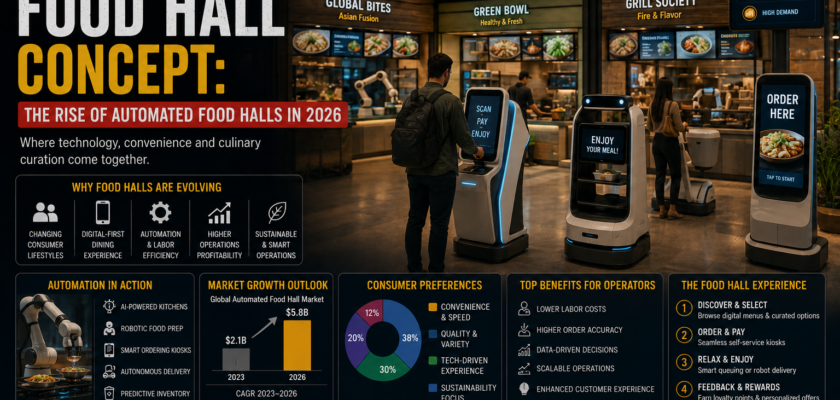
The Rise of the Automated Food Hall: What to Expect from the Next Wave of Curated Culinary Markets.
The traditional dining experience is shedding its old skin. For decades, heading out for a premium group meal meant navigating a series of rigid compromises. You either booked a table at a single conventional restaurant—forcing everyone to order from the same menu—or you resorted to a standard shopping mall food court, sacrificing ingredient quality and atmosphere for the sake of variety. The middle ground was hard to find.
But as we move through 2026, a fascinating intersection of gourmet culinary arts and edge automation is revolutionizing urban dining.
We are witnessing the evolution of the Curated Food Hall Concept into an autonomous, experiential ecosystem.
No longer just a collection of standard vendor stalls, the next generation of culinary markets uses smart ordering systems, contactless food pick-up tech, and predictive supply chains to eliminate the classic headaches of eating out. By removing long order lines, crowded payment counters, and slow table service, these spaces let diners focus entirely on what matters most: exploring world-class, artisan-made dishes in a high-energy social environment. Here is what to expect from the automated food hall revolution transforming cities this year.
1. Fluid Gastronomy: The Multi-Vendor, Single-Cart Experience
The most significant operational friction point in a traditional food hall is the fragmented checkout process. If a family of three wants to order from three separate stalls—such as wood-fired Neapolitan pizza, authentic Japanese ramen, and artisan gelato—they historically had to stand in three separate physical lines, swipe their cards three individual times, and track three different buzzers.
                    [ The Legacy Food Hall Hassle ]
     (Line 1: Pizza ──► Line 2: Ramen ──► Line 3: Dessert ──► Fragmented Chaos)
                                    │
                                    ▼
                [ The 2026 Automated Fluid Experience ]
     (Unified App/Kiosk ──► Single Multi-Vendor Cart ──► Synchronized Pick-Up)
                                    │
         ┌──────────────────────────┴────────────────___________┐
         ▼                                                       ▼
┌─────────────────────────────────┐                     ┌─────────────────────────────────┐
│     The Digital Ledger Core     │                     │     Smart Locker Collection     │
│ • Single, aggregated checkout   │                     │ • Insulated, code-locked boxes  │
│ • Instant, split vendor payouts │                     │ • Perfect humidity maintenance   │
│ • Zero line-standing fatigue    │                     │ • Fresh, automated hand-offs    │
└─────────────────────────────────┘                     └─────────────────────────────────┘
The 2026 automated marketplace completely re-engineers this layout through unified digital carts.
- The Unified Order Matrix: Whether using an interactive touchscreen kiosk or scanning a table-side QR code, guests browse a single, aggregated digital menu displaying every active dish in the building.
- The Single Checkout: You add items from entirely different kitchens into one virtual basket and pay once. Behind the scenes, smart routing software instantly splits the ticket, firing the exact preparation steps to the respective kitchen lines simultaneously.
- Synchronated Ready Times: The platform tracks preparation times dynamically, ensuring that your table’s appetizers, main courses, and hot beverages are completed within the same micro-window to prevent food from getting cold.
2. Behind the Counter: Robotic Efficiency Meets Human Craft
A common misconception about “automated food halls” is that they replace human chefs with soulless, robotic arms that strip the artistry out of cooking. In a premium curated food hall concept, the reality is exactly the opposite: automation is deployed behind the scenes to take over repetitive, manual tasks, freeing up human culinary masters to focus on flavor execution.
Automating the Heavy Lifting
Machines handle high-volume, precision-dependent tasks with absolute consistency. Automated induction woks control flash-fry temperatures down to the degree; automated dough stretchers prep flawless pizza bases in seconds; and ingredient dispensers measure portions precisely to reduce kitchen waste.
Elevating the Human Touch
By outsourcing the tedious prep work and continuous temperature monitoring to local automated systems, the master chef steps out from the stress of a chaotic kitchen line. They can spend their time focusing on complex tasks that software cannot replicate—tasting stocks, refining delicate sauces, creating seasonal food specials, and beautifully plating dishes for an unforgettable dining experience.
3. Strategic Matrix: Traditional Food Courts vs. Automated Curated Food Halls
| Dining Axis | Legacy Shopping Mall Food Courts | Automated Curated Food Halls (2026) |
| Vendor Selection | Fast-food corporate chains; frozen ingredients | Vetted artisan kitchens; fresh, hyper-local sourcing |
| Ordering Flow | Fragmented; separate physical queues per vendor | Unified; single digital cart for the entire hall |
| Service Technology | Mechanical plastic buzzers or shouting numbers | Smart insulated lockers and automated mobile notifications |
| Atmosphere & Design | Utility-focused; high noise, plastic seating | Premium experiential; modular social hubs, lush lighting |
| Risk Characterization | High risk of order mistakes and cold, delayed food | Minimized Risk; tech-optimized quality and pacing |
4. Insulated Lockers: The End of the Countertop Crowd
The final piece of the automated dining puzzle transforms how food is handed off to guests. The old, chaotic countertop scene—where diners crowd around an open kitchen waiting for an employee to shout their order—has been replaced by sleek smart climate lockers.
  [ Unified Digital Order ] ───► [ High-Efficiency Kitchen Prep ]
                                               │
                                               ▼
                              [ Automated Climate Locker Placement ]
                           "Maintains Exact Dish Temperature & Texture"
                                               │
                                               ▼
                              [ Secure Contactless Collection ]
                            "Scan QR Code to Open Insulated Vault"
When your meal is perfectly cooked, the kitchen team places the plate into an internal holding vault.
These lockers are engineered with separate micro-climates; a hot, dry vault preserves the crispness of fried chicken or fries, while an adjacent humid locker keeps pasta or ramen at the perfect serving texture.
The diner receives a notification on their device containing a secure QR code. Walking up to the locker wall, a quick scan gently opens the glass door, providing a flawless, hygienic hand-off that entirely bypasses the friction of a crowded kitchen counter.
Conclusion
The rapid expansion of the automated Curated Food Hall Concept proves that advanced technology is at its best when it enhances, rather than replaces, the joy of a real-world experience. By cleaning up the slow, high-friction logistics of ordering and collection, smart food halls are saving us from the old abacus maze of standing in endless lines and managing fragmented payments.
These automated systems don’t take away from the soul of a great meal; they protect it. They clear out the operational noise so that artisan kitchens can perform at their highest level, and diners can enjoy a diverse culinary experience with absolute ease. As these tech-driven food halls continue to redefine urban dining centers across the globe, they offer a clear look at the future of hospitality: a world where ordering food is completely seamless, quality is uncompromised, and every seat at the table gets exactly what they want.


