
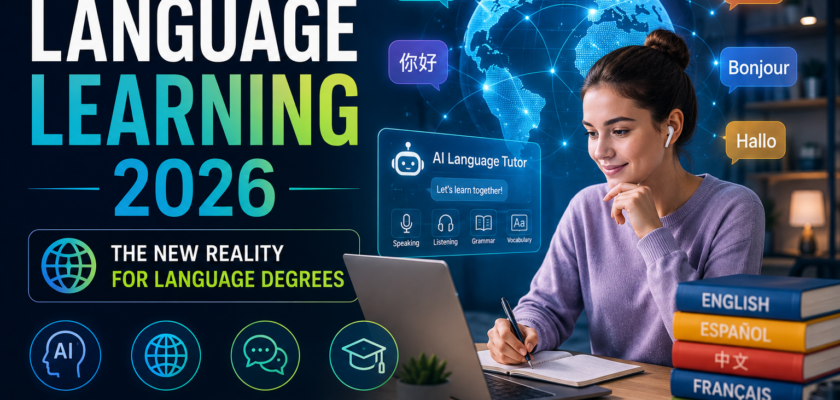
Beyond Translation: Why Real-Time Simultaneous Translation Tech is Changing the Value of Language Degrees.
The traditional foundation of global linguistics has officially cracked. For generations, earning a university degree in a foreign language—whether French, Mandarin, Japanese, or German—was universally regarded as an elite, future-proof career path. Academic departments focused heavily on training students in a very specific set of skills: memorizing complex grammar trees, mastering local slang, perfecting speech accents, and spending months translating books or corporate documents word-for-word. Graduates were highly valued across the global economy, stepping easily into lucrative roles as corporate translators, international embassy guides, or cross-border logistics managers.
But as we push through May 2026, the widespread integration of advanced AI audio networks has turned that old business model on its head.
The incredible speed of generative AI models has transformed machine translation from a slow, glitchy app trick into a seamless, high-speed reality.
We have entered a brand-new phase in the future of language learning 2026: the era of universal, zero-friction simultaneous translation.
With modern neural audio engines achieving sub-100-millisecond latency and tracking human emotional tones across dozens of dialects at once, the basic act of translating words has been completely automated. This massive shift is forcing a deep re-evaluation of language programs across top universities worldwide—demanding that departments rapidly upgrade their curricula to save the liberal arts from total obsolescence.
1. The Loss of the Literal Filter: Navigating the Zero-Latency Era
To understand why the value of a traditional translation degree is dropping so quickly, we must look at the immense technical progress made by modern audio models. Early machine translation tools were highly static; a user recorded a full sentence, waited multiple seconds for an offshore cloud server to process the audio, and received a flat, robotic voice output that frequently missed local context and emotional nuances.
Today’s AI real-time translation impact has shattered that slow operational barrier completely.
                    [ Legacy Machine Translation ]
     (Voice Input ──► Cloud Upload ──► Flat Text Conversion ──► 3-Second Robotic Output)
                                     │
                                     ▼
                [ The 2026 Zero-Latency Neural Audio Loop ]
     (Live Voice ──► Continuous On-Device Stream ──► Real-Time Emotion & Dialect Match)
                                     │
         ┌───────────────────────────┴────────────────___________┐
         ▼                                                       ▼
┌─────────────────────────────────┐                     ┌─────────────────────────────────┐
│     Sub-100ms Processing        │                     │      Cultural Tone Protection   │
│ • Zero artificial speech pauses │                     │ • Captures regional humor/idioms│
│ • Translates mid-sentence flows │                     │ • Replicates speaker's voice map│
│ • Functions completely offline  │                     │ • Adapts matching context shifts│
└─────────────────────────────────┘                     └─────────────────────────────────┘
Modern translation software processes audio directly on edge devices, breaking speech down into continuous, rolling sound waves.
- The Natural Flow: The system translates sentences as they are being spoken, entirely eliminating awkward gaps and pauses during cross-border business meetings.
- Preserving Human Identity: The software doesn’t just swap words; it analyzes the speaker’s unique vocal tone, pacing, and emotional energy. It recreates their exact voice profile in the destination language while keeping regional humor, idioms, and context perfectly intact.
- The Frictionless Reality: Two professionals from completely different countries can now sit down for dinner wearing low-profile wireless earbuds, chatting smoothly in their own native languages for hours without a single linguistic barrier—making raw human translation a completely integrated background utility.
2. Re-Engineering the Curriculum: The Shift from Vocabulary to Culture
As the mechanical act of memorizing vocabulary words becomes a commodity managed by basic microchips, the core purpose of a university language degree must undergo a profound evolution. Leading academic institutions—including Oxford, Sorbonne, and Tokyo University—are aggressively overhauling their humanities departments to move past basic language processing.
The Structural Academic Evolution:
- From Translation to Diplomacy: University programs are systematically retiring traditional translation drills and vocabulary tests.
- The New Curriculum Focus: Instead of grading students on pure spelling and grammar accuracy, modern 2026 courses focus heavily on deep cultural sociology, regional political history, international negotiation tactics, and psychological frameworks.
- The Cultural Bridge: The core goal is training students to become elite cultural architects. While an AI agent can instantly translate words during a high-stakes trade negotiation, it cannot understand the deep, unspoken social hierarchies, historical sensitivities, or subtle body language gestures that define international deals. Human specialists are stepping up to fill this critical gap, focusing entirely on high-level relationship management.
3. Strategic Matrix: Traditional Philology Degrees vs. 2026 Strategic Linguistics Programs
| Educational Parameter | Traditional Foreign Language Degree (Pre-2025) | Strategic Cultural Linguistics (2026) |
| Core Pedagogy Focus | Vocabulary memorization and grammar rule drilling | Deep cross-cultural sociology and regional diplomacy |
| Primary Testing Metric | Exact, word-for-word text and speech translation | Complex situational negotiation and context audits |
| Infrastructure Tooling | Textbooks, audio tapes, and manual dictionaries | Real-time translation engines and dynamic AI workflows |
| Career Trajectory Target | Commercial document translator or travel guide | Cross-border strategic consultant, policy advisor |
| Risk Characterization | High vulnerability to instant automated replacement | Withdrawn Risk; focuses entirely on elite human skills |
4. Tech Disruption in Education: The Rise of the Automated Classroom
The far-reaching implications of the tech disruption in education go far beyond university lecture halls; it is completely democratizing how humans interact across the globe. For decades, access to high-quality language learning was heavily gatekept by socioeconomic status, requiring families to pay immense premiums for elite private tutors or specialized language schools.
Modern translation platforms have wiped out this geographic and financial divide completely.
Primary schools in remote, lower-income districts are using basic hardware setups to link classrooms with sister schools on entirely different continents.
  [ Local Village Classroom ] ───► [ High-Speed Multi-Language Audio Mesh ]
                                                   │
                                                   ▼
                                    [ Real-Time Collaborative Projects ]
                              "Students Brainstorm Solutions Across Dialects"
                                                   │
                                                   ▼
                                    [ Democratized Global Education ]
                               "Wipes Out Expensive Private Tutoring Walls"
Children can now collaborate on science experiments, share cultural stories, and brainstorm solutions to local climate issues in real time—with the underlying technology managing the multi-language audio mesh flawlessly in the background.
This democratization completely shifts the focus of early education away from stressful language drilling. It allows young minds to focus their energy on shared creativity, global empathy, and cross-border problem solving—proving that the ultimate goal of language technology isn’t to replace human connection, but to give every single person on earth the un-bottlenecked power to build it.
Conclusion
The dramatic transformation unfolding across the global education market delivers an undeniable lesson to modern students and academic leaders: technological automation should never be feared as a destructive threat, but embraced as the ultimate tool for human liberation. The old abacus maze of spending years of your life memorizing flashcards, verb conjugations, and rigid syntax structures just to serve as a literal human dictionary is officially dead.
By clearing away the tedious, mechanical layers of linguistics and replacing them with hyper-efficient, sub-100ms neural audio networks, technology is returning the study of language to its truest, highest purpose.
University programs that adapt to this shift are discovering a new generation of students: thinkers who don’t just speak another language, but deeply understand the people, culture, and history behind it. As these real-time systems continue to scale across headsets and classrooms worldwide, they offer a brilliant promise for the future of humanity: a world where our diverse tongues no longer divide us, but serve as an open gateway to shared wisdom, borderless collaboration, and lasting global progress.


