
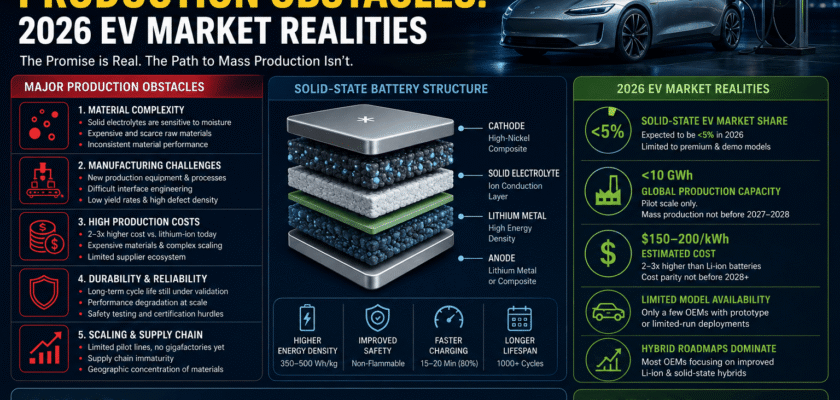
Solid-State Production Obstacles: Why Lithium-Ion Batteries Are Keeping Their Hold on the 2026 EV Market.
The industrial timeline for next-generation electric vehicle powertrains is undergoing a necessary reality check. For years, automotive venture capital rushed into energy startups promising an immediate structural leap away from traditional chemistries. The narrative was highly captivating: solid-state batteries (SSBs) would completely eliminate flammable liquid electrolytes, instantly boost driving ranges past 1,000 kilometers, and deliver five-minute charging intervals. This relentless marketing push convinced casual observers that conventional power packs would become thoroughly obsolete by the middle of the decade.
However, scaling a laboratory breakthrough into a multi-gigawatt automotive assembly line has proven to be a deeply complex engineering bottleneck.
As we navigate the 2026 EV market, mainstream liquid lithium-ion batteries are firmly maintaining their industry-wide monopoly.
While marquee prototype fleets and localized semi-solid configurations are hitting global testing grounds, true all-solid mass deployment remains out of reach.
Automotive manufacturers are discovering that severe solid-state battery production obstacles prevent short-term commercialization at scale.
By analyzing severe material limitations and high capital costs, it becomes clear why classic wet chemistries remain the practical foundation of global transport electrification.
1. The Solid-Solid Interface Problem: An Engineering Resistance Barrier
The primary technological hurdle delaying the industrialization of all-solid energy cells lies in the microstructural physics of internal power transfer. In a standard liquid lithium-ion pack, the volatile fluid acts as a perfect wetting agent, seamlessly coating the microscopic contours of both the positive cathode and negative anode surfaces.
In sharp contrast, compressing two rigid, non-fluid components together creates immense internal mechanical resistance.
                    [ Liquid Lithium-Ion Fluidity ]
     (Liquid Electrolyte ──► Complete Surface Wetting ──► Low Internal Resistance)
                                     │
                                     ▼
                [ The 2026 Solid-State Micro-Gap Trap ]
     (Rigid Solid Electrolyte ──► Microscopic Contact Patches ──► High Interface Impedance)
This rigid interface geometry triggers severe operational inefficiencies inside experimental automotive cells:
- High Interface Impedance: Because solid particles only touch at sporadic microscopic contact points, the pathways for traveling ions are highly restricted, driving up overall internal impedance.
- Mechanical Cycle Degradation: As the battery repeatedly charges and discharges, the physical expansion and contraction of the electrodes gradually pull these tiny contact patches apart.
- Catastrophic Internal Degradation: Consequently, these microscopic separations cause rapid capacity loss, dropping the lifespan of early all-solid prototypes way below standard automotive market requirements.
2. The Threat of Internal Whiskers: Dendrite Growth Across Rigid Crystals
The second prominent safety roadblock blocking rapid industrial scaling involves the persistent development of sub-surface metallic formations known as lithium dendrites. Early industry hype falsely claimed that replacing liquid separators with a solid ceramic or sulfide slab would act as an unpierceable wall against internal short circuits.
However, real-world laboratory testing has thoroughly disproven this assumption under intensive fast-charging operations.
  [ Fast Charging Initiated ] ───► [ Lithium Ions Build High Local Stresses ]
                                                   │
                                                   ▼
                                    [ Microscopic Cracking Provoked ]
                              "Whiskers Liquidize and Travel via Grain Boundaries"
                                                   │
                                                   ▼
                                    [ Catastrophic Cell Short Circuit ]
                              "Dendrite Pierces Ceramic Wall and Destroys Cell"
Advanced solid electrolytes feature tiny, invisible boundaries and structural imperfections within their crystalline matrix.
- The High-Current Push: When drivers plug into high-power fast chargers, the rapid push of lithium ions generates extreme local physical stresses.
- Piercing the Crystalline Separator: Seeking the path of least resistance, microscopic lithium fibers slowly force their way through the solid electrolyte’s grain boundaries.
- Instant Safety Failures: Once these metallic whiskers completely bridge the gap between the anode and cathode, they trigger an immediate internal short circuit, destroying the cell instantly.
3. Strategic Matrix: Mature Liquid Lithium-Ion vs. 2026 Solid-State Prototypes
| Performance & Manufacturing Vector | Mature Liquid Lithium-Ion Ecosystem | 2026 Experimental Solid-State Lines |
| Average Cell Energy Density | Optimized at ~250–300 Wh/kg via high-nickel setups | Boasts 350–500 Wh/kg in low-volume laboratory tests |
| Manufacturing Line Yield Rate | Reliably exceeds 90–95% across global gigafactories | Extremely volatile; plagued by high component rejection |
| Required Factory Atmosphere | High-precision dry-rooms with standard controls | Ultra-strict inert atmospheres to block toxic gases |
| Raw Material Supply Chains | Globally mature, scaled, and highly cost-optimized | Fragmented; lacks processed sulfides/oxides supply |
| Average Production Cost Tier | Balanced; continuously dropping via infrastructure | Extreme; currently tracks 3× to 5× higher per pack |
4. The Dry-Room Financial Strain: Extreme Scale-Up Expenditures
The final and most decisive factor keeping traditional liquid lithium-ion batteries dominant centers on the massive financial costs tied to all-solid manufacturing lines. Sulfide-based solid electrolytes—currently the leading option chosen by major global automotive groups—are highly sensitive to environmental humidity.
Consequently, processing these advanced materials requires building massive, specialized assembly environments.
  [ Material Exposes to Humidity ] ───► [ Chemical Breakdown Triggers Instantly ]
                                                       │
                                                       ▼
                                        [ Toxic Hydrogen Sulfide Gas Output ]
                                  "Demands Massive, Hermetically Sealed Factories"
                                                       │
                                                       ▼
                                        [ Capital Outlays Skyrocket 500% ]
                                  "Locks Scale Progress Away from Commercial Parity"
If a sulfide electrolyte makes contact with even a tiny trace of ambient moisture, it undergoes an immediate chemical breakdown, releasing highly toxic hydrogen sulfide gas. To counter this safety risk, manufacturing teams must abandon standard dry-rooms to construct highly expensive, hermetically sealed industrial environments filled with pure argon or ultra-dry nitrogen gas.
This specialized machinery requirement increases immediate factory development costs by up to 500 percent compared to conventional wet-cell facilities. With liquid lithium-ion production costs continuing to fall globally due to mature infrastructure, solid-state designs face an uphill battle to reach price parity, keeping them locked out of mass-market consumer cars for now.


