
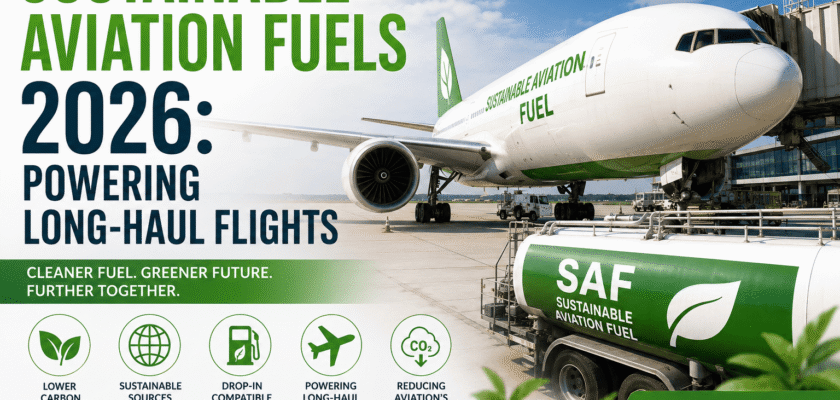
Carbon-Negative Aviation: The Airlines Piloting Synthetic e-Fuels for Long-Haul Transits.
The operational framework directing international commercial aerospace is undergoing a profound, regulatory-led transformation. For nearly a century, international passenger airlines relied entirely on conventional fossil-derived kerosene to power long-distance routes. This petroleum-based fuel setup delivered high energy density, but it steadily built a massive carbon footprint, accounting for nearly three percent of all global carbon emissions. Because making large, heavy commercial aircraft fully electric is physically impossible for long distances, the travel industry struggled to find practical ways to limit carbon output.
Fortunately, international aviation rules are driving a rapid transition toward sustainable, drop-in fuel alternatives.
We have officially entered a new era shaped by the widespread deployment of sustainable aviation fuels 2026 networks.
Driven by strict regional blending mandates across Europe and the UK, carriers are cleaning up their flight paths.
By mixing standard jet fuel with advanced synthetic hydrocarbons, airlines are preserving carbon neutral flight paths cleanly.
This high-impact transition permanently updates eco-friendly luxury tour trends, ensuring that holidaymakers can travel without causing environmental harm. Consequently, aviation networks are scaling up production facilities, proving that green flight is won by transforming renewable inputs into clean energy.
1. The Drops-In Edge: Why Chemical Identity Protects Legacy Fleets
The primary technological catalyst accelerating this green aviation shift centers on the drop-in nature of non-fossil jet fuels. Standard alternative power experiments often require completely replacing aircraft engines or airport storage infrastructure, adding massive capital costs.
In contrast, next-generation synthetic alternatives feature chemical structures nearly identical to conventional kerosene.
                    [ The Capital Rebuild Trap ]
     (Hydrogen or Battery Core ──► Demands New Aircraft ──► Trillions in Fleet Waste)
                                     │
                                     ▼
                [ The 2026 Sustainable Fuel Shield ]
     (Synthetic Hydrocarbons ──► Existing Fuel Lines ──► Immediate 80% Emissions Drop)
These highly compatible synthetic fuels provide immense structural benefits to global travel distribution networks:
- Zero System Modifications: Airlines pump alternative fuel mixtures directly into standard aircraft wing tanks without modifying engines.
- Drastic Emissions Drops: Consequently, utilizing these non-fossil alternatives yields up to an 80 percent reduction in lifecycle greenhouse emissions.
- Utilizing Current Pipe Lines: Therefore, clean fuels travel through existing airport hydrant networks smoothly, saving trillions in development fees.
2. Re-Engineering the Refinery: Power-to-Liquid and Advanced e-Fuel Alliances
The real-world scaling of this green transit model relies on establishing powerful corporate joint ventures to manufacture complex synthetic hydrocarbons from captured carbon and renewable electricity.
A. Testing Real-World Operational Readiness
Aerospace leaders are moving past simple laboratory tests to deploy active, real-world flight evaluation programs.
A prime example is Boeing’s strategic joint testing initiative alongside Norsk e-Fuel across Nordic aviation grids.
This targeted partnership focuses on generating practical operational data regarding how synthetic power-to-liquid fuels perform during everyday flights.
By analyzing fuel pump reliability and combustion traits under varied weather conditions, the group builds a resilient foundation for long-haul energy independence.
B. Building the International Supply Network
Furthermore, this infrastructure push pairs active flight testing with massive, multi-regional distribution agreements to secure fuel access:
  [ Strategic MoU Executed ] ───► [ ENOC Ties with Allied Biofuels Holding ]
                                                   │
                                                   ▼
                                    [ World-Scale Biorefinery Link ]
                              "Taps Advanced e-SAF Facility in Uzbekistan"
                                                   │
                                                   ▼
                                    [ Long-Term Global Supply Secured ]
                              "Guarantees Stable Alternative Fuel Inflows"
Energy leaders are executing comprehensive agreements to distribute electro-synthetic sustainable aviation fuel (e-SAF) across global commercial channels.
A landmark agreement between ENOC Group and Allied Biofuels taps directly into a world-scale biorefinery under development in Uzbekistan.
This complex will manufacture advanced alternative fuels, using smart distribution pipelines to bridge the current supply gap.
Consequently, international carriers lock in reliable access to clean fuel reserves well ahead of schedule, proving that joint investment guarantees stable travel operations.
3. Strategic Matrix: Traditional Kerosene Refineries vs. 2026 Synthetic Fuel Networks
| Aviation Fuel Axis | Traditional Fossil Derived Kerosene | 2026 Synthetic Fuel Networks |
| Primary Raw Feedstock | Crudes extracted from fossil oil reserves | Waste oils, biomass, and captured carbon particles |
| Lifecycle Emission Cuts | Zero percent baseline; adds ancient ground carbon | Up to 80+ percent reduction in greenhouse output |
| Regulatory Compliance | Poor; faces severe penalties under blending rules | Excellent; fulfills strict regional transport mandates |
| Price Stability Stance | Weak; vulnerable to geopolitical commodity spikes | Strong; utilizes local renewable energy links |
| Risk Characterization | High vulnerability to carbon taxation and limits | Withdrawn Risk; tech-backed policy alignment |
4. Decentralized Regional Models: Securing Longevity Through Local Biomass
The final core trend reshaping global travel networks shifts production away from centralized oil nations to build small, regional fuel grids. By producing fuel closer to where aircraft take off, transport networks insulate themselves from international logistics shocks.
  [ Regional Supply Deal Signed ] ───► [ Loganair Partners with ClimaHtech Green Flight ]
                                                         │
                                                         ▼
                                          [ Decentralized Production Nodes ]
                                    "Processes Local Waste Biomass via Clean Grids"
                                                         │
                                                         ▼
                                          [ Island Flight Resilience Locked ]
                                    "Insulates Local Air Travel From Price Shocks"
Regional carriers use long-term agreements to support clean infrastructure near core flight hubs.
Loganair’s landmark 15-year contract with ClimaHtech Green Flight utilizes localized processing facilities across the UK.
These smart systems convert local waste biomass into high-quality fuel, operating flexibly alongside local renewable power grids.
Thus, proactive supply management transforms clean fuel production into a reliable engine for local economic strength. This structural change keeps remote flight routes safe and active, proving that long-term travel growth is won by building independent, sustainable fuel networks right where routes connect.


