
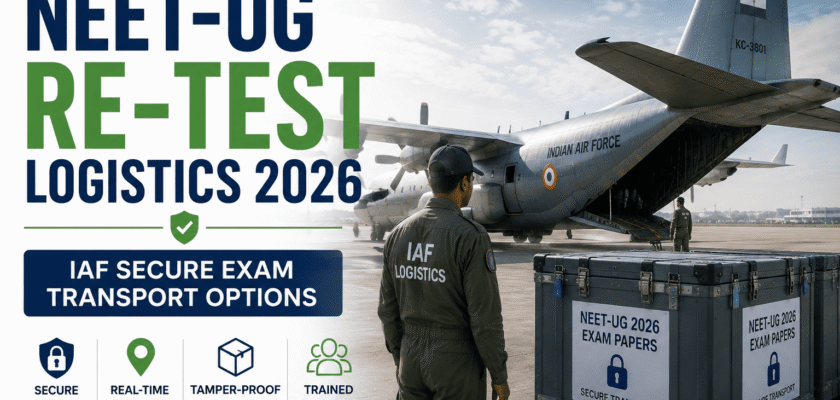
Securing the Retest: Why the Indian Air Force May Transport Upcoming National Exam Papers.
The administrative blueprint directing India’s ultra-competitive medical entrance examinations is undergoing an unprecedented, structural security overhaul. For generations, the logistical distribution of national question papers relied heavily on standard civilian transit frameworks. Testing authorities routed heavy physical bundles through the national postal system, moving documents across multiple distribution offices and intermediate storage banks before final delivery. While this traditional mechanism successfully managed routine volumes for years, its reliance on fragmented civilian channels left vulnerable points open to manipulation by organized paper-leak networks.
However, the recent cancellation of the May 3 medical entrance exam has permanently shattered administrative trust in traditional transit pathways.
The government is executing an aggressive tactical pivot to secure the upcoming June 21 examination cycle.
Trilateral ministries are establishing comprehensive NEET-UG re-test logistics 2026 models to protect academic testing channels.
A landmark proposal explores deploying Indian Air Force (IAF) aircraft to transport question papers directly to state centers.
By replacing vulnerable paths with military transit, officials are deploying ironclad exam paper security measures across the country. This emergency deployment marks a major shift in national testing strategy, introducing IAF transport for board exams to eliminate human intervention. This structural framework ensures that every student’s future remains completely protected from the threat of institutional compromises.
1. The Zero-Trust Mandate: Why Military Logistical Routing Eliminates In-Transit Leakage
The primary operational catalyst driving this rapid security shift centers on implementing a zero-trust architecture across all transportation networks. Civilian transit methods require passing sensitive paper cases through dozens of human links, expanding the attack surface for bad actors.
In sharp contrast, military logistical transport cuts out unnecessary intermediate handovers entirely, placing papers inside a secure, monitored chain of custody.
                     [ Legacy Civilian Postal Trail ]
     (Multiple Sorting Hubs ──► Vulnerable Local Transits ──► High Risk of Compromise)
                                      │
                                      ▼
                   [ The 2026 IAF Strategic Airbridge ]
     (Secure Press Load ──► Direct Airbase Delivery ──► Zero-Intervention Regional Drop)
This strict airbridge methodology provides key advantages to prevent institutional document tampering:
- Eliminating Civilian Infiltration: Moving materials via military logistics isolates question documents from civilian cargo systems.
- Strict Chain of Custody: Consequently, the military chain uses disciplined, tracked handovers, leaving no blind spots for document leaks.
- Beating Tight Timelines: Therefore, the entire shipping timeline shrinks from weeks to hours, allowing teams to deliver papers right before testing windows open.
2. Operational Hardening: Navigating Monsoon Realities and High-Security Delivery Points
The real-world success of this upgraded testing model relies on combining military transport lines with specialized local drop spots to dodge weather challenges.
A. Defeating Adverse Monsoon Weather Interruptions
The mid-June testing window brings severe monsoon downpours, creating massive flooding risks that threaten standard road transport lines across distant states.
By deploying heavy military aircraft, the government ensures that critical testing materials fly over washed-out roads easily.
This reliable air capability protects delivery paths to isolated island areas like Lakshadweep and flood-prone districts in Assam or Bihar.
This operational readiness ensures that bad weather cannot cause sudden exam delays or break delivery schedules.
B. Establishing Secure Regional Hub Distribution Paths
Furthermore, this advanced protection strategy connects secure air corridors directly with local police teams for safe last-mile delivery:
  [ IAF Planes Land at Base ] ───► [ Drop Papers at Secure Regional Hubs ]
                                                   │
                                                   ▼
                                    [ Strict Armed Escorts Engage ]
                              "State Police Escort Vehicles and Track Routes"
                                                   │
                                                   ▼
                                    [ Leak-Proof Delivery Verified ]
                              "Papers Reach Centers Securely with Zero Gaps"
The smart logistical framework routes military cargo planes straight to strategic regional military fields.
Upon touchdown, specialized local security teams and state police units take charge of the sealed document vaults immediately.
These synchronized security escorts guard the cargo tightly on its final road journey to district storage vaults.
This multi-agency tracking system prevents local interference, ensuring that every examination packet arrives untouched and completely pristine.
3. Strategic Matrix: Classic Postal Delivery vs. 2026 Secure Military Airlift Chains
| Logistical Security Axis | Traditional Postal Delivery Channels | 2026 Secure Military Airlift Chains |
| Primary Transit Method | Commercial rail routes and standard road networks | Strategic military aircraft and armed convoys |
| Human Interaction Gaps | Elevated; passes through multiple contract workers | Zero; guarded exclusively by verified personnel |
| Weather Disruption Risk | High; vulnerable to monsoon flash floods and stops | Low; bad-weather flight capabilities ensure access |
| Last-Mile Escort Model | Simple padlocks; light security at local storages | Armed police details guard moving materials |
| Risk Characterization | High vulnerability to intercept tricks and local leaks | Withdrawn Risk; tech-backed transit tracking |
4. Systemic Reform: The Shift Toward Full Computer-Based Standard Settings
The final core trend reshaping national testing frameworks plans to phase out physical paperwork entirely by moving to smart digital testing layouts next year. Because printing and shipping millions of physical papers across large distances always brings security risks, administrators are accelerating digital upgrades.
  [ Launch Advanced Digital Migration ] ───► [ Central Servers Encrypt Testing Data ]
                                                            │
                                                            ▼
                                             [ On-Screen Random Question Sheets ]
                                       "Generates Unique Layouts Right Before Start"
                                                            │
                                                            ▼
                                             [ Complete Security Loop Locked ]
                                       "Erases Material Shipping and Intercept Leaks"
Testing boards are building unified digital setups to host major examinations via secure computer-based networks.
The system uses advanced encryption keys to push question banks straight to terminal screens mere minutes before the start bell.
This fast digital delivery completely deletes the need for physical printing plants, storage vaults, and road convoys.
Thus, proactive digital upgrades turn slow, risky paper loops into clean, unshakeable testing networks. This structural modernization keeps academic evaluation fair and secure, proving that long-term testing integrity is won by using smart, server-based systems that protect student hard work.


