
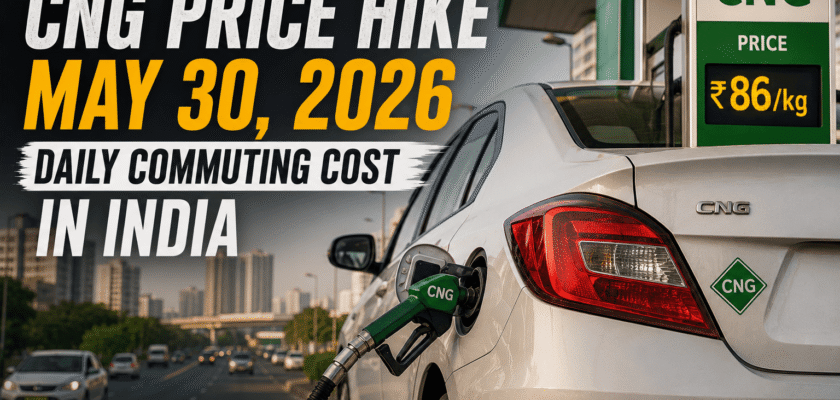
CNG Price Hike May 30 2026: Your Daily Commute Just Got Costlier
For many Indian car owners, CNG has always been the “smart middle path” between petrol cost and electric vehicle pricing. It is cheaper than petrol, cleaner than diesel, and practical for daily city driving. But the latest CNG price hike on May 30, 2026 has again changed the real commuting math for thousands of daily users.
Mahanagar Gas Limited has increased CNG prices by ₹2 per kg in the Mumbai Metropolitan Region. After this revision, CNG now costs ₹86 per kg in Mumbai and nearby areas including Thane and Navi Mumbai. This is not a small update for people who drive daily for office, business, cab service, delivery work, or family travel.
The bigger question is simple: how much more will you now pay per kilometre?
Let’s break it down in a simple way.
What Changed on May 30, 2026?
The latest fuel revision increased CNG by ₹2 per kg. Before the hike, the price was around ₹84 per kg. After the hike, it became ₹86 per kg.
This means the price increase looks small on paper, but the impact becomes visible when you calculate it for daily travel, monthly office runs, and cab operations.
For a normal car owner, ₹2 per kg may not feel very big. But for a person driving 40 to 80 km every day, the monthly difference starts adding up.
The True Per-Kilometre Cost of CNG After the Hike
The real cost of CNG depends on your car’s mileage. Most popular CNG cars in India usually deliver around 24 km/kg to 32 km/kg in real-world city and highway mixed driving.
Here is a simple calculation:
| Real-World CNG Mileage | Earlier Cost at ₹84/kg | New Cost at ₹86/kg | Extra Cost Per Km |
|---|---|---|---|
| 24 km/kg | ₹3.50/km | ₹3.58/km | ₹0.08/km |
| 26 km/kg | ₹3.23/km | ₹3.31/km | ₹0.08/km |
| 28 km/kg | ₹3.00/km | ₹3.07/km | ₹0.07/km |
| 30 km/kg | ₹2.80/km | ₹2.87/km | ₹0.07/km |
| 32 km/kg | ₹2.63/km | ₹2.69/km | ₹0.06/km |
At first, this increase looks very small. But the monthly cost tells the real story.
Monthly Impact for Daily Commuters
Suppose you drive 40 km every day for office and personal work. If you travel around 26 days a month, your monthly running is around 1,040 km.
If your CNG car gives around 26 km/kg, your car will use nearly 40 kg of CNG in a month.
Earlier cost: 40 kg × ₹84 = ₹3,360
New cost: 40 kg × ₹86 = ₹3,440
That means your monthly cost increases by around ₹80.
Now, if you drive 80 km daily, the monthly impact becomes almost ₹160 or more. For taxi drivers, delivery workers, and fleet operators, the impact can be much higher because their running is heavy.
Is CNG Still Cheaper Than Petrol?
Yes, CNG is still cheaper than petrol for most daily users.
A petrol car in city traffic may give around 12 to 16 km/litre. If petrol is around ₹100 per litre, the running cost can be around ₹6 to ₹8 per km.
A CNG car, even after the latest hike, can still run around ₹2.70 to ₹3.60 per km depending on mileage.
So, CNG still saves money in daily use. But the gap is slowly becoming smaller, especially when CNG prices keep rising again and again.
Why This Hike Matters for Metro City Drivers
Metro city drivers already face high costs. Parking, tolls, maintenance, insurance, traffic fuel waste, and service charges are increasing. In this situation, even a small fuel hike affects the total monthly budget.
This hike matters more because:
- Daily office commuters depend on CNG for low running cost.
- Auto and taxi operators may demand fare revision.
- Fleet owners will have to recalculate their operating cost.
- New car buyers may again compare CNG, petrol, hybrid, and EV options.
- Budget car users may become more mileage-focused.
For cities like Mumbai, where daily travel distance is already high, the cost pressure becomes stronger.
Best Affordable Running Cost Cars in India After the CNG Hike
Even after the price increase, factory-fitted CNG cars are still among the best choices for low running cost. Here are some practical options for daily users:
1. Maruti Suzuki WagonR CNG
WagonR CNG is popular because of its good mileage, easy maintenance, and city-friendly size. It is a strong option for office commuters and small families.
2. Maruti Suzuki Alto K10 CNG
Alto K10 CNG is one of the most budget-friendly CNG cars in India. It is best for people who want low purchase cost and low running cost.
3. Tata Tiago CNG
Tata Tiago CNG offers better build quality and a more premium feel compared to many small hatchbacks. It is good for buyers who want safety, style, and economy together.
4. Hyundai Exter CNG
Hyundai Exter CNG is useful for people who want SUV-like styling with CNG savings. It is good for city users who also want modern features.
5. Maruti Suzuki Ertiga CNG
For family users and commercial operators, Ertiga CNG remains a practical choice. It offers 7-seater space with lower running cost.
Should You Buy a CNG Car in 2026?
If your daily running is high, CNG still makes sense. If you drive more than 35 to 40 km per day, a CNG car can save a good amount over petrol in the long term.
But if your driving is very low, like 10 to 15 km per day, then the extra cost of buying a CNG variant may take longer to recover.
Before buying a CNG car, check these points:
- Your daily running distance
- CNG pump availability near your home or office
- Waiting time at CNG stations
- Boot space requirement
- Difference between petrol and CNG variant price
- Real-world mileage, not only company-claimed mileage
What Daily Drivers Should Do Now
The best way to control fuel cost is not only choosing CNG. Driving style also matters.
To reduce your running cost:
- Maintain correct tyre pressure
- Avoid sudden acceleration
- Service your car on time
- Do not carry unnecessary weight
- Use AC smartly in traffic
- Plan routes to avoid long jams
- Compare CNG price and mileage every month
A well-maintained CNG car can still remain one of the most affordable options for city driving.
Final Verdict
The May 30, 2026 CNG price hike has increased the cost pressure on daily commuters, especially in Mumbai and nearby metro areas. The new ₹86/kg price may not look shocking at first, but it changes the per-kilometre calculation for regular drivers.
For normal office users, the monthly increase may be around ₹80 to ₹200 depending on usage. For taxi drivers and high-running users, the impact can be much bigger.
Still, CNG remains cheaper than petrol for most city users. The smart move is to calculate your actual daily running, compare real-world mileage, and choose a car that gives the best balance of price, mileage, maintenance, and comfort.
In 2026, the cheapest car is not always the best car. The best car is the one that gives you the lowest real cost per kilometre.


