
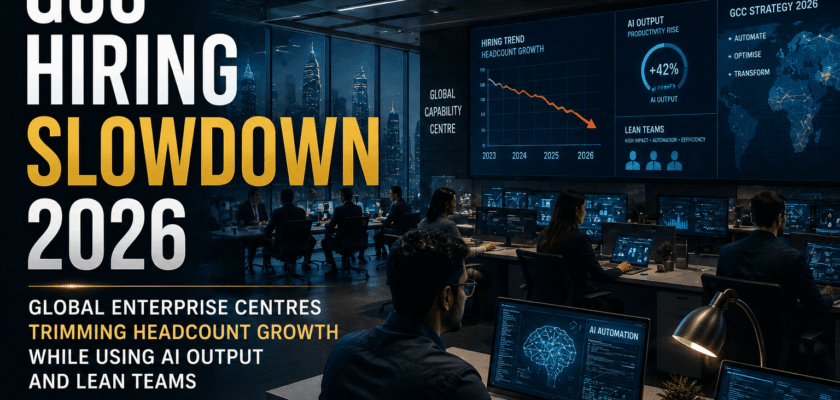
GCC Hiring Slowdown 2026: Why the Hiring Engine Is Changing
GCC hiring slowdown 2026 is becoming a major business trend because global enterprise centres are no longer hiring only for scale. Earlier, many Global Capability Centres in India grew by adding large teams for support, operations, analytics, technology, and back-office functions. Now, companies want more output from smaller and sharper teams.
This does not mean GCCs are disappearing. In fact, India remains the world’s largest GCC hub. However, the hiring style is changing. Companies now prefer AI-ready talent, automation skills, platform engineering, cybersecurity, and senior problem-solvers over mass headcount.
Therefore, the ultra-lean reality is clear: global enterprises want capability, not just capacity.
Why GCC Hiring Slowdown 2026 Matters
GCC hiring slowdown 2026 matters because these centres have become a major part of India’s white-collar job market. Global companies use Indian GCCs for software engineering, finance, analytics, AI, product development, cybersecurity, legal operations, and customer experience.
When GCC hiring slows or becomes more selective, it affects job seekers, recruiters, campuses, staffing firms, and office markets.
Reuters reported that India is expected to host 2,117 GCCs by the end of fiscal 2026, employing 2.36 million people and generating around $100 billion in revenue, according to Nasscom-Zinnov data.
So, even a small shift in hiring strategy can create a large labour-market impact.
What Are Global Capability Centres?
Global Capability Centres, or GCCs, are offshore centres owned by multinational companies. They are not normal outsourcing vendors. Instead, they work as internal teams for global enterprises.
A GCC may handle:
- Software development
- AI and data science
- Cybersecurity
- Finance operations
- HR operations
- Product engineering
- Legal support
- Compliance
- Customer analytics
- Research and innovation
In the past, many GCCs grew through large hiring waves. Now, the focus is moving toward high-value work and AI-led productivity.
GCC Hiring Slowdown 2026 and the 28-Month Hiring Low
The phrase “28-month hiring low” reflects the larger concern that enterprise hiring has become weaker and more selective. GCCs are still hiring, but they are not hiring the same way as before.
Instead of adding large numbers of junior or process-heavy roles, companies are choosing experienced professionals who can deliver faster with AI tools.
Moneycontrol reported that mid and senior-level specialised professionals now account for over 55–70% of new headcount additions across GCCs in 2026.
This means the job market is not closed. It is becoming harder for generalist profiles and stronger for niche skill profiles.
Why AI Output Is Replacing Bulk Headcount
AI output is becoming more important because companies want better productivity without increasing salary cost too much. AI tools can help teams write code, analyse data, create reports, test software, automate workflows, and reduce repetitive tasks.
As a result, one skilled employee with good AI tools can sometimes do work that earlier needed multiple people.
This is why some enterprises are asking a new question: “Can we improve output without adding more headcount?”
That question is changing GCC hiring strategy.
How AI Is Reshaping Enterprise GCC Teams
AI is reshaping GCC teams in three clear ways.
First, routine work is being automated. Repetitive reporting, basic coding, data cleaning, ticket routing, and documentation can now be partly handled by AI tools.
Second, companies need more people who can design and manage AI workflows. These roles require judgement, domain knowledge, and technical skill.
Third, managers now expect employees to use AI as a productivity layer. This means workers must know how to prompt, verify, improve, and safely apply AI outputs.
Therefore, the future GCC employee must be more than a task executor.
Why Companies Are Trimming Headcount Growth
Companies are not always cutting jobs directly. In many cases, they are trimming future headcount growth. This means they may hire fewer people than earlier plans.
Several factors drive this shift:
- AI productivity gains
- Cost pressure
- Global economic uncertainty
- Higher salary expectations
- More automation
- Focus on niche roles
- Vendor consolidation
- Better workflow tools
- Need for faster output
- Pressure from headquarters
So, the hiring slowdown is not only about recession fear. It is also about AI-led redesign.
GCC Hiring Slowdown 2026 and Niche Skill Demand
GCC hiring slowdown 2026 does not mean demand for talent is gone. It means demand is becoming sharper.
Companies are hiring more selectively for areas like:
- AI engineering
- Machine learning operations
- Data engineering
- Platform engineering
- Cloud security
- Product management
- Cybersecurity
- Automation architecture
- Domain consulting
- Risk and compliance technology
This is why many professionals with old skill sets may feel pressure, while AI-era specialists may still see strong opportunities.
Why Junior Roles May Face More Pressure
Junior roles may face more pressure because AI can handle some entry-level tasks faster. For example, basic code generation, test case drafting, Excel analysis, report writing, and documentation can now be supported by AI.
This does not mean freshers have no future. However, it means freshers must become productive faster.
A fresher who only knows theory may struggle. A fresher who can use AI tools, understand business context, and solve problems may stand out.
Therefore, entry-level candidates need stronger practical skills.
What Global Enterprises Want Now
Global enterprises now want GCCs to deliver business outcomes, not only low-cost support. They want Indian centres to work on products, platforms, data, security, AI, and innovation.
Reuters also reported that global firms are rethinking GCC hiring in India as AI shifts skill demand, even while companies continue expanding centres for high-value work.
This shows the new direction clearly. The future GCC is not only a back office. It is a capability engine.
Why India Still Remains Strong for GCCs
Even with hiring slowdown, India remains strong because it has large technical talent, mature office markets, English-speaking professionals, and deep experience in global enterprise work.
Reuters reported that companies like JPMorgan Chase, Walmart, McDonald’s, Nvidia, Eli Lilly, American Airlines, and others have been expanding or building tech presence in India. American Airlines also plans to double its Hyderabad tech hub staff to around 800 by early 2027, according to Reuters sources.
So, the story is not “GCCs are leaving India.” The real story is “GCCs are becoming more selective in India.”
The Ultra-Lean Reality for GCC Leaders
The ultra-lean reality means leaders must do more with fewer layers. A GCC head cannot simply ask for hundreds of new people for every new project. They must show productivity, automation, and measurable business value.
This changes leadership expectations.
GCC leaders now need to:
- Build AI-first workflows
- Improve employee productivity
- Reduce repetitive work
- Upskill current teams
- Hire only high-impact roles
- Measure output clearly
- Cut tool duplication
- Control cost per project
- Improve delivery speed
- Link work to business value
This makes GCC leadership more strategic.
Why AI Does Not Remove the Need for Human Talent
AI can improve output, but it cannot replace all human judgement. Enterprise work still needs context, ethics, compliance, client understanding, security decisions, and domain expertise.
For example, AI can draft code, but humans must review architecture. AI can analyse data, but humans must decide what the data means. AI can generate reports, but leaders must act on the insight.
Therefore, the best GCC teams will combine AI speed with human judgement.
The winning model is not AI versus people. It is AI plus skilled people.
What Employees Should Learn Now
Employees who want to stay relevant in GCCs should upgrade skills quickly.
Important skills include:
- AI tool usage
- Prompt engineering basics
- Data analysis
- Cloud platforms
- Cybersecurity awareness
- Automation tools
- Business communication
- Domain knowledge
- Product thinking
- Problem-solving
Also, employees should learn how to verify AI output. Blindly trusting AI can create errors.
What Freshers Should Do
Freshers should not panic. However, they must prepare differently.
A fresher should build:
- Strong coding basics
- Real projects
- AI tool familiarity
- GitHub portfolio
- Data skills
- Cloud basics
- Communication skills
- Internship experience
- Problem-solving practice
- Domain awareness
Instead of applying with only a degree, freshers should show proof of work.
This makes them more attractive in a selective hiring market.
What Mid-Level Professionals Should Do
Mid-level professionals may face the biggest transition. They already have experience, but some routine management or coordination work may become automated.
They should move toward higher-value skills.
Useful moves include:
- Learn AI workflow design
- Improve domain depth
- Take ownership of outcomes
- Build automation skills
- Learn product metrics
- Manage cross-functional projects
- Mentor junior teams
- Understand cost and ROI
- Improve stakeholder communication
- Become a problem owner
Mid-level workers who only coordinate tasks may face pressure. Those who solve business problems will stay valuable.
What Companies Should Avoid
Companies should avoid blindly cutting headcount without redesigning work. If they reduce people but do not improve processes, quality can fall.
They should also avoid forcing AI tools without training. Employees need clear rules on data privacy, output review, and safe usage.
Common mistakes include:
- Cutting too fast
- Ignoring employee training
- Measuring only AI usage
- Overloading remaining staff
- Hiring only senior talent
- Blocking freshers completely
- Using AI without governance
- Ignoring cybersecurity risk
- Removing human review
- Chasing cost cuts over quality
A smart GCC strategy must balance efficiency and resilience.
Why AI Governance Matters
AI governance is now essential for GCCs. These centres often handle sensitive global data, customer information, financial workflows, product code, and business processes.
AI tools must follow strict controls.
Good governance should include:
- Approved AI tools
- Data access rules
- Model usage policy
- Security checks
- Human review process
- Audit logs
- Cost tracking
- Vendor risk review
- Bias and error checks
- Employee training
Without governance, AI can create legal, security, and quality problems.
GCC Hiring Slowdown 2026 and Office Markets
GCC hiring trends also affect commercial real estate. If companies hire fewer people, they may need less office space per project. However, high-value GCCs may still take premium offices for AI labs, product teams, and leadership centres.
This means office demand may shift from pure seat-count expansion to high-quality, flexible, tech-ready spaces.
Developers and landlords should watch how GCCs balance hybrid work, AI productivity, and specialised team needs.
The Future of GCC Hiring
The future of GCC hiring will likely be selective, skill-heavy, and AI-led. Companies will still expand in India, but they will not hire blindly.
Future hiring may focus on:
- Fewer but stronger teams
- More AI specialists
- More domain experts
- Higher productivity expectations
- More internal upskilling
- Better automation
- Stronger cybersecurity
- Outcome-based performance
- Less routine work
- More strategic ownership
This means job growth may continue, but the quality bar will rise.
Final Verdict
GCC hiring slowdown 2026 shows a major shift in global enterprise strategy. Companies are not giving up on India’s GCC ecosystem. Instead, they are changing what they expect from it.
The old model focused on scale and headcount. The new model focuses on AI output, niche skills, productivity, and business value.
For employees, this is a warning and an opportunity. Routine work may shrink, but skilled work will grow. For companies, the challenge is to use AI without damaging talent pipelines. For India, the goal should be to move from low-cost delivery to high-value capability.
In simple words, the future of GCCs will not belong to the biggest teams. It will belong to the smartest teams.


