
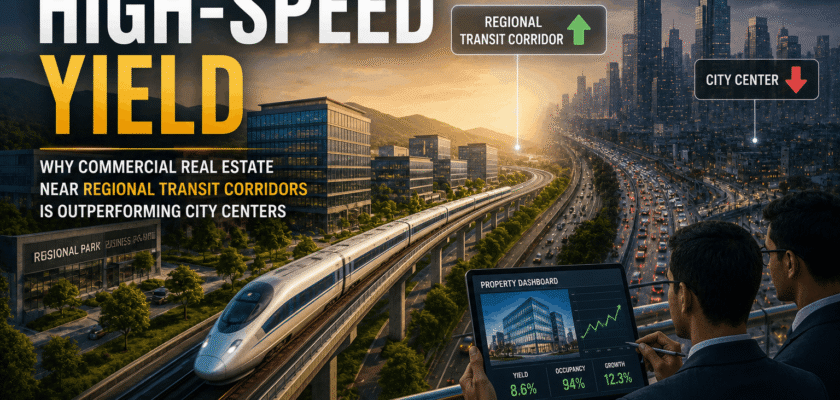
High-Speed Yield: Why Real Estate Money Is Following Transit
High-speed yield is becoming a major real estate trend in 2026 because commercial property investors are no longer looking only at city centers. They are also tracking regional transit corridors, metro extensions, airport links, expressways, and future high-speed rail routes.
This shift is simple to understand. Companies want offices that are easier to reach, cheaper to operate, larger in campus size, and better connected to employee housing. As a result, commercial real estate near strong transit corridors is gaining more attention.
Therefore, the new rule in office real estate is clear: location still matters, but connected location matters more.
Why High-Speed Yield Matters in 2026
High-speed yield matters because infrastructure is changing the value map of Indian cities. Earlier, a central business district address was the biggest advantage. Today, traffic, high rent, limited parking, and old building stock are pushing many companies to consider new corridors.
At the same time, India’s office market is strong. JLL reported that India recorded its best-ever Q1 office leasing performance with 21.5 million sq. ft. gross leasing in Q1 2026.
This demand gives developers and investors confidence to build beyond old downtown hubs.
What Is High-Speed Yield?
High-speed yield means the rental and investment value created by fast connectivity. It can come from metro lines, regional rapid rail, airport corridors, expressways, or high-speed rail projects.
In simple words, when people and businesses can move faster, nearby real estate becomes more useful.
High-speed yield may show up through:
- Better office occupancy
- Higher rental demand
- Faster leasing
- Stronger land value
- Better investor interest
- More mixed-use development
- Higher retail footfall
- Better employee commute
- Stronger housing demand
- Higher long-term asset value
So, transit is not only a transport story. It is also a real estate story.
High-Speed Yield and Commercial Real Estate Near Corridors
High-speed yield is rising because commercial real estate near regional transit corridors can solve several business problems at once. It can reduce commute stress, support large campuses, improve last-mile access, and lower dependence on congested central locations.
Companies now want locations where employees can reach office from multiple areas. A corridor-based office park can serve people from nearby towns, suburbs, airports, and housing clusters.
This is why investors are paying more attention to transit-led growth zones.
Why City Centers Are Losing Some Pull
City centers are not dead. They still have brand value, financial institutions, hotels, government offices, and premium addresses. However, they also face real challenges.
Common city center problems include:
- High rent
- Heavy traffic
- Limited parking
- Old buildings
- Higher operating cost
- Lower expansion space
- Longer employee commute
- Air and noise pollution
- Limited green campus space
- Redevelopment delays
Because of these issues, many companies now prefer connected business parks outside the most congested downtown areas.
Regional Transit Corridors: The New CRE Magnet
Regional transit corridors are becoming commercial real estate magnets because they connect jobs, homes, airports, industrial areas, and business districts.
A strong corridor can support:
- Office towers
- Business parks
- Co-working hubs
- Retail centers
- Hotels
- Warehousing
- Residential projects
- Healthcare services
- Education hubs
- Entertainment zones
When these uses grow together, the corridor becomes a complete business ecosystem.
Budget 2026 and High-Speed Rail Corridors
India’s Budget 2026–27 announced seven high-speed rail corridors as “growth connectors.” PIB said these corridors are planned to integrate key cities and regions, support faster movement of people, and improve economic interaction across states. Together, the corridors may span nearly 4,000 km and attract around ₹16 lakh crore investment.
For real estate, this is important because high-speed rail can reshape where companies choose regional offices.
However, investors should remember one thing: announcements create interest, but execution creates value.
High-Speed Yield and Transit-Oriented Development
High-speed yield works best when cities follow transit-oriented development, or TOD. TOD means offices, homes, shops, hotels, and public spaces are planned around transit stations.
This model reduces long car trips and creates compact growth around mobility nodes.
A good TOD zone should include:
- Walkable streets
- Office space
- Housing nearby
- Retail and food options
- Public transport access
- Last-mile shuttle support
- Safe pedestrian paths
- Parking discipline
- Mixed-use zoning
- Green public spaces
If TOD is planned well, the corridor can generate stronger long-term yield.
Office Market Strength Supports Corridor Growth
The corridor story is stronger because India’s office demand remains healthy. CBRE reported that India’s Q1 2026 office market set a new benchmark, with total office absorption of 20.7 million sq. ft. and record-high GCC leasing of 9.1 million sq. ft.
This matters because GCCs, technology firms, BFSI companies, and domestic enterprises need large and high-quality office spaces.
Many such occupiers prefer modern campuses with better infrastructure instead of small old buildings in crowded centers.
Therefore, corridor-based office parks can capture future leasing demand.
Why GCCs Prefer Connected Office Campuses
Global Capability Centers, or GCCs, often need scale, talent access, security, and high-quality infrastructure. They may house engineering teams, finance teams, AI teams, cybersecurity teams, analytics teams, and product teams.
A connected office campus can give GCCs:
- Large floor plates
- Expansion space
- Employee amenities
- Better security
- Strong internet infrastructure
- Power backup
- Cafeterias and retail
- Shuttle connectivity
- Green campus design
- Lower congestion than downtown
This is why GCC demand can support high-speed yield around regional corridors.
How Transit Premium Works
Transit premium means properties near strong transport links can command better interest. Tenants and buyers value time savings.
For example, if two office locations have similar rent but one has metro access, airport access, or expressway access, the connected location may perform better.
Transit premium depends on:
- Distance from station
- Last-mile access
- Road quality
- Frequency of transit
- Safety
- Parking
- Nearby housing
- Office quality
- Retail support
- Future infrastructure certainty
So, not every corridor creates premium. The best corridors combine movement with livability.
Why Airport Corridors Are Gaining Value
Airport corridors are gaining value because businesses need fast regional and global movement. Senior executives, consultants, sales teams, and global visitors often prefer offices that reduce airport travel time.
Airport-linked zones can also support:
- Hotels
- Convention centers
- Logistics hubs
- Business parks
- Premium housing
- Retail clusters
- Co-working spaces
- Service apartments
- Healthcare facilities
- Education campuses
This creates a wider economic ecosystem around airport access.
Expressways and Office Growth
Expressways can also shift office demand. When a new expressway reduces travel time, nearby land becomes more attractive.
For example, recent reports have linked Dwarka Expressway with New Gurugram’s growth corridor and rising real estate confidence.
The same pattern can appear in other regions when expressways connect residential catchments with employment hubs.
However, expressway-led growth must avoid one mistake: car-only planning. If public transport and last-mile systems are weak, traffic may return quickly.
City Centers vs Corridors: Simple Comparison
| Factor | City Centers | Regional Transit Corridors |
|---|---|---|
| Brand value | Strong legacy | Emerging premium |
| Rent | Usually high | Often more flexible |
| Parking | Limited | Better scope |
| Expansion | Difficult | Easier |
| Traffic | Heavy | Depends on planning |
| Campus design | Limited | Stronger potential |
| Employee commute | Often stressful | Better if transit works |
| Future yield | Stable | Higher growth potential |
This comparison shows why many investors are moving beyond traditional downtown thinking.
Why Mixed-Use Projects Perform Better
Mixed-use projects perform better because people do not want isolated office towers. They want food, retail, gyms, daycare, homes, hotels, and public spaces nearby.
A strong corridor should not become only a line of office blocks. It should become a complete district.
Mixed-use development can improve:
- Rental demand
- Employee satisfaction
- Retail sales
- Residential demand
- Night-time activity
- Safety
- Walkability
- Long-term value
- Tenant retention
- Urban quality
This is why developers are planning larger integrated projects.
High-Speed Yield and Residential Demand
High-speed yield also depends on residential demand. Offices need workers, and workers need homes.
When housing grows near business corridors, the office market becomes stronger. Employees can live closer to work, and companies can attract talent from nearby areas.
This creates a healthy cycle:
Better transit brings offices.
Offices bring jobs.
Jobs bring housing demand.
Housing brings retail and services.
Retail improves the corridor.
This cycle can raise long-term real estate value.
Why Investors Must Avoid Corridor Hype
Not every corridor will become successful. Some corridors remain overhyped because infrastructure is delayed or demand is weak.
Investors should avoid buying only because a brochure says “upcoming growth corridor.”
Before investing, check:
- Is the transit project approved?
- Is construction actually moving?
- Are companies leasing nearby?
- Is residential demand real?
- Is last-mile access good?
- Are civic services ready?
- Is land pricing already too high?
- Is there oversupply risk?
- Is the developer credible?
- Is rental demand proven?
A good corridor needs execution, not only announcement.
Key Risks in High-Speed Yield Investing
High-speed yield investing has risks. The biggest risk is timing.
If you enter too early, money can remain stuck for years. If you enter too late, prices may already include future growth.
Common risks include:
- Infrastructure delay
- Policy changes
- Land acquisition issues
- Poor last-mile connectivity
- Oversupply
- Weak tenant demand
- High maintenance cost
- Speculative pricing
- Low rental yield
- Civic infrastructure gaps
Therefore, investors need patience and due diligence.
What Developers Should Build
Developers should not build only glass towers. They should build work ecosystems.
A strong corridor project should include:
- Efficient office layouts
- Good parking
- Shuttle support
- EV charging
- Food courts
- Green areas
- Strong security
- Digital infrastructure
- Flexible workspaces
- ESG-friendly design
Companies now choose offices that support employee experience. Buildings that ignore this may struggle to lease.
What Tenants Should Check
Tenants should evaluate corridor-based offices carefully.
They should check:
- Employee travel time
- Metro or rail access
- Shuttle availability
- Nearby housing
- Power backup
- Internet reliability
- Safety
- Food options
- Expansion flexibility
- Total occupancy cost
A lower rent location may become expensive if travel, attrition, and operations become difficult.
What Retail Investors Should Watch
Retail investors who invest through REITs, fractional ownership, or commercial property should watch corridor trends carefully.
Important signals include:
- Leasing momentum
- Tenant quality
- Occupancy level
- Rental escalation
- Transit completion timeline
- Building age
- Maintenance quality
- Debt level
- Exit options
- Market supply pipeline
Do not invest only because “near metro” is written in marketing material. Check actual distance and usage.
What REIT Investors Should Understand
REIT investors should understand that office demand is shifting toward high-quality assets. Strong tenants prefer Grade A offices with better infrastructure, compliance, and sustainability features.
Corridor-linked assets can perform well if they have good occupancy and strong tenant profiles.
However, REIT returns depend on rent collection, distribution policy, debt cost, asset quality, and market demand.
So, corridor exposure is useful, but asset quality matters more.
Why Last-Mile Connectivity Decides Success
Last-mile connectivity is often the deciding factor. A high-speed rail station or metro line is not enough if employees cannot reach the office easily.
Good last-mile systems include:
- Walkable paths
- Feeder buses
- Shared mobility
- Safe roads
- Cycling lanes
- Shuttle services
- Parking management
- Clear signage
- Night safety
- Universal accessibility
If last-mile is weak, transit premium becomes weaker.
High-Speed Yield and Sustainability
High-speed yield can also support sustainability if it reduces long car commutes. Better public transport can lower fuel use, emissions, and road congestion.
However, sustainability needs proper planning.
A green corridor should include:
- Public transport integration
- EV charging
- Energy-efficient buildings
- Water recycling
- Waste management
- Green landscaping
- Walkable streets
- Mixed-use zoning
- Lower car dependency
- Climate-resilient design
This makes the corridor future-ready.
Future of Commercial Real Estate Near Transit Corridors
The future of commercial real estate near transit corridors looks strong if infrastructure execution stays on track. Office demand, GCC growth, airport access, expressways, and high-speed rail planning can all support new business districts.
However, the market will reward only the best-planned corridors.
Future winners will have:
- Real tenant demand
- Strong public transport
- Good housing nearby
- Reliable civic services
- Quality developers
- Mixed-use planning
- ESG-compliant buildings
- Last-mile access
- Reasonable pricing
- Long-term policy support
These factors will separate real growth from hype.
Final Verdict
High-speed yield is becoming a major theme in commercial real estate because investors and occupiers are following connectivity. City centers still matter, but regional transit corridors are gaining power due to better mobility, larger campuses, lower congestion, and future infrastructure growth.
India’s strong office leasing numbers and GCC expansion support this shift. At the same time, the planned high-speed rail corridors can create new real estate growth zones if execution happens properly.
In simple words, the next commercial real estate winners may not sit in the oldest downtown towers. They may rise near the fastest and best-connected corridors.
For investors, the smart move is clear: follow infrastructure, but verify demand.


