
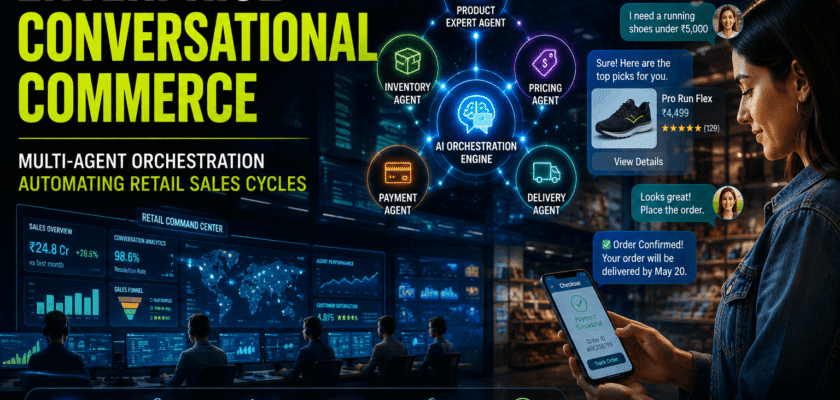
Enterprise Conversational Commerce: Why Retail Sales Are Changing
Enterprise conversational commerce is changing how retail brands talk to customers, recommend products, answer questions, manage checkout, and close sales. Earlier, chatbots mostly answered simple FAQs. Now, AI agents can understand customer intent, guide product discovery, compare options, check stock, apply offers, and move the buyer closer to purchase.
This shift matters because customers no longer want slow search filters, confusing menus, and repeated support calls. They want a simple chat-like experience that helps them buy faster.
Therefore, enterprise conversational commerce is becoming a growth tool, not only a customer support tool.
Why Enterprise Conversational Commerce Matters in 2026
Enterprise conversational commerce matters because shopping behaviour is becoming more conversational. Customers now ask questions like they talk to a store expert.
They may ask:
- Which phone is best under my budget?
- Which sofa fits a small living room?
- Which skincare product suits oily skin?
- Can I return this product?
- Is this size available?
- Can you compare these two items?
- Can you find a cheaper alternative?
- Can you add this to my cart?
AI can answer these questions in real time and guide the next step.
As a result, retail brands can reduce friction and improve conversion.
What Is Enterprise Conversational Commerce?
Enterprise conversational commerce means using AI-powered chat, voice, and messaging systems to support the full customer journey at scale. It works across websites, apps, WhatsApp, Instagram DMs, call centres, smart assistants, and in-store digital screens.
A strong system can help with:
- Product search
- Product comparison
- Size guidance
- Price and offer explanation
- Cart building
- Checkout support
- Order tracking
- Returns
- Loyalty rewards
- Customer support
In simple words, it turns conversation into a sales channel.
Enterprise Conversational Commerce and Multi-Agent Orchestration
Enterprise conversational commerce becomes more powerful when it uses multi-agent orchestration. This means several AI agents work together under one controller.
For example:
- Product agent finds the right item
- Inventory agent checks stock
- Pricing agent applies offers
- Payment agent manages checkout
- Support agent explains return policy
- Delivery agent estimates shipping
- Loyalty agent applies rewards
- Human handoff agent transfers complex cases
One chatbot alone may struggle with all tasks. But a team of specialised agents can complete the sales cycle more smoothly.
Why Multi-Agent Orchestration Is the Next Big Step
Multi-agent orchestration is the next big step because retail sales are not one simple task. A customer journey includes discovery, comparison, trust, purchase, delivery, and post-sale support.
A single AI assistant may answer questions. But a multi-agent system can coordinate many backend tools.
Codewave describes multi-agent AI platforms as systems where multiple specialised agents work together through orchestration to complete tasks across tools, data sources, and departments.
This is exactly what large retailers need.
How AI Agents Automate Retail Sales Cycles
AI agents can automate retail sales cycles by moving customers from interest to purchase with fewer manual steps.
A normal retail sales cycle includes:
- Customer discovery
- Product education
- Comparison
- Price check
- Offer application
- Cart creation
- Payment
- Delivery confirmation
- Post-sale support
- Repeat purchase
AI agents can support each step.
This reduces human workload and keeps customers engaged.
Product Discovery Becomes Conversational
Product discovery is one of the biggest benefits of enterprise conversational commerce. Instead of typing keywords, customers can describe what they want.
For example, a user may say:
“I need a formal black shoe under ₹3,000 for office use.”
The AI can understand budget, colour, use case, and style. Then it can suggest suitable products.
This makes shopping easier than browsing hundreds of listings.
Moreover, AI can ask follow-up questions if the customer is unsure.
Personal Recommendations Improve Conversion
Personal recommendations can improve conversion because they reduce decision fatigue. Many customers leave a website because there are too many options.
Conversational AI can narrow choices based on:
- Budget
- Past purchases
- Size
- Style preference
- Location
- Occasion
- Stock availability
- Delivery timeline
- Reviews
- Return risk
A customer who gets a useful recommendation is more likely to buy.
This is why AI shopping assistants are becoming important for large retailers.
Real Retail Example: Google, Walmart, and Gemini Shopping
Google announced at NRF 2026 that Gemini would support shopping through partnerships with major retailers, including Walmart, Shopify, and Wayfair. The update allows users to browse and buy products inside the Gemini chat interface instead of leaving the conversation for a retailer website.
This is a major sign of where commerce is going.
The shopping journey may move from search bars and product grids to AI-guided conversations.
For retailers, this means product data, inventory, pricing, and checkout systems must become AI-readable.
Agentic Commerce and Payments
Agentic commerce goes one step ahead. It allows AI agents to take action, not only suggest products.
Mastercard showcased India’s first fully authenticated agentic commerce transaction at the India AI Impact Summit 2026. The AI agent could search for products, verify merchant safety, and complete the transaction through secure infrastructure.
This shows why payment security is critical.
If AI agents start buying on behalf of users, systems must confirm identity, merchant trust, payment approval, and fraud protection.
Why Trust Is the Biggest Barrier
Trust is the biggest barrier in enterprise conversational commerce. Customers may like AI suggestions, but they will not allow AI to purchase freely without control.
Retailers must answer:
- Is the AI recommendation honest?
- Is the price correct?
- Is the merchant safe?
- Can the customer approve before payment?
- Can the order be cancelled?
- Is personal data protected?
- Can a human help if needed?
- Are returns clearly explained?
Without trust, agentic commerce can fail quickly.
Enterprise Conversational Commerce and Human Handoff
Enterprise conversational commerce should not remove humans completely. Some cases need human support.
Human handoff is important for:
- High-value purchases
- Complaints
- Refund disputes
- Delivery failures
- Product damage
- Sensitive customer cases
- Fraud alerts
- Technical errors
- Legal or warranty questions
- Angry customers
A good system knows when to stop automation and call a human.
This improves customer trust.
Why Retailers Need Clean Product Data
AI agents are only as good as the data behind them. If product data is wrong, AI recommendations become wrong.
Retailers need clean data for:
- Product names
- Prices
- Sizes
- Colours
- Stock status
- Delivery time
- Warranty
- Return policy
- Reviews
- Images
- Product compatibility
- Offer rules
If data is messy, the AI may recommend out-of-stock items or wrong sizes.
So, data quality becomes a core business requirement.
Inventory Agents Can Reduce Lost Sales
Inventory agents can reduce lost sales by checking real-time stock before recommending a product.
For example, if a product is not available in the customer’s location, the agent can suggest alternatives.
It can also say:
- Available today
- Delivery by tomorrow
- Only 2 left
- Similar item in stock
- Available at nearby store
- Restock expected next week
This improves customer experience and reduces frustration.
Pricing and Offer Agents Can Improve Cart Value
Pricing agents can apply offers, coupons, cashback, loyalty points, and bundle discounts automatically.
This helps customers feel they are getting the best deal.
For example, an AI agent may say:
“If you add one more item, you can unlock free delivery.”
Or:
“This combo saves ₹400 compared with buying separately.”
These small nudges can increase cart value.
However, the system must stay transparent and avoid manipulative dark patterns.
Customer Support Agents Reduce Cost-to-Serve
Customer support is one of the biggest areas for AI automation. Retailers receive repeated questions about orders, returns, refunds, product availability, and delivery timelines.
AI agents can answer many of these instantly.
Acuvate notes that AI-powered retail agents can support brand bots, conversational commerce agents, complaint automation, and support desk assistants, helping improve CSAT while reducing cost-to-serve.
This makes conversational AI useful for both sales and support.
Why WhatsApp and Messaging Channels Matter
In India and many global markets, customers spend more time on messaging apps than on brand websites. That makes WhatsApp, Instagram DMs, and chat channels important for retail.
A customer may discover a product on Instagram, ask questions on WhatsApp, get a payment link, and track delivery in the same chat.
This reduces friction.
For small and large retailers, messaging commerce can become a major sales channel.
In-Store Retail Also Benefits
Enterprise conversational commerce is not only for online shopping. It can also help physical stores.
A store associate can use AI to check:
- Product details
- Stock availability
- Size options
- Alternatives
- Warranty information
- Customer purchase history
- Cross-sell suggestions
- Loyalty offers
- Return eligibility
- Delivery-from-store options
This makes store staff faster and more helpful.
So, AI supports human sellers instead of replacing them fully.
Why Multi-Agent Systems Need Governance
Multi-agent systems can create risk if they act without control. One agent may give wrong product information. Another may apply the wrong discount. A payment agent may trigger the wrong flow.
That is why governance is necessary.
Retailers need:
- Role-based agent permissions
- Human approval for payments
- Audit logs
- Data privacy rules
- Error monitoring
- Refund controls
- Fraud checks
- Compliance review
- Clear escalation process
- Regular testing
Automation must stay accountable.
Common Mistakes Retailers Should Avoid
Retailers often make mistakes when adopting conversational commerce.
Common mistakes include:
- Launching AI without clean data
- Hiding human support
- Overpromising AI capability
- Giving wrong delivery dates
- Ignoring regional languages
- Using too much upselling
- Making checkout confusing
- Not tracking AI errors
- Weak payment security
- Poor return policy explanation
These mistakes can damage trust.
A helpful AI assistant must be accurate, clear, and respectful.
Enterprise Conversational Commerce and Regional Languages
Regional languages can make conversational commerce more powerful in India. Many customers prefer asking questions in Hindi, Hinglish, Tamil, Telugu, Bengali, Marathi, Gujarati, or other languages.
If AI can understand local language intent, retailers can reach more customers.
This is especially useful for:
- Tier-II and Tier-III cities
- First-time online shoppers
- Older customers
- Voice-based shopping
- Beauty and fashion queries
- Grocery commerce
- Consumer electronics
- Automobile lead generation
- Banking-linked retail offers
- Local store commerce
Language support can become a competitive advantage.
How AI Can Reduce Cart Abandonment
Cart abandonment happens when customers add items but do not complete purchase. AI agents can reduce this by solving doubts at the right moment.
They can help with:
- Size confusion
- Delivery time questions
- Payment failure
- Coupon issues
- Return doubts
- Warranty questions
- Product comparison
- Budget alternatives
- Stock urgency
- Free shipping nudges
If the agent removes the reason for hesitation, conversion can improve.
How AI Agents Support Repeat Purchases
Repeat purchases are very valuable in retail. AI agents can help by remembering customer preferences and suggesting useful reorders.
For example:
- “You bought this facewash last month. Do you want to reorder?”
- “Your pet food may be running low.”
- “Your favourite coffee is back in stock.”
- “This shirt now has matching trousers.”
- “Your loyalty points can reduce this order.”
This makes shopping feel personal.
However, customers should control notification frequency.
Enterprise Conversational Commerce and Data Privacy
Data privacy is critical because conversational commerce uses customer behaviour, purchase history, location, preferences, and payment intent.
Retailers must protect:
- Customer identity
- Payment data
- Chat history
- Address details
- Purchase patterns
- Loyalty information
- Return history
- Voice data
- Product preferences
- Consent records
Privacy mistakes can destroy trust.
So, every AI commerce system must follow strong data protection rules.
Measuring Success: What Retailers Should Track
Retailers should not measure conversational commerce only by number of chats. They should measure business outcomes.
Important metrics include:
- Conversion rate
- Average order value
- Cart abandonment rate
- Customer satisfaction
- First response time
- Resolution rate
- Human handoff rate
- Return rate
- Repeat purchase rate
- Revenue influenced by AI
These numbers show whether AI is creating real value.
Future of Enterprise Conversational Commerce
The future of enterprise conversational commerce will likely include more AI-native shopping flows. Customers may ask an AI assistant to plan outfits, compare appliances, build grocery lists, reorder essentials, negotiate bundles, and complete checkout.
Retailers will need systems that support:
- AI-readable product data
- Secure payments
- Multi-agent orchestration
- Cross-channel messaging
- Store integration
- Human escalation
- Fraud protection
- Regional language support
- Personalised recommendations
- Transparent consent
The retailers that prepare early will gain an advantage.
Final Verdict
Enterprise conversational commerce is moving retail from basic chatbot support to AI-driven sales automation. Multi-agent orchestration can connect product discovery, inventory, pricing, payment, delivery, and support into one smoother customer journey.
This does not mean human sales teams disappear. Instead, AI handles repetitive tasks and gives human teams more time for complex, emotional, and high-value customer moments.
In simple words, the future of retail sales will not depend only on websites and apps. It will depend on intelligent conversations that can guide, recommend, verify, and complete purchases safely.
Brands that build trustworthy AI commerce systems now will be better prepared for the next-gen digital scaling wave.


