
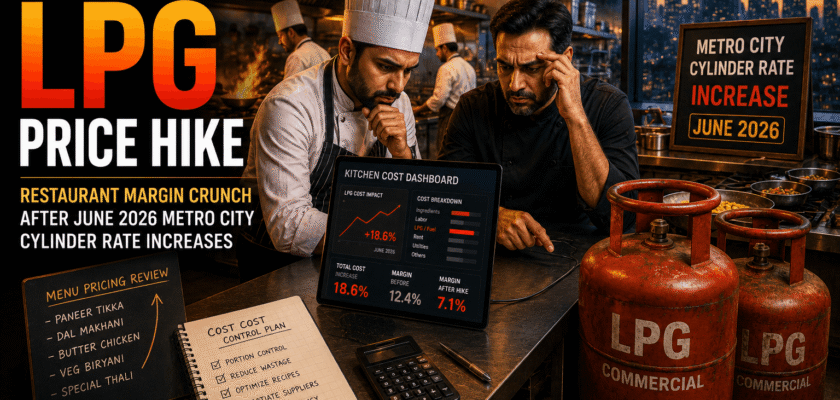
Commercial LPG Price Hike: Why Restaurants Need a Budget Reset
Commercial LPG price hike has created fresh pressure for restaurants, cloud kitchens, hotels, dhabas, bakeries, caterers, and small food businesses in June 2026. The 19-kg commercial LPG cylinder has become costlier in major cities, while domestic LPG rates remain unchanged for households.
This matters because restaurants use commercial LPG every day for cooking, frying, baking, boiling, reheating, and bulk preparation. Even a small cylinder price rise can slowly reduce profit when daily usage is high.
Therefore, food businesses now need a clear kitchen operational budget. They must track gas use, menu margins, wastage, staff process, and pricing before the hike starts eating profit silently.
Why Commercial LPG Price Hike Matters in June 2026
Commercial LPG price hike matters because restaurants already work on thin margins. Food cost, rent, staff salary, packaging, delivery commission, electricity, rent, maintenance, and discounts already reduce profit.
Now, cooking fuel is adding one more burden.
Reuters reported that Indian Oil increased the price of a 19-kg commercial LPG cylinder to ₹3,113.50, up from ₹3,071.50. Other oil marketing companies generally follow similar pricing trends.
This price change may look small for one cylinder. However, for a busy restaurant using many cylinders every month, the total impact becomes serious.
Latest Commercial LPG Price Hike Across Cities
The latest commercial LPG price hike came into effect from June 1, 2026. In Delhi, the 19-kg commercial LPG cylinder price increased by ₹42 to ₹3,113.50. In Kolkata, NDTV reported a steeper hike of ₹53.50, taking the price to ₹3,255.50.
Economic Times also reported that commercial LPG cylinder prices increased by ₹42 to ₹53.50 across locations, while domestic LPG cylinder rates stayed unchanged in major metros.
This means the pressure is mainly on commercial users, not household consumers.
How Commercial LPG Price Hike Hits Restaurant Margins
Commercial LPG price hike affects restaurant margins because gas is a daily operating cost. A food business cannot stop cooking, so the cost must be absorbed, reduced, or passed to customers.
The impact depends on:
- Number of cylinders used monthly
- Cooking style
- Menu type
- Delivery volume
- Wastage level
- Batch preparation method
- Peak-hour rush
- Staff efficiency
- Pricing power
- Customer sensitivity
A premium restaurant may pass some cost to customers. But a small dhaba or cloud kitchen may struggle because customers compare prices quickly.
Restaurant Margin Crunch: Simple Cost Example
Let’s take a simple example.
If a restaurant uses 20 commercial LPG cylinders per month, a ₹42 increase adds:
20 × ₹42 = ₹840 extra per month
If it uses 80 cylinders per month, the extra cost becomes:
80 × ₹42 = ₹3,360 extra per month
If the city hike is ₹53.50 and the business uses 80 cylinders, the extra monthly cost becomes:
80 × ₹53.50 = ₹4,280 extra per month
This is only the direct LPG hike. It does not include food inflation, packaging cost, staff cost, or delivery commission.
Why Small Restaurants Feel the Pressure More
Small restaurants feel the pressure more because they have less pricing power. A large brand can negotiate supply, optimize menu engineering, and absorb temporary cost. A small restaurant may not have that cushion.
Small food businesses often face:
- Fixed rent
- Staff salary pressure
- Local competition
- Low menu pricing flexibility
- Delivery app commission
- Ingredient price changes
- Cash flow stress
- Limited storage
- No advanced kitchen software
- Higher wastage risk
That is why small restaurants must manage every rupee carefully after the commercial LPG price hike.
Cloud Kitchens Face a Different Problem
Cloud kitchens do not have dine-in costs, but they have their own margin pressure. Delivery commission, packaging, discounts, refunds, cancelled orders, and ad spend can reduce profit.
When LPG price rises, cloud kitchens must review:
- Prep timing
- Batch cooking
- Order acceptance
- Waste control
- Packaging accuracy
- Menu profitability
- Delivery area radius
- Discount strategy
- Platform commission
- Gas consumption per dish
A cloud kitchen that does not track fuel cost per order may not notice margin leakage until profit falls.
Commercial LPG Price Hike and Menu Engineering
Commercial LPG price hike should push restaurants to review menu engineering. Menu engineering means checking which dishes sell well and which dishes give good profit.
A restaurant should divide menu items into four groups:
High Sale, High Profit
Promote these dishes more.
High Sale, Low Profit
Improve portion, price, or ingredient cost.
Low Sale, High Profit
Market these items better.
Low Sale, Low Profit
Remove or redesign these dishes.
This method helps businesses protect margins without blindly increasing all prices.
Should Restaurants Raise Menu Prices?
Restaurants may need to raise menu prices, but they should do it carefully. A sudden increase across all items can upset customers.
A smarter approach is:
- Increase only low-margin items
- Add combo meals
- Reduce unnecessary freebies
- Improve portion control
- Offer premium add-ons
- Review delivery pricing separately
- Reduce discount dependency
- Keep popular entry items affordable
- Use psychological pricing
- Explain value through better packaging and quality
Customers accept small price changes if food quality stays strong.
Gas Usage Audit: First Step for Every Kitchen
Every restaurant should do a gas usage audit after the commercial LPG price hike. This means tracking how many cylinders are used and where gas is being wasted.
Check:
- Daily cylinder use
- Peak-hour consumption
- Idle burner time
- Batch cooking efficiency
- Fryer heating time
- Boiling and reheating habits
- Staff cooking behaviour
- Equipment condition
- Leakage risk
- Dish-wise gas intensity
If you do not measure gas use, you cannot reduce it.
Common LPG Wastage Mistakes in Kitchens
Many kitchens waste LPG without noticing.
Common mistakes include:
- Keeping burners on during idle time
- Using wrong flame size
- Reheating food repeatedly
- Poor batch planning
- Using oversized vessels
- Not covering pots while boiling
- Dirty burners
- Delayed prep coordination
- Poor staff timing
- Cooking small orders inefficiently
Fixing these habits can reduce LPG usage without reducing food quality.
Equipment Maintenance Can Save Fuel
Equipment maintenance is important because dirty burners, blocked nozzles, poor regulators, and weak flame control can increase gas waste.
Restaurants should check:
- Burner cleaning
- Gas pipe condition
- Regulator safety
- Flame colour
- Leakage test
- Stove alignment
- Fryer efficiency
- Oven calibration
- Pressure control
- Exhaust balance
A blue and steady flame usually shows better combustion. A yellow flame can indicate incomplete burning or maintenance issues.
Regular maintenance saves fuel and improves safety.
Batch Cooking Can Reduce LPG Cost
Batch cooking can reduce LPG cost when done correctly. Preparing ingredients in planned batches uses fuel more efficiently than cooking tiny quantities repeatedly.
However, batch cooking must match demand. Over-preparation creates food waste.
A good batch plan should use:
- Past order data
- Peak-hour demand
- Day-wise sales pattern
- Weather impact
- Festival demand
- Delivery app offers
- Staff shift timing
- Storage safety
- Shelf-life rules
- Waste tracking
Smart batch cooking saves both LPG and ingredients.
Food Waste Control Protects Margins
Food waste is directly linked to restaurant margins. If a restaurant wastes cooked food, it loses both ingredient cost and LPG cost.
Waste happens due to:
- Over-preparation
- Wrong demand forecast
- Poor storage
- Staff mistakes
- Customer returns
- Incorrect orders
- Bad packaging
- Low-selling dishes
- Expired ingredients
- Portion inconsistency
Reducing waste is one of the fastest ways to protect profit after a fuel price hike.
Portion Control Without Upsetting Customers
Portion control does not mean cheating customers. It means serving consistent quantity every time.
A restaurant should use:
- Standard ladles
- Measuring cups
- Recipe cards
- Digital weighing
- Staff training
- Fixed garnish quantity
- Sauce control
- Packaging marks
- Recipe costing sheets
- Regular plate audits
This helps maintain customer trust and reduce hidden cost.
Delivery App Menus Need Separate Pricing
Delivery app pricing should not always match dine-in pricing. Delivery orders include platform commission, packaging, discounts, delivery delays, and refund risk.
After the commercial LPG price hike, restaurants should review delivery menu pricing separately.
They should check:
- App commission
- Packaging cost
- Average order value
- Discount cost
- Cancellation rate
- Return or complaint rate
- Delivery radius
- Gas-heavy items
- Low-margin items
- Combo profitability
Some dishes may be profitable for dine-in but weak for delivery.
Combo Meals Can Help Recover Cost
Combo meals can help restaurants recover cost because they increase average order value. A smart combo uses high-margin items with popular dishes.
For example:
- Biryani + raita + drink
- Chole bhature + lassi
- Pizza + garlic bread
- Thali + dessert
- Roll + fries + beverage
- Pasta + drink
- Dosa + filter coffee
- Burger + fries
- Meal bowl + add-on
- Sandwich + soup
Combos should be designed carefully so they improve profit, not only sales.
Supplier Negotiation Becomes Important
LPG is not the only cost rising. Restaurants should also review supplier pricing for vegetables, dairy, flour, oil, spices, packaging, and beverages.
A small negotiation can offset part of the LPG hike.
Owners can try:
- Bulk buying for stable items
- Weekly price comparison
- Alternate suppliers
- Seasonal menu planning
- Direct farm sourcing
- Local supplier contracts
- Packaging vendor review
- Credit term negotiation
- Waste return policies
- Quality-based buying
Cost control must happen across the full kitchen, not only gas.
Use Seasonal Ingredients to Protect Food Cost
Seasonal ingredients are often cheaper and fresher. Restaurants can use them to design profitable specials.
For example, seasonal vegetables, local grains, regional chutneys, summer drinks, and festival foods can reduce cost and improve customer interest.
A seasonal menu helps:
- Reduce ingredient cost
- Improve freshness
- Support local suppliers
- Create new marketing content
- Reduce storage pressure
- Improve taste
- Avoid expensive off-season items
This is a simple way to protect margins.
Commercial LPG Price Hike and Bakery Businesses
Bakeries may feel LPG or fuel cost pressure strongly because ovens run for long periods. Even a small increase can affect cakes, bread, biscuits, puffs, and snacks.
Bakeries should review:
- Oven batch planning
- Preheating time
- Product batch size
- Low-margin items
- Unsold stock
- Display planning
- Advance order system
- Energy-efficient ovens
- Staff timing
- Wastage from expiry
Better baking schedules can reduce fuel waste.
Caterers Need Event-Wise Costing
Caterers should review event-wise costing because they use large amounts of LPG during bulk cooking. A fixed package price may become weak if fuel and ingredients rise.
Caterers should update:
- Per-plate costing
- Cylinder estimate per event
- Transport cost
- Staff cost
- Menu complexity
- Live counter fuel usage
- Waste buffer
- Service duration
- Equipment rental
- Emergency cylinder planning
Large events need careful fuel planning to avoid surprise costs.
Safety Should Not Be Compromised
Restaurants must never compromise LPG safety to save money. Cheap repairs, poor regulators, illegal refilling, and unsafe cylinders can create fire risk.
Safety rules include:
- Use authorised cylinders
- Check leaks regularly
- Keep cylinders ventilated
- Train staff
- Install fire extinguishers
- Keep emergency numbers visible
- Maintain gas pipes
- Avoid overcrowded cylinder storage
- Shut valves after use
- Follow local fire safety norms
A safe kitchen protects both business and people.
How Customers May Feel the Impact
Customers may see the impact in small ways. Some restaurants may increase menu prices. Some may reduce discounts. Others may redesign portions or remove low-margin items.
Customers may notice:
- Higher food prices
- Fewer deep discounts
- Revised delivery charges
- New combo offers
- Smaller free add-ons
- More seasonal menus
- Limited-time price changes
- Better portion discipline
If restaurants communicate value clearly, customers may accept moderate changes.
What Restaurants Should Avoid
Restaurants should avoid panic decisions after the commercial LPG price hike.
Avoid:
- Sudden large price hikes
- Reducing quality
- Using unsafe LPG sources
- Cutting staff training
- Removing popular dishes blindly
- Ignoring customer feedback
- Over-discounting to maintain volume
- Not tracking gas usage
- Poor portion cuts
- Blaming customers for price changes
A calm, data-based response works better.
Smart Kitchen Budget Checklist
Restaurants should build a weekly kitchen budget checklist.
Track:
- LPG cylinders used
- Food cost percentage
- Wastage value
- Packaging cost
- Delivery commission
- Electricity cost
- Staff overtime
- Best-selling dishes
- Low-margin dishes
- Customer complaints
This weekly review helps owners act before losses become large.
Future of Restaurant Cost Control
Restaurant cost control will become more technology-driven. Food businesses may use inventory software, kitchen display systems, demand forecasting, digital recipe cards, and waste dashboards.
These tools can help track:
- Gas-heavy dishes
- Cooking time
- Ingredient usage
- Waste patterns
- Staff productivity
- Order timing
- Profit per dish
- Supplier price changes
- Delivery profitability
- Menu performance
In 2026, a profitable kitchen needs both good food and good data.
Final Verdict
Commercial LPG price hike has added fresh pressure to India’s restaurant and food business ecosystem. The June 2026 increase in 19-kg commercial LPG cylinder prices may look small per cylinder, but it can reduce margins for restaurants, bakeries, caterers, dhabas, hotels, and cloud kitchens that use multiple cylinders every month.
The solution is not only raising menu prices. Food businesses need better gas usage audits, menu engineering, waste control, portion discipline, supplier negotiation, batch cooking, equipment maintenance, and delivery menu review.
In simple words, the restaurant margin crunch is real. But smart kitchens can protect profit by tracking every process and reducing hidden waste.


