
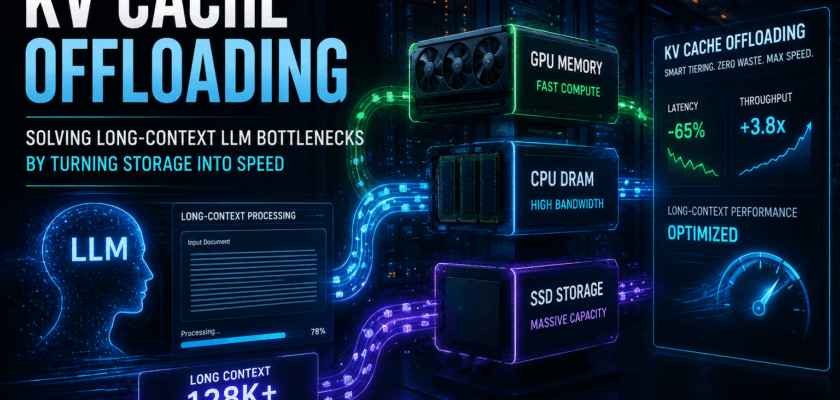
KV Cache Offloading: Why Long-Context LLMs Need a New Memory Strategy
KV cache offloading is becoming one of the most important infrastructure ideas in generative AI because long-context LLMs are getting bigger, heavier, and more memory-hungry. When users ask AI models to read long documents, codebases, chat histories, legal files, research papers, or agent memory, the model must keep track of past tokens. That tracking creates a key-value cache, usually called the KV cache.
This cache helps the model avoid recomputing old tokens again and again. However, as context length grows, the KV cache can become a major GPU memory bottleneck. GPU memory is fast, but it is expensive and limited.
Therefore, KV cache offloading tries to move some cache data from GPU memory to CPU memory, SSD, or other storage layers without slowing the model too much.
Why KV Cache Offloading Matters in 2026
KV cache offloading matters because AI users now expect longer context windows. They want models to handle 100K, 1M, or even larger context tasks. They want AI agents to remember tools, files, conversations, and workflow history.
But the technical cost is huge.
A 2026 paper on KV cache offloading says that with growing demand for long-context LLMs, the KV cache has become a critical bottleneck for both latency and memory usage. The paper also notes that offloading has emerged as a promising method to reduce memory footprint and inference latency while preserving accuracy.
In simple words, long-context AI needs memory. KV cache offloading helps manage that memory more intelligently.
What Is KV Cache in an LLM?
KV cache stands for key-value cache. During LLM inference, transformer models use attention to understand relationships between tokens. For every token, the model creates key and value states. These states are reused when generating the next token.
Without KV cache, the model would need to recompute old context again and again. That would make generation much slower.
KV cache helps by storing past token information.
It improves:
- Token generation speed
- Multi-turn chat performance
- Long document processing
- Agent workflow continuity
- Codebase understanding
- Retrieval-heavy tasks
- Lower repeated computation
However, storing all this cache takes memory.
KV Cache Offloading and the GPU Memory Problem
KV cache offloading directly targets the GPU memory problem. In LLM serving, GPU memory is used for model weights, activations, runtime overhead, and KV cache. When context length becomes large, KV cache can consume a huge part of GPU memory.
This creates problems like:
- Lower batch size
- Fewer concurrent users
- Higher serving cost
- Slower response time
- Out-of-memory errors
- More expensive GPU needs
- Lower throughput
- Poor long-context scalability
BentoML’s LLM inference guide explains that offloading KV cache can free GPU memory, allow longer sequences or more concurrent users, and reduce the need to over-provision expensive GPUs only for cache storage.
This is why storage is becoming part of AI speed.
Turning Storage Into Speed: The Core Idea
The phrase “turning storage into speed” sounds strange because storage is usually slower than GPU memory. But in long-context inference, the issue is not only raw speed. It is memory placement.
If GPU memory is full, the model slows down or cannot serve more requests. If less-used KV cache data can move to cheaper memory or SSD and return only when needed, the system can handle larger contexts.
The goal is not to put everything on storage. The goal is to place the right cache in the right tier.
Fast and active cache stays near the GPU.
Older or less-used cache moves to CPU memory or SSD.
The system fetches cache back when needed.
That is the heart of KV cache offloading.
Why Long-Context LLMs Create Bottlenecks
Long-context LLMs create bottlenecks because every extra token adds more KV cache. As context grows, memory demand grows almost linearly.
This becomes serious in tasks like:
- Legal contract review
- Research paper analysis
- Code repository understanding
- Long chat history summarization
- AI agent memory
- Customer support history
- Medical document review
- Financial report analysis
- Large knowledge-base Q&A
- Enterprise document automation
A short prompt may be easy. A long-context task can stress the full inference system.
KV Cache Offloading vs KV Cache Compression
KV cache offloading and KV cache compression solve related problems, but they are different.
KV Cache Offloading
Moves some KV cache from GPU to CPU memory, SSD, or storage.
KV Cache Compression
Makes the KV cache smaller by reducing precision, using sparsity, eviction, or quantization.
Both methods can work together.
For example, a system may compress older KV states and store them outside GPU memory. Then it can fetch them when needed.
This hybrid approach may become common in future AI infrastructure.
Multi-Tier KV Cache Management
Multi-tier KV cache management means using several memory layers together.
A typical hierarchy can include:
- GPU HBM for hot cache
- CPU DRAM for warm cache
- SSD for cold cache
- Distributed storage for shared cache
- Networked storage for multi-node serving
The challenge is coordination. Moving data between tiers takes time. If the model waits for data, latency increases.
So, modern systems try to overlap data movement with computation.
This is where pipeline scheduling becomes important.
KVDrive: GPU, DRAM, and SSD Working Together
KVDrive is a 2026 research system that treats KV cache management as a multi-tier systems problem across GPU memory, host DRAM, and SSD. It focuses on cache placement, pipeline scheduling, and cross-tier coordination. The paper reports up to 1.74x higher throughput compared with state-of-the-art systems while preserving accuracy.
This matters because it shows that SSD is not only passive storage. With smart scheduling, storage can support long-context inference.
KVDrive’s core lesson is simple: data movement must be managed as carefully as model computation.
TTKV: Temporal-Tiered KV Cache
TTKV is another 2026 system that treats KV cache like a memory hierarchy. It places more recent KV states in faster, higher-precision tiers and older states in slower tiers. The idea is inspired by human memory, where recent and important information is easier to recall.
The TTKV paper reports that it reduces cross-tier traffic by 5.94x on 128K-context tasks and achieves up to 76% latency reduction and 2x throughput improvement over strong baselines.
This is important because not every token needs the same treatment.
Recent tokens may need fast access. Older tokens may be stored differently.
ScoutAttention: GPU-CPU Collaboration
ScoutAttention is another 2026 KV offloading framework focused on GPU-CPU collaboration. It uses block-wise sparse attention and layer-ahead CPU precomputation to reduce the CPU bottleneck during offloading.
This is useful because CPU offloading can fail if CPU work becomes too slow.
A good offloading system must answer:
- Which KV blocks stay on GPU?
- Which blocks move to CPU?
- Which blocks move to SSD?
- When should data be prefetched?
- How can compute overlap with transfer?
- How can accuracy be protected?
- How can stalls be avoided?
ScoutAttention shows that offloading is not just memory movement. It is coordinated computation.
Why Accuracy Can Drop in Context-Intensive Tasks
KV cache offloading can improve performance, but it can also hurt accuracy if done poorly. This is especially true when the task needs many details from the full context.
A 2026 paper on context-intensive tasks found that modern KV offloading can suffer performance degradation on tasks like structured information extraction from long text. The authors identified issues such as low-rank key projection and unreliable landmarks, and argued for more rigorous evaluation of long-context compression techniques.
This is a key warning.
Speed is not enough. The model must still answer correctly.
Why Context-Intensive Tasks Are Hard
Context-intensive tasks are hard because the model may need to retrieve many facts from the prompt, not just one hidden clue.
For example, a user may ask an AI to extract all invoice fields from a long PDF, convert a legal file into structured clauses, or turn a long report into JSON.
In these tasks, missing one detail can break the output.
So, KV cache systems must preserve important information.
This means offloading must be tested on real tasks, not only easy benchmarks.
KV Cache Offloading for Enterprise AI
KV cache offloading is especially useful for enterprise AI. Companies often ask LLMs to process large internal documents, customer histories, product manuals, legal records, and codebases.
Enterprise workloads need:
- Long context
- Low latency
- High accuracy
- Many concurrent users
- Lower GPU cost
- Secure serving
- Stable throughput
- Reusable context
- Multi-tenant isolation
- Better cost control
KV cache offloading can help by reducing GPU memory pressure and allowing larger workloads to run on available infrastructure.
How KV Cache Reuse Reduces Latency
KV cache reuse means the system can reuse cached context across requests. For example, if many users query the same policy manual, the system may avoid reprocessing the same long document each time.
BentoML describes LMCache as an LLM serving extension designed to reduce time to first token and increase throughput, especially for long-context workloads, by supporting KV cache reuse across repeated input content and across engine instances.
This can be powerful in enterprise settings.
If the same context appears repeatedly, cache reuse can save compute and speed up responses.
NVIDIA Dynamo and KV Cache Bottlenecks
NVIDIA has also discussed KV cache bottlenecks in modern inference systems. NVIDIA’s Dynamo guidance says offloading KV cache to CPU or storage is most effective when KV cache exceeds GPU memory and when cache reuse outweighs transfer overhead. It is especially valuable in long-context, high-concurrency, or resource-constrained inference environments.
This is practical advice.
Offloading is not always useful. It works best when the cost of keeping everything on GPU is higher than the cost of moving some cache out.
So, deployment teams must measure workloads carefully.
Native KV Cache Offloading to File Systems
The llm-d project discussed native KV cache offloading to any filesystem in 2026. The goal is to support KV cache sharing and scaling by enabling storage-backed cache handling.
This kind of approach matters because large AI serving clusters may need cache sharing across multiple engines, not only one GPU.
If cache can move across filesystems or shared storage, AI serving systems can reuse context more flexibly.
However, storage speed, network bandwidth, and scheduling become very important.
Edge Devices and SmartSSD Offloading
KV cache offloading is not only for cloud data centres. It can also help edge devices, where memory is limited.
HillInfer, a 2026 research framework, uses SmartSSD-assisted hierarchical KV cache management for long-context LLM inference on edge devices. It reports up to 8.56x speedup over baselines while preserving model accuracy.
This points to an interesting future.
PCs and local AI devices may use smarter storage to run longer-context models without huge GPUs.
Why SSDs Are Becoming Part of AI Infrastructure
SSDs are becoming part of AI infrastructure because they offer much larger capacity than GPU memory at lower cost. They are slower than GPU memory, but they can store cold or less-used KV data.
Modern AI systems can use SSDs if they:
- Prefetch data early
- Compress cache
- Overlap I/O with compute
- Avoid unnecessary transfers
- Use fast NVMe storage
- Coordinate GPU and CPU work
- Track attention behaviour
- Prioritise hot cache
- Reduce random reads
- Use pipeline scheduling
This turns storage into an active inference layer.
The Data Movement Problem
The biggest challenge in KV cache offloading is data movement. Moving data from SSD or CPU memory to GPU takes time. If the GPU waits, latency increases.
So, the system must predict which KV blocks will be needed and move them early.
This is called prefetching.
A good prefetch system can reduce stalls. A bad prefetch system can waste bandwidth and slow everything down.
This is why cache management is now a serious systems problem.
Hot, Warm, and Cold KV Cache
A simple way to understand KV cache tiers is hot, warm, and cold.
Hot Cache
Most active cache. It stays on GPU memory.
Warm Cache
Possibly needed soon. It may stay in CPU memory.
Cold Cache
Less likely to be used soon. It can move to SSD or storage.
This idea helps reduce GPU pressure while keeping important data close.
The hard part is deciding which cache is hot, warm, or cold during real-time generation.
KV Cache Offloading and Time to First Token
Time to first token, or TTFT, is the time a user waits before the model begins responding. Long prompts can increase TTFT because the model must process the full input before generating output.
Cache reuse and offloading can help reduce TTFT when repeated context appears.
For example, if a company chatbot already processed a product manual, future questions about that manual can start faster if the cache is reused.
This improves user experience.
Nobody wants to wait too long for the first word.
KV Cache Offloading and Throughput
Throughput means how many tokens or requests the system can handle over time. KV cache offloading can improve throughput by freeing GPU memory for more users or longer requests.
This helps AI platforms serve more people with the same hardware.
Better throughput can reduce:
- GPU cost per request
- Queue delays
- Infrastructure waste
- Need for overprovisioning
- Long-context serving cost
For AI companies, throughput is directly linked to business economics.
When KV Cache Offloading Works Best
KV cache offloading works best in specific conditions.
It is useful when:
- Context length is very large
- GPU memory is the bottleneck
- Many users share similar context
- Cache reuse is common
- Transfer overhead is controlled
- Storage is fast
- Prefetching works well
- Accuracy is preserved
- Workload is predictable
- Serving cost is high
It may not help much for very short prompts or small models where GPU memory is not under pressure.
When KV Cache Offloading Can Fail
KV cache offloading can fail if the system moves too much data too slowly. If data transfer becomes the bottleneck, users may see slower responses.
It can also fail if compression or eviction removes information needed for accuracy.
Common failure points include:
- Poor prefetching
- Slow storage
- Network bottlenecks
- CPU overload
- Too much cache movement
- Weak attention prediction
- Accuracy degradation
- Poor workload matching
- Bad scheduling
- Lack of monitoring
So, offloading must be engineered carefully.
KV Cache Offloading vs Buying More GPUs
One simple solution is to buy more GPUs with more memory. But that is expensive. KV cache offloading offers another path.
Instead of solving every problem with bigger GPUs, teams can use memory hierarchy more efficiently.
This can help companies:
- Lower infrastructure cost
- Serve longer contexts
- Increase concurrency
- Use existing hardware better
- Reduce wasted GPU memory
- Improve deployment flexibility
- Support more enterprise workloads
However, offloading does not eliminate the need for strong GPUs. It makes GPU usage smarter.
Why Long-Context Agents Need KV Cache Offloading
AI agents often need long memory. They may read files, call tools, remember previous steps, and operate across many turns.
This creates long-context pressure.
Agent workloads can include:
- Multi-document research
- Long coding sessions
- Customer support history
- Workflow automation
- Browser tasks
- Legal review
- Data analysis
- Project planning
- Enterprise knowledge search
- Multi-step reasoning
KV cache offloading can help agents keep more context available without using all GPU memory.
Security and Privacy Concerns
Offloading KV cache can create security questions. KV cache may contain information derived from user prompts, documents, or private conversations.
If cache moves to CPU memory, SSD, or shared storage, it must be protected.
AI infrastructure teams should use:
- Encryption
- Access controls
- Tenant isolation
- Secure deletion
- Cache expiration
- Audit logs
- Memory protection
- Data retention policy
- Storage security
- Compliance checks
Performance should not come at the cost of privacy.
Monitoring KV Cache Systems
KV cache systems need monitoring because problems may not be obvious at first.
Teams should track:
- GPU memory usage
- Cache hit rate
- Cache transfer time
- TTFT
- Throughput
- Token latency
- Accuracy impact
- CPU usage
- SSD read/write load
- Network bandwidth
Without monitoring, offloading can silently hurt performance.
Good dashboards help teams tune the system.
Why Developers Should Understand KV Cache
Developers building AI applications should understand KV cache at a basic level because it affects cost and latency.
If an app sends huge prompts repeatedly, it can become expensive. If it reuses context smartly, it can become faster and cheaper.
Developers should think about:
- Prompt size
- Repeated context
- Document chunking
- Cache reuse
- Session memory
- Retrieval strategy
- Latency targets
- Cost per user
- Privacy rules
- Model serving limits
Better app design reduces infrastructure pressure.
Future of KV Cache Offloading
The future of KV cache offloading will likely combine several methods.
Future systems may use:
- Multi-tier cache placement
- KV quantization
- SSD-backed cache
- Cache sharing across nodes
- Smart prefetching
- Attention-aware eviction
- GPU-CPU collaboration
- Compression with accuracy checks
- Hardware-assisted storage
- Agent-specific memory systems
Tom’s Hardware reported that NVIDIA’s 2026 BlueField-4 STX architecture is designed to support agentic AI workloads by managing KV cache and storage more directly, using fast networking and NVMe storage to improve token throughput and reduce bottlenecks.
This shows that hardware companies also see KV cache as a major AI infrastructure problem.
Final Verdict
KV cache offloading is becoming a key solution for long-context LLM bottlenecks. As AI models handle larger prompts, longer chats, bigger documents, and agentic workflows, GPU memory becomes a serious limit. KV cache offloading helps by moving less-active cache data to CPU memory, SSD, or storage while keeping critical data close to the GPU.
The best systems do not simply dump cache into storage. They use smart tiering, prefetching, compression, scheduling, and accuracy checks. Research like KVDrive, TTKV, ScoutAttention, and HillInfer shows that the field is moving fast.
However, offloading is not magic. If data movement is poorly managed, latency can increase. If information is compressed or evicted badly, accuracy can fall.
In simple words, the future of long-context AI will not depend only on bigger models. It will also depend on smarter memory systems. KV cache offloading is one of the clearest examples of storage turning into speed.


